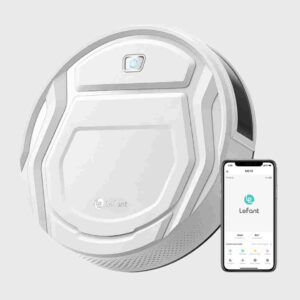
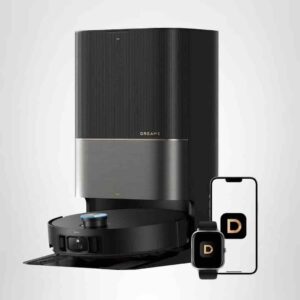
Commonly included extras across kits/reviews: spare side brushes, spare filter, and a small cleaning tool; some versions include a remote and batteries.
Some reviewers highlight a generous bundle (extra brushes/mop pads/filters and cleaning solution), plus optional add‑ons like a water hookup/refill kit for a more hands‑off setup. Accessory availability is seen as a convenience rather than a core differentiator.
Step/threshold climbing is a standout feature across nearly every source, with repeated claims and demonstrations of clearing tall transitions that stop other robots. Reviewers treat it as a real functional advantage for multi-room homes with raised thresholds.
Design feedback is mostly positive: the dock is often described as sleek and premium enough to leave out in the open. The tradeoff is size—like most full-featured docks, it’s still a noticeable footprint.
App control is repeatedly described as straightforward and useful for scheduling and mode selection; some note it uses a Tuya/Smart Life-style backend and supports voice assistants (Alexa/Google) depending on configuration.
Smart features are a major highlight: advanced scheduling and per-room routines, object recognition, and voice assistant/support integrations are frequently mentioned. Some reviews also discuss camera-based remote viewing and automation add-ons, though polish and reliability can vary by platform.
Setup is described as beginner-friendly: install side brushes, place/plug the dock, charge, and pair via app/Wi-Fi; pairing steps are generally manageable though still require 2.4GHz network and manual steps.
Setup is generally described as straightforward—fill tanks, add solution, pair the app, and let it map—though the dock/robot can be heavy to move. Mapping is often noted as quick on first run.
Battery life is frequently reported as strong for the class, with typical auto-return behavior; occasional mid-floor shutdowns are reported but described as infrequent and sometimes linked to charging contact/placement issues.
Battery feedback is mixed: some testing finds above-average endurance, while several reviewers report faster drain during long, slow cleans (sometimes around ~90 minutes in real homes). Recharge-and-resume mitigates this, but it’s not the longest-running flagship.
Bin capacity and access are generally viewed positively for a budget robot, with reviewers describing it as easy to remove and dump; some users empty every run out of habit but note it can often go multiple runs.
The X50’s auto-empty system relies on a disposable dust bag, which reviewers generally find clean and low‑mess versus bagless bins. Long intervals between bag changes are frequently mentioned, though auto-empty effectiveness can vary by debris type.
Build quality impressions are generally decent for the price (lightweight, basic plastics). Reviewers don’t expect premium durability, but several report it feels solid enough for entry-level use.
Build quality impressions are strong, with mentions of solid materials and thoughtful sealing/details on the robot and dock. No widespread durability failures are reported in the provided reviews.
High-pile/deeper carpet pickup is consistently identified as a weak point due to the lack of a main brush roller; it may pass over carpet but won’t deep-clean embedded dirt well.
High‑pile carpet results are competitive in comparative testing, especially when the robot can lift or remove mop pads for dry vacuuming. Some reviews still note fine powders may remain embedded, so it may not replace occasional deep cleans.
Low-pile carpet pickup is described as acceptable for surface debris, but not comparable to robots with main brush rollers; results improve with higher suction and repeated passes.
Low‑pile carpet performance is generally strong, but at least one review notes fine powder can be harder to fully remove from tightly bound carpet. Overall it ranks as a high performer with occasional edge cases.
Medium‑pile carpet results are frequently above average in comparative testing, with strong deep-clean style scores. Performance is generally praised, though fine powders can still require extra passes depending on carpet type.
Reviews mention design changes intended to reduce clogging and residue in the dock (including improved washboard/drain management). Debris and hair can still collect on secondary parts like the side brush or wheels, but major clogs are not a dominant complaint.
In comparisons, the X50 Ultra is repeatedly positioned near the top of the flagship tier, often trading blows with leading competitors. It tends to win on obstacle recognition and threshold climbing, while sometimes losing ground on edge/corner consistency or runtime.
Controls are commonly praised as simple (app plus single-button operation; some kits include a remote). Mode selection and suction level adjustments are typically app/remote-driven.
Reviewers like the breadth of controls, but opinions on usability vary: some call the app experience among the best, while others note confusing wording or less-polished UI compared with top competitors. Overall, it’s powerful but can take time to learn.
Corner performance is mixed: the extending side brush can improve reach, but several reviews still show misses in tight corners or around furniture legs. It tends to do better in open corners than in cluttered zones.
Crevice and groove pickup gets less attention overall, but one lab-style review calls it comparatively weak even on max power. If you rely heavily on grout lines or deep floor grooves, results may be more mixed than open-floor pickup.
Docking is mixed: some reviewers report it finds and docks reliably, while others report longer docking searches or occasional failure/erratic docking, especially without mapping and in less-ideal dock placement.
Docking and auto-emptying are generally reliable and a core part of the hands-free experience, including mop washing/drying. Comparative testing shows it can leave more debris in the onboard bin than the very best docks in some scenarios, but day-to-day performance is still strong.
Dried and sticky spills are a common strength: multiple tests show it can lift dried-on stains like tea, ketchup, and muddy tracks better than average for spinning-pad robots. Some reviewers still find edge-adjacent stains harder when they’re right against cabinets or furniture.
Edge and baseboard performance is usually described as only fair to decent; several reviews note it doesn’t prioritize perimeter runs like higher-end bots or can miss edges depending on mode.
Edge and baseboard cleaning is the most polarized area: some reviewers praise the extending mop/arms for strong wall-to-wall coverage, while others report consistent misses along baseboards and around cabinet toe-kicks. Expect great results on open straight edges and less consistency around complex furniture layouts.
Emptying is usually straightforward (lift lid, pull bin, dump). However, at least one test source notes it’s not among the easiest in class to keep filter/bin clean, so expectations should be modest.
In comparative testing, energy use for mopping/drying is reported in the same ballpark as other premium robot mops (around a few tenths of a kWh for a run). No reviews flag it as unusually inefficient.
Filtration is described as basic HEPA-style/filter-in-bin. Some sources praise having an included spare filter, while lab-style commentary raises concerns about maintenance ease and overall containment versus higher-performing robots.
Hair pickup on carpets is inconsistent and generally weaker than on hard floors; reviewers point to the no-roller design as the reason it can push hair rather than lift it.
Carpet hair pickup is generally strong (including pet hair), though in multi-bot comparisons it can land mid-pack rather than always first. Consistency improves when hair doesn’t have to compete with heavy embedded fine dust.
Hair pickup on hard floors is often reported as good for the price, especially for day-to-day pet hair, though occasional pushing of hair is also mentioned in testing.
Hair on hard floors is handled well in testing, with strong pickup and minimal tangling reported. Most hair-related complaints center on the side brush/wheels rather than the main rollers.
The no-main-brush design reduces classic brush-roll hair wrap, lowering one major tangle point; side brushes can still collect some hair and may need occasional cleaning.
Anti‑tangle performance is one of the product’s biggest wins, with multiple tests reporting near‑zero wrap on the main rollers. Small caveats remain: side brushes, wheel axles, or accessories can still collect some hair over time.
On hard floors, fine dust pickup is described as generally good for light daily cleaning, though performance varies by suction setting and repeated passes can be needed for denser messes.
Fine debris pickup is generally strong in comparative tests on hard floors, though some reviewers note powdery messes can cling to carpet fibers more than hard surfaces. On hard floors, it’s typically close to top performers.
On hard floors, it handles everyday crumbs and small-to-moderate debris reasonably well, but very dense piles or stubborn messes often require extra passes.
Large-debris pickup on hard floors is repeatedly excellent, with reviewers showing it handling mixed snack messes and heavier particles with minimal leftovers. This is one of the most consistently praised performance areas.
Integrated lighting is mentioned as helpful for dark areas and for improving camera-based navigation/obstacle detection. Reviewers note it can be toggled in settings and generally works as intended.
The dock’s hot‑water mop washing and heated/active drying are repeatedly highlighted as premium features that improve hygiene and reduce odor/residue. Some sources also mention additional sanitizing touches (e.g., UV treatment) as part of the dock routine.
Reviewers consistently frame the X50’s climbing system and retracting sensor tower as genuinely differentiating innovations versus typical robot vacs. The consensus is that these features expand where it can clean, even if they don’t guarantee perfect edges.
Low-profile behavior is generally positive, with reviewers noting it can fit under furniture well for basic under-furniture pickup in many homes.
The low-profile, retractable sensor design is frequently praised for improving under-furniture access (around ~8.9–9cm clearance when lowered). It adds versatility without major downsides beyond occasional hesitation in tight spots.
Maintenance is generally considered low effort (simple bin/filter access; fewer brush-roll tangles), but periodic side-brush cleaning and filter tapping/rinsing is still recommended.
Ownership effort is typically low thanks to auto-emptying plus automated mop washing/drying, with bags and tanks lasting a long time between servicing. Maintenance still includes periodic cleaning of the washboard/drain area and occasional hair removal from side brushes or wheels.
Lacks true mapping and stored maps; navigation is basic (random/row-by-row/edge/spot-style patterns depending on mode). This limits efficiency in larger multi-room layouts and contributes to inconsistent coverage.
Mapping and navigation are generally rated highly, with fast initial mapping and good room-by-room control. A minority note route choices can be inefficient in some modes, but coverage is still typically thorough.
Mop management is a highlight: reviews repeatedly mention high mop lift and the ability to leave pads behind at the dock for carpet-only runs. This helps protect rugs and reduces the need to manually remove mops.
Overall mopping is rated above average for a spinning-pad system, with strong everyday results and good scrubbing on dried spots. The biggest limitation called out is inconsistent edge performance and occasional streaking that may require setting tweaks.
Generally described as quiet during cleaning, with some notes that collisions/bumping can create louder momentary noise than the suction itself; higher suction settings increase volume.
Noise is generally described as reasonable for a flagship robot, with several notes that mopping is especially quiet. Vacuuming at max power can still be loud, but it’s not a standout complaint overall.
Obstacle avoidance is basic: it can avoid some larger obstacles and cliffs/stairs, but small objects (cords, tassels) can still cause issues and bumping behavior is reported across multiple reviews.
Obstacle avoidance is generally rated very strong, with at least one comparison calling it best-in-test for detecting and labeling objects. Still, multiple reviewers note occasional failures with thin cables, flat papers, or simulated pet mess, so it’s not 100% set-and-forget on messy floors.
Multiple reviews call it a strong fit for pet homes thanks to low hair tangling, solid pickup, and camera-based obstacle recognition modes aimed at pet mess and bowls. A few tests still show occasional misses on small/flat hazards, so a quick pre‑tidy helps.
Consistently positioned as strong value for the money (often highlighted around budget pricing and frequent sale pricing). Reviewers accept missing mapping and weaker carpet performance as the main compromises for the low price.
Across sources, pricing is consistently framed as premium (often cited around $1,700 MSRP) with better value when discounted. Several reviewers say the feature set can justify the cost for the right home, but it’s hard to recommend for budget shoppers.
Privacy discussions focus on the camera: some comparisons note remote viewing can require a physical confirmation on the robot, which is viewed positively. On the other hand, at least one reviewer is disappointed by limited offline/local-only operation options.
Default runtime is commonly described around the ~100–120 minute class (varies by mode and suction). Reviewers generally find it adequate for small/medium spaces and routine runs.
The dock’s self-cleaning routine (mop washing, drying, and washboard management) is widely praised for reducing hands-on cleanup. Several reviews call out newer design elements aimed at minimizing residue and keeping the base cleaner over time.
Reviews reference detergent support and automated solution handling as part of the dock’s hands‑off promise, and the included cleaner is often noted. Performance appears strong, with most streak issues tied more to moisture settings and edge behavior than the solution system itself.
Streaking is an occasional complaint rather than a constant: some reviewers report clean, even drying, while others see visible streaks/residue depending on moisture settings and floor type. Fine-tuning water flow and detergent use is often implied as the fix.
Stuck resistance is mixed: it may do fine in open areas, but multiple sources note getting stuck on rug tassels or struggling around certain clutter; cords can be a recurring challenge.
Most reviews say it avoids getting stuck better than many rivals thanks to climbing hardware, but it’s not foolproof. Thin cords, flat papers, and low objects can still jam brushes or snag the robot, sometimes requiring a rescue.
Reviews consistently describe strong real‑world cleaning power, often citing the 20,000Pa spec and excellent pickup in open areas. One lab-style review notes suction/airflow is only average on instrumentation even though pickup results remain top-tier.
No summary yet.
Reliability sentiment is mixed: many experiences are smooth, but a few note occasional manual intervention (jams on thin/flat items) and at least one reviewer criticizes customer service responsiveness. Ongoing firmware updates are implied as important for long-term satisfaction.
The retracting sensor tower enables low-clearance access, and several reviews show it cleaning under cabinets/sofas that trip up taller robots. A few note it can be conservative about entering very tight spaces even when it physically fits.
The dock’s clean/dirty water tanks are repeatedly described as large and convenient, supporting longer hands‑off periods. Water usage can be high on aggressive mopping settings, and some reviewers point to a plumbing/water hookup kit to reduce refills.