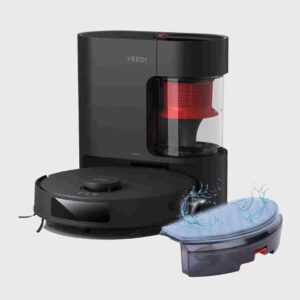
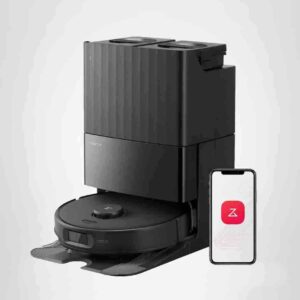
The box contents are comprehensive for an all-in-one robot: dock, ramp, mop pads, power cord, an extra dust bag, and printed guides, making it easy to get started without extra purchases.
This model does not include an adaptive lift chassis, which limits threshold climbing compared with the higher Edge model and some flagships. If your home has tall transitions, this is a notable constraint.
Design is generally viewed as modern and clean, though some reviewers prefer the more premium-looking alternatives (for example Curv or flagships). The dock can look a bit industrial, but the robot and station still fit well in most rooms.
Smart/app features cover the essentials (Wi-Fi app control, mapping, schedules), but reviews note missing or limited voice-assistant support compared with some rivals. Automation is strongest inside the Yeedi app rather than through external ecosystems.
Automation and smart features are a highlight: schedules, no-go/no-mop zones, multi-floor maps, granular suction and water control, assistant integrations, and dock control. Obstacle detection relies on structured-light style sensing rather than a camera on this model.
On rugs, it performs well on low-pile area rugs for vacuuming, but mopping around rugs requires care and planning. Homes with many rugs benefit from no-mop zones or running vacuum-only on rug-heavy areas.
Mop pads lift when carpet/rugs are detected and many users report rugs staying dry during transitions. Very high-pile carpets may still get damp depending on settings, so vacuum-first routines can be helpful.
Setup is widely described as straightforward, with quick app pairing and mapping after initial runs. Some users note you may need to learn the vacuum-vs-mop configuration steps early to avoid confusion.
Setup is described as straightforward: attach the ramp, plug in the dock, charge, pair to Wi‑Fi, and fill the clean water tank. Most reviewers report quick, hassle-free first run and mapping.
Battery and charging behavior is described as dependable, with enough endurance for typical apartments/medium homes and expected recharge behavior when needed. Long sessions may involve recharge-and-resume depending on floorplan and settings.
Battery life is repeatedly called a strong point, with a large battery and long runtimes on lower suction settings. Higher suction drains faster, and some testing shows max-power coverage below average, but typical mixed use is expected to fall in between.
Bin/bag capacity is viewed as a strong point for the class, with a usable onboard bin and a larger base collection capacity that reduces daily maintenance. This setup supports longer stretches between manual empties for most households.
Uses a dock dust-bag system that empties cleanly and is easy to swap with minimal mess. Reported replacement cadence ranges from roughly 30–60 days to about 2–3 months depending on debris load.
Build quality impressions are generally solid for the price tier, with a functional, mid-range feel rather than premium materials. Long-term durability is viewed as reasonable, though a few reviews raise typical reliability caveats for budget robots.
Low-pile carpet pickup is consistently reported as strong for routine maintenance, with enough suction to lift daily dust and hair. Deep cleaning still benefits from occasional manual vacuuming.
Carpet cleaning is generally rated strong for the tier, including an above-average deep-cleaning score in testing and good pickup on rugs. Performance is not positioned as flagship-level, but it is consistently described as effective.
The brush and dock system handle heavy hair and mixed debris without frequent clogs, and auto-emptying is reported to work without choking on hair. Occasional checks are still advisable, but clogging is not a common complaint.
Across comparisons, the S5A is framed as upper mid-tier: strong fundamentals and automation, but behind flagships in obstacle avoidance sophistication and premium extras. Many reviewers still consider it a sweet spot when priced well.
Controls and UI (especially in-app) are generally described as easy to use, with clear mapping, room selection, and scheduling. Occasional limitations are mentioned around deeper smart-home integration.
The Roborock app and controls are repeatedly called intuitive and customizable, with clear UI for maps, routines, suction, and water levels. Live video-style viewing is not available on this model, but core control is polished.
Corner cleaning is acceptable but not class-leading; several reviews note it can leave some debris in tight corners, especially compared to higher-end robots with more advanced edge strategies.
Corner cleaning improves notably thanks to an extending side brush, leaving corners visibly cleaner than many robots. Some reviews still note a small amount of leftover debris in tight corners.
The dock dirt-detection and remopping concept can work well (for example, triggering a second pass after muddy paw prints). However, other testing reports it did not reliably detect certain dried stains, making the behavior inconsistent.
Docking and auto-emptying are generally reliable, with the base consistently collecting debris after runs. The station is simpler than self-washing mop docks, but it delivers the core convenience of hands-off dust disposal.
Docking and automation are consistently reliable in reviews: automatic dust emptying, water refilling, mop washing, and drying generally work as expected. The tradeoff is a larger dock footprint compared with simpler stations.
Handles common dried messes well, including muddy paw prints and dried coffee, often improving significantly on a second pass. Tougher stains like dried ketchup may require multiple passes and sometimes manual intervention.
Ease of use is high for day-to-day vacuuming and scheduled runs, especially with auto-emptying. Mopping is less effortless because it can require manual pad handling and configuration changes.
Edge and baseboard cleaning is a consistent strength, helped by an extending mop pad and flex arm side brush that can reach right up to walls. It is often described as better than most robot mops, though not always perfect in tight corners.
Edge performance is frequently called out as only okay, with some reviewers explicitly noting it is not great on edges/baseboards. It can miss fine debris right against walls without occasional targeted runs.
Edge-following is strong, with the robot staying close to walls and the mop pad reaching into baseboard lines. Reviewers often show it maintaining contact better than typical robot mops.
Emptying is convenient and largely mess-controlled thanks to the auto-empty dock, reducing how often users handle the onboard bin. A few reviews still recommend routine checks to prevent overfill or clogs, especially with heavy hair.
Auto-emptying to a sealed bag keeps dust handling clean and hands off, and swapping bags is reported to be quick with minimal mess. This is a major convenience advantage for frequent cleaning.
Fresh liquid pickup is reported as effective when mopping up spills like a glass of water, with the spinning pads absorbing and clearing liquid without leaving notable residue.
When hair does collect, it tends to channel toward the center of the split brush, making it quick to remove by hand. This is described as manageable rather than a major snagging problem.
Carpet hair pickup is generally good on low-pile surfaces, with enough power for maintenance. For homes with lots of hair on thicker carpet, results are more variable and may require extra passes.
Carpet hair pickup is usually strong, especially on rugs, though a few tests still show small amounts of hair remaining after a pass. Overall performance is described as better than average for this tier.
On hard floors, reviews report very good pickup of pet hair, crumbs, and dust for everyday cleaning. Fine dust performance is generally praised, especially when paired with consistent scheduling.
Hair pickup on hard floors is a standout, including long and even slightly damp strands, with users reporting thorough collection and minimal cleanup afterward.
Hair-wrap resistance earns positive mentions, with the anti-tangle brush design handling pet hair well in many tests. Some routine brush checks are still recommended, but tangling appears less frequent than on basic rollers.
Hair-wrap resistance is one of the biggest strengths: the DuoDivide brush and redesigned side brush greatly reduce tangles. In extreme stress tests, some hair may channel to the center and require a quick manual pull, but it is easy to clear.
Hard-floor fine dust pickup is repeatedly described as strong, including successfully collecting very fine particles like powdery debris without leaving a visible film.
Handles larger debris well on hard floors, such as crumbs, rice, and oatmeal, often clearing scattered mess in a single run or a couple of passes.
This model is noted as lacking built-in LED or headlight illumination, which some reviewers say would help in dim rooms and for better obstacle detection.
The dock uses heated processes (hot water mop washing and warm/hot air drying). Some testing questions whether advertised maximum water temperature is reached, but the heating still appears effective for pad cleaning and drying.
Its relatively low profile (often cited around 9.6cm / 3.77in) helps it slip under more furniture than taller bots, improving day-to-day coverage in living rooms and bedrooms.
The robot is relatively slim for a LiDAR-top model (around 4 inches / ~9.8 cm), helping it fit under more furniture than many competitors. It is still taller than ultra-thin flagships that remove the top LiDAR turret.
Maintenance is moderate: auto-empty reduces daily chores, but owners still need to wash/replace the mop pad, clean brushes/filters, and periodically check sensors. The simpler mop system shifts some upkeep back to the user.
Maintenance is largely hands off thanks to the auto-empty and mop-wash dock, plus reduced hair tangling. Users still need to replace bags, rinse/clean the dock tray occasionally, and maintain filters and pads.
Mapping and navigation are a highlight in most reviews, with the app map described as accurate and efficient for room-to-room coverage. Users report reliable route planning and useful scheduling/zoning, helping it keep floors tidy between deeper cleans.
LiDAR-based navigation earns strong marks for fast, accurate mapping and efficient room coverage. Multi-floor support and reliable pathing are repeatedly highlighted as core strengths.
The mop lifting system (about 10 mm) works well for most rugs and carpets and helps prevent wetting during transitions. Very plush/high-pile carpet can still be challenging without using vacuum-first settings.
Mopping is generally rated as good for upkeep and everyday grime, but the system is simpler than flagship bots: a single flat pad, smaller onboard tank, and no dock-based pad washing/drying. Expect effective light mops, with more effort needed for dried-on messes and periodic manual pad cleaning.
Mopping performance is widely praised: dual spinning pads, adjustable water output, and frequent pad washing produce clean, refreshed hard floors. Sticky dried stains may take multiple passes, but everyday grime is handled very well.
Noise is mixed: several reviews describe louder operation than quieter premium models, especially on higher suction settings. It is generally tolerable for daytime cleaning, but can be noticeable in smaller homes or when running near people.
Generally quieter than many competitors; peak loudness is cited around 70 dB on higher suction, and real-home testing reports low disruption (pets barely reacting).
Obstacle/object avoidance is a common weak spot. Multiple reviews mention it can struggle with small clutter (like socks or low items) and benefits from pre-tidying, making it less set-and-forget in busy rooms.
Obstacle avoidance is the most mixed area: some users see graceful navigation around common items, while multiple controlled tests show it can run over cables and miss smaller or low objects, especially on carpet. Camera-equipped models are consistently reported as better here.
Hot-water washing plus hot/warm air drying helps keep mop pads fresh, and at least one real-home review explicitly reports no lingering smells after repeated runs.
Consumables are typical for an auto-empty robot: dust bags and periodic filter cleaning/replacement. Reported bag life of 30–60 days (or 2–3 months) helps keep ongoing costs manageable, but you may also buy cleaning solution since it is manually dosed.
Pet owners generally find it effective for keeping up with hair and tracked-in debris, helped by solid suction and anti-tangle design. It works best as a frequent-maintenance bot rather than a once-a-week deep clean for heavy-shedding homes.
Well-suited to pet homes thanks to excellent hair pickup and anti-tangle brush design. It lacks camera-based pet recognition features found on higher models, but day-to-day pet hair cleanup is a standout.
Value is a major selling point in reviews: it is often framed as a budget-to-midrange option that delivers strong cleaning and mapping for the price. The tradeoff is fewer premium automation features (like advanced obstacle avoidance or mop-wash docks).
Value is strongest when discounted, with multiple reviewers calling sale pricing an excellent deal versus higher models with cameras or chassis lift. At full price it sits in an upper mid-tier range and may feel expensive if you mainly want top obstacle avoidance.
The absence of a front-facing camera means no live video monitoring, which many see as a privacy benefit. The tradeoff is weaker camera-assisted obstacle recognition and fewer monitoring features compared with models that include an RGB camera.
Runtime in default modes is typically sufficient for routine whole-home maintenance in small-to-mid spaces, with most reviewers implying it completes normal schedules without frequent interruptions.
Measured low-suction runtime and coverage are impressive in testing, with the robot covering roughly 3,947 sq ft before reaching 0% battery, which is above average. Measured max-suction runtime and coverage are weaker in testing, with roughly 513 sq ft covered before depletion, which is below average. Expect significantly better results on mixed or lower suction settings.
The dock automates mop washing, pad drying, water refills, and in some cases self-cleaning of the base tray. Reviews generally find these cycles effective and appreciate the reduced hands-on maintenance.
There is no auto solution or detergent dispensing tank, so cleaning solution must be added manually to the clean water tank. Multiple reviews call this a missed feature at this price.
The dock is described as larger because it houses clean/dirty tanks and the auto-empty system, so it needs dedicated floor space. Some comparisons note it is narrower than certain flagship docks, but it is still a sizable station.
Mopping is typically reported as streak free on hard flooring, but heavy muddy messes can smear on an initial pass before pad washing and follow-up cleaning improves the result.
Stuck resistance is average: it handles common thresholds and room transitions, but small clutter and cords can still cause interruptions. Prepping the floor improves consistency.
Most day-to-day runs are described as smooth with few stops, but the robot can still get caught by cables or a sock in some tests. Lack of chassis lift also limits its ability to self-recover on tall thresholds.
Reviews consistently describe strong suction for a mid-tier robot (often citing 8,000Pa), with very good pickup on hard floors and low-pile rugs. Performance is solid for daily maintenance, but it is not positioned as a deep-clean replacement for thicker carpet or heavy debris in one pass.
Strong rated suction (up to 18,500 Pa) and consistently good real-world pickup, even when lab airflow/pressure measures slightly below average. Overall cleaning results on hard floors and rugs are described as above average for the price tier.
The robot itself suits small spaces well thanks to efficient mapping, but the multifunction dock is relatively large. Homes with limited floor space near outlets may need to plan dock placement carefully.
Support/reliability sentiment is mixed-to-positive overall: many report stable performance, while others mention occasional quirks or the need for troubleshooting. It does not stand out as the most robust support experience in the category.
The low stance helps it reach under many beds/sofas for routine pickup, though very low-clearance furniture can still be a limitation depending on leg height and clutter.
Its relatively low height helps it reach under furniture and low cabinetry where many robots miss dust. At least one real-home test highlights under-cabinet cleaning as a major day-to-day benefit.
The onboard water tank is sufficient for light maintenance mops rather than heavy scrubbing sessions. Several reviews highlight the absence of a large dock water system, so refills and pad care are part of ownership.
The clean/dirty water tank setup is a key convenience feature; reviewers cite large tanks (around 4 L clean and ~3.5 L dirty in one real-home test) and automatic onboard refills. This enables multiple full clean-and-mop sessions before needing attention.