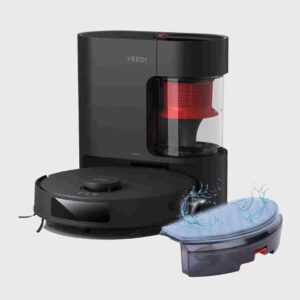
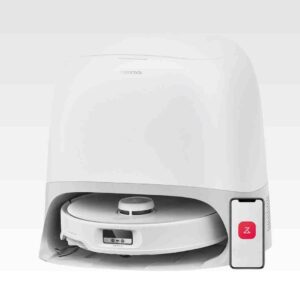
The adaptive chassis lift/threshold capability is a standout differentiator, helping it clear taller transitions than many robots. A few reviewers suggest real-world limits can be below marketing claims, but it’s still viewed as meaningfully better than average.
Its curved, modern dock and polished styling are frequently described as more living-room-friendly than boxier competitors. Overall sentiment on design is strongly positive.
Smart/app features cover the essentials (Wi-Fi app control, mapping, schedules), but reviews note missing or limited voice-assistant support compared with some rivals. Automation is strongest inside the Yeedi app rather than through external ecosystems.
The app is consistently described as feature-rich, with strong automation options (room-by-room settings, scheduling, empty frequency, remop triggers, etc.). Overall sentiment is that the software is powerful without being overly hard to use.
On rugs, it performs well on low-pile area rugs for vacuuming, but mopping around rugs requires care and planning. Homes with many rugs benefit from no-mop zones or running vacuum-only on rug-heavy areas.
For mixed flooring, mop lifting and carpet detection are praised for keeping rugs dry while maintaining cleaning coverage; reviewers generally see it as well-suited to homes with area rugs.
Setup is widely described as straightforward, with quick app pairing and mapping after initial runs. Some users note you may need to learn the vacuum-vs-mop configuration steps early to avoid confusion.
Setup is described as straightforward: the dock is largely ready out of the box, pairing/mapping is quick, and most complexity comes from exploring app settings rather than assembly.
Battery and charging behavior is described as dependable, with enough endurance for typical apartments/medium homes and expected recharge behavior when needed. Long sessions may involve recharge-and-resume depending on floorplan and settings.
Battery life and efficiency are rated highly (including strong coverage per charge), making it a good fit for larger homes or multi-room schedules.
Bin/bag capacity is viewed as a strong point for the class, with a usable onboard bin and a larger base collection capacity that reduces daily maintenance. This setup supports longer stretches between manual empties for most households.
Reviews commonly mention a disposable dust bag in the dock plus an onboard bin; overall feedback is that it reduces dust mess and feels appropriately sized for typical households.
Build quality impressions are generally solid for the price tier, with a functional, mid-range feel rather than premium materials. Long-term durability is viewed as reasonable, though a few reviews raise typical reliability caveats for budget robots.
Low-pile carpet pickup is consistently reported as strong for routine maintenance, with enough suction to lift daily dust and hair. Deep cleaning still benefits from occasional manual vacuuming.
Carpet deep-clean performance is rated very strong in testing, placing it near the top tier among vacuum+mop hybrids.
Controls and UI (especially in-app) are generally described as easy to use, with clear mapping, room selection, and scheduling. Occasional limitations are mentioned around deeper smart-home integration.
Controls are generally praised: reviewers cite an intuitive app, useful remote-control features (e.g., pin-and-go), and broad customization. Some note competitor apps can feel more confusing, making Roborock’s UI a relative bright spot.
Corner cleaning is acceptable but not class-leading; several reviews note it can leave some debris in tight corners, especially compared to higher-end robots with more advanced edge strategies.
Corner cleaning gets frequent praise thanks to an extending side brush, improving reach into tight corners. One stress test notes the side brush can scatter debris in extreme scenarios, but overall corner performance is viewed as above average.
Crevice/groove pickup is noted as a relative weak spot: one review calls it average compared to the robot’s otherwise high-performing hard-floor and carpet results.
A dirty-water / dirt-detection sensor is credited with enabling remop/extra wash behavior, helping prevent spreading grime and improving hands-off cleaning.
Docking and auto-emptying are generally reliable, with the base consistently collecting debris after runs. The station is simpler than self-washing mop docks, but it delivers the core convenience of hands-off dust disposal.
Docking and auto-empty reliability are repeatedly praised: the robot returns consistently, empties well, and handles mop washing/drying and refills with little fuss.
Dock emptying noise is described as relatively quiet for the category, including one report around ~67 dB.
In at least one standardized test, dried-on stain performance is described as more mid-pack than class-leading—good, but not the standout reason to buy.
Ease of use is high for day-to-day vacuuming and scheduled runs, especially with auto-emptying. Mopping is less effortless because it can require manual pad handling and configuration changes.
Day-to-day ownership is described as low-effort because the dock automates most chores; typical hands-on tasks are water refills/empties and occasional cleaning of the dock tray/consumables.
Edge coverage is repeatedly highlighted: an extending mop pad and sweep arm help it clean closer to walls and baseboards than many rivals. Reviewers still wish for true baseboard scrubbing, but edge pickup is considered a strength.
Edge performance is frequently called out as only okay, with some reviewers explicitly noting it is not great on edges/baseboards. It can miss fine debris right against walls without occasional targeted runs.
Emptying is convenient and largely mess-controlled thanks to the auto-empty dock, reducing how often users handle the onboard bin. A few reviews still recommend routine checks to prevent overfill or clogs, especially with heavy hair.
The bagged emptying system is viewed as clean and convenient, with quiet emptying noted in at least one review and helpful indicators when water tanks need attention.
Carpet hair pickup is generally good on low-pile surfaces, with enough power for maintenance. For homes with lots of hair on thicker carpet, results are more variable and may require extra passes.
For carpet hair, reviews and pet-hair testing place it among the better performers, though some results suggest two passes may still be needed for the most thorough pickup.
On hard floors, reviews report very good pickup of pet hair, crumbs, and dust for everyday cleaning. Fine dust performance is generally praised, especially when paired with consistent scheduling.
Hard-floor hair pickup is described as excellent in pet-focused testing, with near-perfect results reported.
Hair-wrap resistance earns positive mentions, with the anti-tangle brush design handling pet hair well in many tests. Some routine brush checks are still recommended, but tangling appears less frequent than on basic rollers.
Hair‑wrap resistance is a major highlight: the split/DuoDivide-style roller design earns perfect or near-perfect tangle-test results in multiple discussions. One reviewer still noted minor hair accumulation in certain joints, but overall sentiment remains very strong.
Testing-focused reviews describe excellent fine-dust pickup on hard floors, with strong results across small particulate debris.
Large-debris intake is repeatedly described as excellent in testing, handling bigger particles without major issues.
Hot-water mop washing and heated/warm-air drying are consistently praised for hygiene and for keeping mop pads from staying damp between runs.
Its relatively low profile (often cited around 9.6cm / 3.77in) helps it slip under more furniture than taller bots, improving day-to-day coverage in living rooms and bedrooms.
Maintenance is moderate: auto-empty reduces daily chores, but owners still need to wash/replace the mop pad, clean brushes/filters, and periodically check sensors. The simpler mop system shifts some upkeep back to the user.
Maintenance is often framed as low thanks to automation, but owners still need to refill clean water, empty dirty water, replace bags/consumables, and occasionally clean the dock tray and brushes.
Mapping and navigation are a highlight in most reviews, with the app map described as accurate and efficient for room-to-room coverage. Users report reliable route planning and useful scheduling/zoning, helping it keep floors tidy between deeper cleans.
Lidar mapping and route planning are described as fast and efficient, with organized straight-line coverage and solid room handling/multi-level mapping.
Mop lifting is frequently cited as effective (often framed around a ~17mm lift), enabling it to vacuum carpets/rugs without soaking them.
Mopping is generally rated as good for upkeep and everyday grime, but the system is simpler than flagship bots: a single flat pad, smaller onboard tank, and no dock-based pad washing/drying. Expect effective light mops, with more effort needed for dried-on messes and periodic manual pad cleaning.
Mopping is broadly praised—dual spinning pads with adjustable wetness tackle everyday grime and paw prints well, and the extending mop pad improves edge coverage. A few reviewers still give the edge to the best-in-class moppers for heavy stains, but Curv is considered an excellent all‑around performer.
Noise is mixed: several reviews describe louder operation than quieter premium models, especially on higher suction settings. It is generally tolerable for daytime cleaning, but can be noticeable in smaller homes or when running near people.
Obstacle/object avoidance is a common weak spot. Multiple reviews mention it can struggle with small clutter (like socks or low items) and benefits from pre-tidying, making it less set-and-forget in busy rooms.
Obstacle avoidance is usually described as good for larger items and many everyday obstacles, but several reviewers call out missed small cables/cords. In cable-heavy rooms, it may snag or stop, so floor prep or no-go zones are recommended.
Across the reviews, Qrevo Curv lands as a top-tier vacuum+mop with strong cleaning results, a highly automated dock, and smart navigation. Praise centers on edge/corner reach and pet-hair handling, while the most common knocks are premium pricing and imperfect cable avoidance.
Pet owners generally find it effective for keeping up with hair and tracked-in debris, helped by solid suction and anti-tangle design. It works best as a frequent-maintenance bot rather than a once-a-week deep clean for heavy-shedding homes.
Multiple reviews frame it as a great choice for pet owners thanks to strong hair pickup, anti-tangle brush design, and camera/app features (where enabled) for monitoring. Pet homes with lots of cords still need some floor prep.
Value is a major selling point in reviews: it is often framed as a budget-to-midrange option that delivers strong cleaning and mapping for the price. The tradeoff is fewer premium automation features (like advanced obstacle avoidance or mop-wash docks).
The price is repeatedly called premium (often framed around a ~$1,600 MSRP), and several reviewers recommend waiting for discounts. When on sale, value is described as far more compelling; a few reviewers question whether camera/chassis-lift extras are worth the upcharge versus cheaper variants or rivals.
Camera-based features (obstacle recognition, remote viewing/voice) bring privacy considerations. Reviews note the camera can be disabled/off by default, and a camera-free variant exists for buyers who prioritize privacy.
Runtime in default modes is typically sufficient for routine whole-home maintenance in small-to-mid spaces, with most reviewers implying it completes normal schedules without frequent interruptions.
The dock’s self-cleaning base/tray features reduce manual scrubbing, though reviewers still expect periodic cleaning to keep things fresh.
Most reviewers say detergent dosing is manual (add solution to the clean-water tank rather than a dedicated auto-dosing reservoir), while one review lists a detergent capacity/mixing capability. Net takeaway: plan for at least some manual solution handling.
Stuck resistance is average: it handles common thresholds and room transitions, but small clutter and cords can still cause interruptions. Prepping the floor improves consistency.
Adaptive lift helps it clear thresholds and some obstacles, but cable snags and occasional attempts to 'climb' awkward objects can still interrupt runs in some homes.
Reviews consistently describe strong suction for a mid-tier robot (often citing 8,000Pa), with very good pickup on hard floors and low-pile rugs. Performance is solid for daily maintenance, but it is not positioned as a deep-clean replacement for thicker carpet or heavy debris in one pass.
Vacuuming performance is described as strong in real homes and on carpets, helped by high rated suction. One evaluation calls out only average airflow/bench suction and weaker performance in tight crevices compared with its overall cleaning results.
Support/reliability sentiment is mixed-to-positive overall: many report stable performance, while others mention occasional quirks or the need for troubleshooting. It does not stand out as the most robust support experience in the category.
The low stance helps it reach under many beds/sofas for routine pickup, though very low-clearance furniture can still be a limitation depending on leg height and clutter.
The onboard water tank is sufficient for light maintenance mops rather than heavy scrubbing sessions. Several reviews highlight the absence of a large dock water system, so refills and pad care are part of ownership.
Reviews consistently mention separate clean/dirty water tanks plus onboard water handling that keeps pads wet. Tank refills/empties are a routine task, but capacity and adjustable water use are generally seen as practical for whole-home runs.