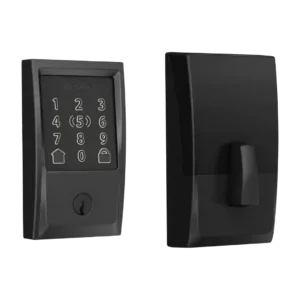
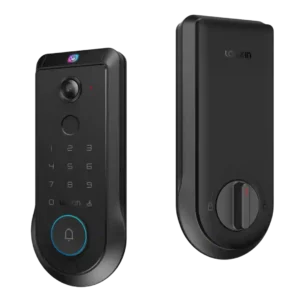
Access history is available in the Schlage app and is frequently cited as useful. More than one review notes the log window may be limited (for example, roughly four weeks).
Event/activity logs are repeatedly mentioned, with reviewers noting access to doorbell and lock/unlock histories and the ability to review event records inside the app.
The built-in alarm is widely described as present but not very loud. It functions more as a local deterrent than a house-wide siren.
Audio/alarm volume is adjustable in the app and reviewers note it can be loud by default during setup; the ability to tune or mute sounds is a plus, but audio quality for doorbell recordings was criticized by at least one reviewer.
The Schlage app is frequently required for full functionality (alarms, logs, some code management, and settings). A recurring tradeoff is app fragmentation between Apple Home and Schlage, plus occasional code-sync quirks.
The Lockin app is widely described as feature-packed and customizable (modes, power management, access controls, event viewing), but multiple reviewers also flagged rough edges such as hidden controls, missing/immature video history features at launch, slow clip loading, and occasional troubleshooting or resets.
Auto-lock is supported and commonly used, but multiple reviewers note it is configured in the Schlage app (or handled via Apple Home automations) rather than being fully exposed inside Apple Home.
Auto-lock is widely praised and highly configurable (immediate to timed delays). The built-in door-closed sensing helps prevent locking before the door is shut, improving real-world reliability.
Several reviews describe lockout behavior after repeated wrong code entries, sometimes paired with an alarm and temporary keypad disablement. This is framed as a useful protection against brute-force guessing.
Wrong-try protection and lockout behavior are described as available and configurable, adding a practical layer of protection against repeated code attempts.
Battery life is the most inconsistent theme: some reviewers report around six months, while at least one long-term user reports closer to two months even on Thread. Several imply that door alignment, resistance, and usage patterns strongly affect longevity.
Battery life is commonly framed as roughly three months for the Pro, with USB-C charging and emergency power options. Several reviews highlight an optional solar panel that can meaningfully top up the battery, although placement and looks are a frequent complaint.
Bluetooth is mentioned mainly as a pairing or fallback connection path; most reviewers prefer Wi-Fi or Thread for day-to-day responsiveness.
Bluetooth is used in setup/bridging to Wi-Fi in several reviews and is generally portrayed as convenient during onboarding.
Hardware is repeatedly described as solid and premium, and one review highlights top BHMA/ANSI certifications. Size/bulk is noted by some, but durability and fit-and-finish are generally praised.
Build quality impressions are mostly positive: reviewers call the lock hefty, solid, and less plastic-heavy, though the exterior assembly is bulky and at least one reviewer criticized hardware tolerances (bolts/threads) as a quality-control pain point.
Multiple reviews explicitly call out the lack of a built-in door open/close sensor. Some users add a separate contact sensor to approximate door-sense behavior.
The integrated door-open/closed sensing via the strike plate and smart deadbolt is repeatedly called out as a smart, cleaner alternative to external sensors and is tied to better auto-lock behavior and door-status awareness.
One review provides specific door thickness and bore-fit guidance and generally treats the lock as compatible with standard deadbolt installs; the main fit concern raised is bulk rather than incompatibility.
Firmware and software updates are mentioned as part of ownership, with reviewers recommending keeping the Schlage app available for updates and settings. Some hope updates improve behavior such as battery longevity and code syncing.
Most reviews state there is no fingerprint reader, and some frame this as a missed feature at the price. One overview-style video appears to describe biometrics, but this conflicts with the rest of the review set.
Fingerprint access is usually described as quick and usable, but experiences vary: some found it reliable, others needed multiple tries or noted setup is slower than palm enrollment and can be harder for some users (including kids).
Finish options and certification callouts are described positively, with at least one review referencing high finish ratings. No consistent complaints about premature wear appear in the transcripts.
Geofencing is commonly called out as missing. Reviewers who want proximity-based automation rely on Apple Home automations or other platforms, but treat the lack of built-in geofencing as a gap.
Geofencing is mentioned as present in some materials and apps, but reviewers say it is limited, often used for changing modes/settings rather than true automatic lock/unlock behavior.
Code-based guest access is a major strength, with up to 100 codes mentioned and options for temporary or scheduled access in the Schlage app. Several reviews note occasional quirks in how codes appear or sync in Apple Home.
Guest access features are a highlight: reviewers cite one-time, temporary, and scheduled PIN codes and easy sharing, though some note restrictions (temporary access may be PIN-only, and permission tiers/time restrictions for full users can be limited).
No third-party bridge is required for Wi-Fi, but Apple Home remote control typically needs a Home hub (Apple TV or HomePod). Thread performance also depends on having a Thread border router in the home.
For ecosystem control, reviewers note you may need a Matter controller hub (or similar hub) to add the lock to platforms like Apple Home, Google Home, Alexa, or SmartThings; hub use often comes with reduced feature depth versus the Lockin app.
Most reviewers describe installation as a standard deadbolt swap that takes about 10 minutes, with clear steps and included hardware. A few note minor setup hiccups (pairing, network, or HomeKit add flow), but overall onboarding is straightforward.
Installation is often reported as a straightforward 10–15 minute swap for a standard deadbolt, with guided in-app setup, but one critical review cited poorly machined/jamming long bolts and lots of cable routing that can make assembly more frustrating than typical.
Physical key access is consistently positioned as the dependable backup, especially because emergency external power is not emphasized across reviews. A few reviewers note only one key is included.
A physical key is included and used as a backup method; no review reported key override failures, and several call out the presence of emergency power as an additional fallback.
Keypad responsiveness is often rated well, but visibility and backlighting are recurring criticisms: faint numbers or uneven/jagged lighting make it harder to use in bright conditions for some users. Others report it is bright and easy to read.
The keypad is generally seen as useful for kids/guests and as a backup method, but at least one reviewer criticized poor outside usability (a non-illuminated lock button and unclear manual locking cues).
One reviewer specifically calls out that the cylinder can be re-keyed, and mentions compatibility with common five-pin Schlage-style cylinders. This is framed as a practical benefit for matching existing keys.
The keyway is typically hidden behind the doorbell button and presented as a practical backup; reviewers do not report pick/drill testing, but also do not flag obvious keyway quality problems in normal use.
Speed is often praised, especially when using Home Key or Thread, with near-instant responses reported in several videos. One reviewer notes NFC can require close positioning and may feel less convenient than the keypad in certain door/frame situations.
Lock/unlock responsiveness is frequently described as very fast (both biometrics and app control), though overall perceived speed can be undercut when video clips or app functions lag.
Motor operation is usually described as smooth and quiet. A slight whir is mentioned in one review, and several point out that door friction or resistance can increase strain and noise.
Reliability is generally strong once configured, but there are scattered reports of HomeKit responsiveness issues or access-code quirks that are resolved by network resets, re-pairing, or using the Schlage app for certain settings.
Locking reliability is rated highly in several hands-on tests, but one critical review characterized the product as still beta-like, requiring reboots/force-quits and not yet fully trustworthy without more firmware refinement.
Notifications are praised in Apple Home, including alerts that can identify who unlocked via Home Key or specific access codes in some setups. Users value this for household tracking and automation triggers.
Notifications are often described as fast and informative (motion/doorbell/lock events), but at least one reviewer reported major notification failures that required support and factory resets, and another noted limited per-alert toggles in the app.
One review highlights high BHMA and ANSI grade certifications, and others emphasize Schlage's reputation for security hardware. Overall, physical security is presented as strong for a residential smart deadbolt, though detailed pick/drill testing is not common in the transcripts.
At least two reviews cite BHMA/ANSI Grade 2 level certification for the lock, suggesting solid baseline physical security for residential use, though most testing focused on convenience and software rather than attack trials.
Remote access is supported via Wi-Fi, but multiple reviews emphasize that Apple Home users need a hub for away-from-home control and status updates. In practice, remote features work well once the ecosystem requirements are met.
Remote control via the Lockin app is positioned as a core strength (live view, lock/unlock, codes, alerts), though performance varies by reviewer, with some praising responsiveness and others reporting lag or slow video clip loading.
One review explicitly cites 128-bit AES encryption as part of the lock's security approach. Most other reviews focus more on ecosystem security and account practices than on cryptography details.
Some reviewers highlight on-device processing, local storage, and direct device-to-phone style connections (often described as more private), but concrete third-party verification details are limited; advanced security claims should be weighed against real-world software stability.
Smart-home integration is a headline win: HomeKit with Home Key, plus Alexa and Google Assistant support are repeatedly cited. Thread support is highlighted as improving responsiveness and stability in Apple Home environments.
Smart-home compatibility is frequently advertised as broad (Matter/Thread plus major platforms), and pairing generally works, but reviewers repeatedly note that third-party apps expose only basic lock functions and omit many advanced features (especially doorbell/camera and granular access controls).
Tamper and forced-entry detection settings are described as configurable, including sensitivity adjustments. Reviewers appreciate the deterrent behavior even if the alarm volume is not described as extreme.
Anti-tamper and unusual-activity detection are referenced (including tamper events surfaced in some ecosystem apps), but few reviewers deeply tested sensitivity or false-alarm behavior.
The touch interface is convenient and modern, but a few reviewers want stronger feedback (physical buttons or clearer confirmation). Backlight quality is a common tweak request.
The touch interface is often described as responsive and modern, with some praise for smudge resistance; however, visibility/UX issues (fish-eye video framing noted elsewhere, and unlit button behavior) can reduce ease of use at night.
At least one review criticizes the Schlage app for lacking two-factor authentication. Security-conscious users may see this as a weak spot for an account-connected device.
Access management is described as strong, with residents/guests and easy enable/disable of codes. Some reviewers note labeling and syncing differences between Apple Home and the Schlage app.
User management is generally organized (multiple palms/fingerprints/PINs per user), but at least one reviewer criticized limited permission granularity, with full users effectively receiving always-on access.
Price is repeatedly described as premium, and value is framed as strongest for Apple households who will use Home Key daily. Outside that use case, reviewers suggest the cost and feature omissions (like fingerprint or geofencing) may be harder to justify.
Value depends heavily on price: reviewers see the all-in-one concept and no-subscription local storage as compelling, but MSRP is considered expensive, and early-bird pricing is viewed as much more competitive given software maturity concerns.
Voice control support via Siri, Alexa, and Google Assistant is referenced as convenient for locking and status checks. Some sources imply security confirmations for unlocking via voice in certain assistants.
Voice control via assistants (Siri/Alexa/Google) is described as working for basic lock/unlock commands; richer smart-home routines are possible, but broader feature access still tends to live in the Lockin app.
Warranty coverage is praised in at least one review, citing lifetime mechanical coverage and multi-year electronics coverage. Support is not a major complaint area across the set.
Weather protection is not a headline strength in the reviews; one source notes there is no IP rating, though temperature specs are cited. Most feedback treats it as typical residential hardware rather than a lock built for harsh exposure.
Multiple reviews cite IP65 weatherproofing and describe the lock holding up to rain/dust and outdoor conditions; long-term durability claims exist, but most evidence is short-to-medium term testing.
Built-in 2.4GHz Wi-Fi is consistently highlighted as a convenience because it avoids a separate bridge. Reviews generally describe stable remote-capable connectivity, with platform-specific hub requirements for Apple Home.
Built-in 2.4GHz Wi-Fi is a recurring positive, enabling direct app control and remote features without a separate bridge for basic operation.