Activity logging is available and useful for seeing who unlocked and when, but some reviewers want more detail and better accuracy, and at least one notes that logs can be more accessible when you are within Bluetooth range.
Access history is available in the Schlage app and is frequently cited as useful. More than one review notes the log window may be limited (for example, roughly four weeks).
Sound feedback is polarizing: the lock offers volume controls, but multiple reviewers still find the lowest setting too loud and wish silence or finer-grained control were available without relying on the Level app.
The built-in alarm is widely described as present but not very loud. It functions more as a local deterrent than a house-wide siren.
The Level app is generally seen as capable for setup, sharing, passes, and tuning settings like sound and range, but several reviews note quirks (e.g., firmware update progress) and many Apple-first users rely more on the Home app day to day.
The Schlage app is frequently required for full functionality (alarms, logs, some code management, and settings). A recurring tradeoff is app fragmentation between Apple Home and Schlage, plus occasional code-sync quirks.
Auto-lock works as a time-based setting and is generally seen as useful, but reviewers note it cannot confirm the door is actually closed. Some users compensate with Home automations using a separate door sensor. Auto-unlock exists but is treated as more finicky than Home Key, because it relies on Bluetooth plus location logic and often requires leaving the geofence boundary before it will re-arm. Several reviewers prefer NFC/Home Key for intentional, predictable entry.
Auto-lock is supported and commonly used, but multiple reviewers note it is configured in the Schlage app (or handled via Apple Home automations) rather than being fully exposed inside Apple Home.
Several reviews describe lockout behavior after repeated wrong code entries, sometimes paired with an alarm and temporary keypad disablement. This is framed as a useful protection against brute-force guessing.
Backset support is geared toward common standards (2-3/8 and 2-3/4 inches), with included parts like bolt extenders/long caps noted as helpful when adapting to typical door setups.
Battery design (CR2 hidden in the bolt) is widely praised for tool-free access and simplicity, with typical life estimates around six months. The most common complaint is the app reporting being too coarse (no percentage), making planning replacements harder.
Battery life is the most inconsistent theme: some reviewers report around six months, while at least one long-term user reports closer to two months even on Thread. Several imply that door alignment, resistance, and usage patterns strongly affect longevity.
Bluetooth is central for local operation and some features, but it draws mixed feedback: some reviewers find it stable, while others call it temperamental and prefer Thread-class reliability. A boost-range option can help at the cost of battery life.
Bluetooth is mentioned mainly as a pairing or fallback connection path; most reviewers prefer Wi-Fi or Thread for day-to-day responsiveness.
Build quality is consistently described as premium and discreet, with lots of metal and very little visible bulk. Multiple reviewers cite robust ratings/standards and generally trust the hardware durability once properly aligned.
Hardware is repeatedly described as solid and premium, and one review highlights top BHMA/ANSI certifications. Size/bulk is noted by some, but durability and fit-and-finish are generally praised.
Door-sense is a notable omission: multiple reviewers explicitly wish the lock could detect when the door is closed to make auto-lock smarter and reduce mis-lock scenarios on ajar doors.
Multiple reviews explicitly call out the lack of a built-in door open/close sensor. Some users add a separate contact sensor to approximate door-sense behavior.
Fit is best on standard deadbolt-prepped doors that close smoothly. Several reviews stress that misalignment, shallow strike holes, or the Lock+ round bolt/battery design can cause extra tweaking on some doors.
This model replaces the full deadbolt, so you generally cannot reuse your existing keyed hardware the way retrofit kits can. Rekeying is possible but often framed as a locksmith job, and some reviewers note it is not a casual DIY swap.
Firmware and future features come up often: reviewers mention updates and the expectation of expanded Thread/Matter capabilities, but also express frustration with delays or minor app update bugs like progress reporting.
Firmware and software updates are mentioned as part of ownership, with reviewers recommending keeping the Schlage app available for updates and settings. Some hope updates improve behavior such as battery longevity and code syncing.
Fingerprint entry is not included, and at least one reviewer flags this as a missing convenience feature compared with similarly priced competitors that bundle fingerprint readers.
Most reviews state there is no fingerprint reader, and some frame this as a missed feature at the price. One overview-style video appears to describe biometrics, but this conflicts with the rest of the review set.
Aesthetics are a major strength, but finish and matching hardware are mixed: some praise the available finishes while others want more color options or matching strike plates for cohesive looks.
Finish options and certification callouts are described positively, with at least one review referencing high finish ratings. No consistent complaints about premature wear appear in the transcripts.
Geofencing underpins auto-unlock and some touch behaviors, typically using a ~200-meter home boundary. It can work, but many reviewers note extra constraints and prefer Home Key for faster, less error-prone entry.
Geofencing is commonly called out as missing. Reviewers who want proximity-based automation rely on Apple Home automations or other platforms, but treat the lack of built-in geofencing as a gap.
Guest access options include app-based invites, shareable passes, NFC cards/fobs, and keypad PINs if you add the keypad. The main downside is friction when guests must install the Level app, unless you lean on keypad/cards instead.
Code-based guest access is a major strength, with up to 100 codes mentioned and options for temporary or scheduled access in the Schlage app. Several reviews note occasional quirks in how codes appear or sync in Apple Home.
Hub/bridge needs are a recurring theme. Apple Home users get the cleanest remote experience with a Home hub, while non-Apple ecosystems often need Level Connect or other bridges and may still feel less complete until Thread/Matter support is fully active.
No third-party bridge is required for Wi-Fi, but Apple Home remote control typically needs a Home hub (Apple TV or HomePod). Thread performance also depends on having a Thread border router in the home.
Most reviewers found installation quick with basic tools, but doors that are tight, have nonstandard cutouts, or mismatched strike plates sometimes required sanding, drilling, or careful alignment to avoid binding.
Most reviewers describe installation as a standard deadbolt swap that takes about 10 minutes, with clear steps and included hardware. A few note minor setup hiccups (pairing, network, or HomeKit add flow), but overall onboarding is straightforward.
Jam detection/alerts appear when alignment is off or the strike-hole depth is shallow; reviewers who encountered it generally resolved the issue by adjusting the door/strike rather than blaming the motor itself.
Physical keys remain a dependable fallback and are appreciated because the lock lacks external emergency power terminals. Reviewers report rarely needing the key, but value having it when batteries or connectivity fail.
Physical key access is consistently positioned as the dependable backup, especially because emergency external power is not emphasized across reviews. A few reviewers note only one key is included.
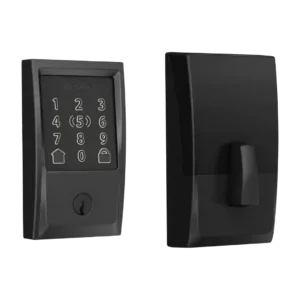
There is no built-in keypad, which is a frequent tradeoff callout. An optional keypad accessory is viewed as useful and flexible to mount, but it adds cost and reduces the stealth aesthetic.
Keypad responsiveness is often rated well, but visibility and backlighting are recurring criticisms: faint numbers or uneven/jagged lighting make it harder to use in bright conditions for some users. Others report it is bright and easy to read.
The keyway/cylinder is widely described as a standard consumer-grade core, and several reviewers criticize it for lacking higher-security pins. Upgrading or rekeying to a stronger cylinder is a common recommendation if pick resistance matters.
One reviewer specifically calls out that the cylinder can be re-keyed, and mentions compatibility with common five-pin Schlage-style cylinders. This is framed as a practical benefit for matching existing keys.
Home Key and NFC interactions are usually described as fast and near-instant, while app-based control can be slower—especially when routing through a hub for remote commands or when Bluetooth has to sync first.
Speed is often praised, especially when using Home Key or Thread, with near-instant responses reported in several videos. One reviewer notes NFC can require close positioning and may feel less convenient than the keypad in certain door/frame situations.
The internal motorized chassis is praised for its clean, hidden design, but it is sensitive to resistance from door alignment. When the door throws smoothly it performs well; binding can trigger jams or slower operation.
Motor operation is usually described as smooth and quiet. A slight whir is mentioned in one review, and several point out that door friction or resistance can increase strain and noise.
Overall reliability is strong once the door and strike are aligned, with Home Key working the vast majority of the time in multiple long-term accounts. The main reliability complaints revolve around Bluetooth/geo features and mechanical binding when the door is not fully closed.
Reliability is generally strong once configured, but there are scattered reports of HomeKit responsiveness issues or access-code quirks that are resolved by network resets, re-pairing, or using the Schlage app for certain settings.
Notifications are commonly referenced through Apple Home (alerts when the lock is used) and through activity updates in the Level app, though detail and consistency vary depending on connectivity and which app you rely on.
Notifications are praised in Apple Home, including alerts that can identify who unlocked via Home Key or specific access codes in some setups. Users value this for household tracking and automation triggers.
Against brute-force attacks, reviewers point to strong hardware ratings and argue the deadbolt strength is solid, with the door or frame likely failing before the bolt does in many scenarios.
One review highlights high BHMA and ANSI grade certifications, and others emphasize Schlage's reputation for security hardware. Overall, physical security is presented as strong for a residential smart deadbolt, though detailed pick/drill testing is not common in the transcripts.
Pick resistance is a consistent weak spot in the review set, with multiple references to quick picks or bump-style demonstrations using basic tools. Several reviewers recommend rekeying or upgrading the cylinder if this is a concern.
Remote access is reliable when paired with the right hub (Apple Home hub or a Wi-Fi bridge), but without one the lock is largely a local-control device. Several reviewers highlight this as the key deciding factor beyond aesthetics.
Remote access is supported via Wi-Fi, but multiple reviews emphasize that Apple Home users need a hub for away-from-home control and status updates. In practice, remote features work well once the ecosystem requirements are met.
Security-wise, encryption is described positively (including end-to-end encryption mentions), and Home Key offers choices like Express Mode vs requiring device authentication, letting users balance speed and protection.
One review explicitly cites 128-bit AES encryption as part of the lock's security approach. Most other reviews focus more on ecosystem security and account practices than on cryptography details.
Smart-home integration is best in Apple Home/HomeKit, where Home Key is a standout differentiator. Alexa/Google/SmartThings support is more conditional (often bridge- or version-dependent), and Thread/Matter readiness is frequently discussed as a future-proofing promise.
Smart-home integration is a headline win: HomeKit with Home Key, plus Alexa and Google Assistant support are repeatedly cited. Thread support is highlighted as improving responsiveness and stability in Apple Home environments.
Tamper and forced-entry detection settings are described as configurable, including sensitivity adjustments. Reviewers appreciate the deterrent behavior even if the alarm volume is not described as extreme.
The touch interface is convenient and modern, but a few reviewers want stronger feedback (physical buttons or clearer confirmation). Backlight quality is a common tweak request.
At least one review criticizes the Schlage app for lacking two-factor authentication. Security-conscious users may see this as a weak spot for an account-connected device.
Access management is a strong point, with clear admin vs guest roles, time windows, recurring schedules, and revocation. Reviewers especially like the flexibility for service providers, visitors, and short-term use cases.
Access management is described as strong, with residents/guests and easy enable/disable of codes. Some reviewers note labeling and syncing differences between Apple Home and the Schlage app.
Pricing is consistently called high (roughly $329-$349). Reviewers see the value proposition as strongest for buyers who prioritize an invisible design plus Home Key convenience, and weakest for those who want built-in keypad features or higher-security cylinders without extra cost.
Price is repeatedly described as premium, and value is framed as strongest for Apple households who will use Home Key daily. Outside that use case, reviewers suggest the cost and feature omissions (like fingerprint or geofencing) may be harder to justify.
Voice control works well in Apple environments via Siri (often with confirmation) and can work with Alexa/Google depending on bridges and ecosystem choices. Several reviews caution that cross-ecosystem support is not equally mature.
Voice control support via Siri, Alexa, and Google Assistant is referenced as convenient for locking and status checks. Some sources imply security confirmations for unlocking via voice in certain assistants.
Warranty coverage is praised in at least one review, citing lifetime mechanical coverage and multi-year electronics coverage. Support is not a major complaint area across the set.
Weather and temperature considerations show up mainly as door-fit sensitivity (cold weather can change alignment) plus mentions of sealing details like an O-ring and broad operating temperature specs.
Weather protection is not a headline strength in the reviews; one source notes there is no IP rating, though temperature specs are cited. Most feedback treats it as typical residential hardware rather than a lock built for harsh exposure.
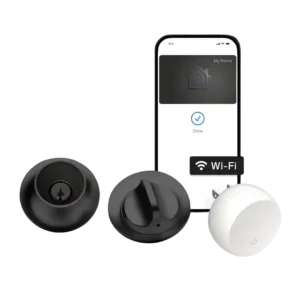
The lock does not include direct Wi-Fi, so remote control depends on a bridge or ecosystem hub. Reviews that used a Wi-Fi bridge generally liked the added reach, but complained about placement constraints and the one-bridge-per-lock reality in some setups.
Built-in 2.4GHz Wi-Fi is consistently highlighted as a convenience because it avoids a separate bridge. Reviews generally describe stable remote-capable connectivity, with platform-specific hub requirements for Apple Home.