The JBL Portable app is commonly described as stable and straightforward, adding speaker grouping, firmware updates, and EQ; a few call it bare-bones but functional.
The Soundcore app is repeatedly called stable and genuinely useful, with fast connection, firmware updates, lighting control, and rich audio/karaoke settings that are easy to navigate.
USB-C wired playback is reported to support lossless/hi-res sources in several reviews, but some hear only subtle gains versus Bluetooth and one reviewer could not get USB audio working, making it somewhat setup-dependent.
Backwards compatibility is a consistent negative: many sources state Flip 7 cannot pair with older PartyBoost/Flip generations, and stereo pairing requires another Flip 7.
Battery claims cluster around 14 hours (up to 16 with Playtime Boost), but real results vary widely by volume/EQ: some report multi-day casual use, while one standardized test measured about 6 hours at steady 80dB.
Battery life is advertised around 12 hours, but multiple reviews call it average for the size; with lights, BassUp, and higher volume, real-world endurance is often closer to a single party session (roughly mid single-digits of hours).
Codec support is described as limited: several reviews say SBC-only, while a few mention AAC alongside SBC; there is no consistent report of higher-end codecs like aptX.
Bluetooth audio codec support is limited (SBC is commonly cited, with AAC also mentioned), and reviewers explicitly call out the absence of higher-resolution options like LDAC/aptX.
Bluetooth stability is widely praised, with most reporting solid connection in typical indoor/outdoor use.
Bluetooth performance is generally described as stable with low video lag; however, a few users mention occasional quirks (like multipoint handoffs or brief dropouts/behavior changes when powering mics).
Range impressions are positive, including reports of maintaining connection across large rooms and outdoor distances (one reviewer cites about 50 meters), though real range depends on environment.
Multiple sources cite recharge time around 2.5 hours, with notes that there is no fast-charge feature and a charger/cable may not be included.
Charging is commonly described as slow for the category, with about a 6-hour full recharge cited by multiple reviewers.
Overall presentation is commonly described as energetic and composed for a compact portable, but dissenting takes call out midrange muddiness or less refined sound depending on genre and volume.
Physical controls are generally described as tactile and responsive, with a cleaner layout and backlit buttons on some controls improving usability.
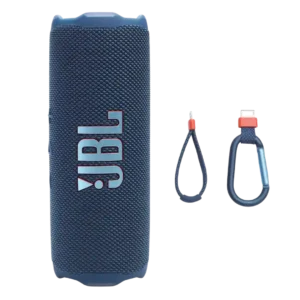
Design feedback is largely positive (rugged, fun colors, familiar Flip shape), though a few describe the styling as casual or less elegant than some rivals.
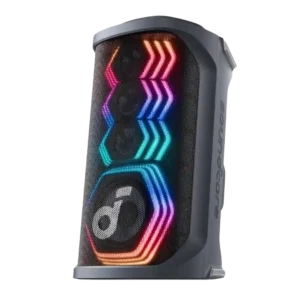
Build and styling are broadly praised as sturdy and modern, with a metal grille, textured housing, and thoughtful touches like mic holders and rubber rails for horizontal/spatial mode.
Detail is often judged strong for a speaker this small, but several reviewers still note limited nuance and separation in busy tracks (especially orchestral/classical) compared with larger or stereo speakers.
AI Sound Boost and the updated driver/tweeter are frequently credited with keeping distortion low, but multiple tests still note sibilance/harshness or occasional crackle when volume is pushed high.
Cleanliness at high volume is mixed: some reviewers report it staying composed with BassUp, while others hear high-frequency fuzz or bass/sub-bass distortion when pushed to maximum levels, especially outside.
Durability is a standout theme: reviewers emphasize reinforced bumpers/endcaps and commonly cite drop-proof claims around 1 meter onto hard surfaces.
Dust resistance is consistently described as fully dustproof (often as part of IP68), positioning it as well-suited for sand, trails, and outdoor use.
Dynamic headroom is frequently praised, with reviewers noting it can be pushed louder than expected for the form factor, though some caution that tonality can harden at very high levels.
The move to a 7-band EQ is a major usability win and is frequently praised; caveats include Playtime Boost disabling EQ adjustments and some complaints about not saving multiple custom profiles.
EQ is a strong point: reviewers highlight multiple presets, a detailed 9-band EQ, BassUp, and vocal effects controls that make it easy to tailor both music and karaoke sound.
One review claims the Flip 7 can float while playing, but this is not consistently verified across sources, so treat it as a nice-to-have rather than a core guarantee.
Most reviewers hear punchy, fun tuning with good bass for the size, but some report a V-shaped balance (boosted bass/treble), midrange that can feel recessed or shouty, and thinner sound when Playtime Boost is enabled.
Tuning favors party impact with strong bass and a forward, energetic sound; several reviewers note the deepest sub-bass and the very top end are less refined, but EQ and BassUp let you rebalance for different genres.
Android setup is described as especially easy thanks to Google Fast Pair, making initial connection quick for supported phones.
The new PushLock loop/carabiner system is widely praised for portability and security, with most calling it a meaningful upgrade over the older simple loop.
The built-in handle helps, and mic storage is integrated, but multiple reviewers wish for additional handles or wheels; a few note the single-handle carry can feel awkward depending on how far you walk.
Auracast is widely highlighted for linking compatible speakers (and two Flip 7s for stereo), though some note Auracast is used mainly for broadcasting and cannot bridge to older PartyBoost models.
Inter-speaker connectivity is a key feature: reviewers mention Auracast/Oracast for linking speakers and the ability to create a stereo setup with a second Rave 3S.
Latency feedback is mixed: several reviewers note noticeable Bluetooth lag and no dedicated low-latency gaming mode, while others say it is fine for casual video; USB-C can reduce lag but may not eliminate it in every app.
For video use, reviewers generally report low perceived latency over Bluetooth, and some use the speaker as a simple TV/audio source via AUX when needed.
The LED light show is frequently praised as bright and customizable, with multiple presets and app control (including dimming/off options); lights are most visible from the front and can noticeably reduce battery life.
Nearly every reviewer calls the Flip 7 impressively loud for its size, often needing only mid-range volume levels for small rooms or outdoor hangs; several warn that pushing it hard can sound harsher.
Across reviews, the Rave 3S is described as extremely loud for its size (200W class output) and easily fills small-to-medium rooms; it is still capable outdoors, though a few testers found it less dominant in open spaces versus larger, wheeled party speakers.
Low-volume listening is generally described as enjoyable with audible bass presence, but some note separation improves at higher volumes and Playtime Boost changes the tonal balance noticeably.
Auracast/Party Together multi-speaker grouping is generally described as easy and reliable with newer compatible JBL models, though a few note the older PartyBoost ecosystem can feel more mature and stable.
It supports linking multiple speakers (Auracast/Oracast) and can form a stereo pair; direct long-term reliability reports are limited, but the feature is consistently present and straightforward to access in controls/app.
Multipoint is often reported as fast and seamless, but at least one reviewer experienced pausing instead of clean source switching when two paired devices played at once.
Multipoint is supported in several reviews, allowing two devices to stay connected; switching works most of the time, though one tester reported occasional awkward handoffs in a busy party scenario.
On-speaker controls are generally straightforward and tactile (play/pause, volume, power, Bluetooth, Auracast); some reviewers also highlight new shortcuts like track navigation and the wired-audio activation via the play button.
At least one reviewer explicitly notes you cannot use the Flip 7 as a power bank to charge your phone via USB-C.
The speaker does not function as a power bank; the USB-C port is for charging the speaker itself, not for charging phones or other devices.
Setup is repeatedly described as simple: power on, pair quickly (often aided by Fast Pair), and optionally use the app for deeper controls.
Setup is consistently described as easy: microphones auto-connect, on-speaker buttons mirror app controls, and most karaoke/light features can be used without deep configuration, aside from optional app tuning.
Smart/party features are the headline: AI vocal removal with adjustable strength (and in some cases an auto guide mode), vocal enhancement/reverb controls, and a spatial mode for wider playback; some reviewers note minor artifacts or level changes when the AI is active.
Soundstage is commonly described as narrow due to mono playback; reviewers who test classical/orchestral especially note a confined presentation with instruments blending together.
Multiple sources explicitly say the Flip 7 lacks a microphone, so it cannot function as a speakerphone for calls.
Multiple sources note there is no speakerphone/calling feature, which is typical for this kind of party speaker.
Status feedback is generally good, including battery indicators on the speaker and in-app percentage readouts; some reviewers also mention warnings/indicators around charging when wet.
Several reviews appreciate the on-speaker battery/status indicators and the clear battery percentage readout inside the app.
The Flip 7 is repeatedly described as a mono speaker with limited imaging; real stereo is possible only by pairing a second Flip 7.
Out of the box it is primarily a mono, front-firing party speaker; laying it on its side enables a spatial mode that widens presentation, and true left/right stereo is achieved by pairing two units.
One review highlights the use of recycled materials (recycled plastics and fabric), suggesting JBL is making tangible moves toward more sustainable construction.
USB-C is the standard charging method and is treated as expected for the category; some reminders note you may need to let the port dry before charging after water exposure.
Most reviewers see strong value at the $149 price given the durability and sound, but a few highlight cheaper rivals that add speakerphone functions or higher-res Bluetooth codecs; sale pricing materially improves the value case.
Value is a standout theme: the price is repeatedly justified by the included dual wireless mics, AI karaoke features, loud output, and customizable lighting, even with compromises in codecs, portability, and battery.
Vocal intelligibility for music is generally good, but karaoke mic output varies by reviewer: some praise the included mics, while others note a noise gate/limiter, proximity sensitivity, or low-level hiss/static.
Most reviews cite an IP68 rating with submersion around 1.5 meters for 30 minutes; a couple sources mention IP67, but overall consensus is that water resistance is class-leading for the size.
Protection is splash-level only (IPX4 in multiple reviews): fine for spills or light rain, but not intended for submersion or heavy weather.
At roughly 23 lb, most reviewers consider it manageable for short carries but not convenient for frequent transport; the lack of wheels is a recurring complaint.
USB-C wired audio is a headline addition and is often described as easy to activate, but at least one reviewer reported they could not get wired audio working reliably on their devices.
Connectivity is flexible for a karaoke boombox: reviewers cite a 1/4-inch mic/guitar input with gain controls plus a 3.5mm AUX input, alongside Bluetooth and USB-C charging; there are no TV-style ports like HDMI.