Average score
P1
Product 1: Bang & Olufsen Beosound A1...
4.3
P2
Product 2: Soundcore Boom 2 Plus Portable...
4.1
Amplifier power requirements
P1Product 1: Bang & Olufsen Beosound A1...
No score yet
P2
Product 2: Soundcore Boom 2 Plus Portable...
4.8
Reviewers repeatedly describe the Boom 2 Plus as a high-output portable speaker, with 100W normal operation and up to 140W with BassUp. The power is consistently tied to party use, strong bass, and outdoor loudness rather than quiet hi-fi listening.
App reliability
P1
Product 1: Bang & Olufsen Beosound A1...
4.7
The Bang & Olufsen app is widely praised as polished, stable and genuinely useful, with EQ, stereo setup, battery readouts and extra content. One review noted a radio feature hiccup.
P2
Product 2: Soundcore Boom 2 Plus Portable...
4.4
The Soundcore app is generally described as intuitive, clean, and useful for EQ, lighting, firmware, and basic controls. One review noted an early beta/prerelease state, but most comments support reliable everyday app usability.
Audio format support
P1Product 1: Bang & Olufsen Beosound A1...
No score yet
P2
Product 2: Soundcore Boom 2 Plus Portable...
3.8
Codec and format evidence is limited but specific: reviewers mention Bluetooth playback with SBC and AAC support. They do not describe advanced hi-res Bluetooth codecs, and one review notes the lack of AptX for high-resolution playback.
Battery life (if portable)
P1
Product 1: Bang & Olufsen Beosound A1...
4.8
Battery life is one of its best features. The 24-hour claim is repeatedly praised and several reviewers found real-world endurance strong or even conservative at moderate volume.
P2
Product 2: Soundcore Boom 2 Plus Portable...
3.6
Battery life is usually stated around 20 hours under moderate conditions with BassUp and lights off. Reviewers consider that usable for a day out, but several call it unimpressive versus rivals or note that loud playback and lighting reduce it substantially.
Bluetooth codec support
P1
Product 1: Bang & Olufsen Beosound A1...
4.5
AAC and aptX Adaptive support are appreciated, but Bluetooth 5.1 feels dated and the lack of Auracast comes up repeatedly as a missed opportunity.
P2
Product 2: Soundcore Boom 2 Plus Portable...
3.8
Codec support is presented as serviceable rather than premium. Reviews cite SBC and AAC, which helps Apple users, but there is no evidence of LDAC, AptX, or broader audiophile codec support.
Bluetooth connection stability
P1
Product 1: Bang & Olufsen Beosound A1...
4.7
Bluetooth stability is a strong point, with reviewers reporting dependable pairing and no meaningful dropouts in normal use.
P2
Product 2: Soundcore Boom 2 Plus Portable...
4.6
Bluetooth stability is strong in the available evidence. Reviewers report reliable Bluetooth 5.3 pairing, steady playback, and no problems moving between common streaming apps.
Bluetooth range
P1
Product 1: Bang & Olufsen Beosound A1...
4.1
Bluetooth range is solid for normal portable use, roughly room-to-garden or around 10 meters, but nobody describes it as exceptional.
P2
Product 2: Soundcore Boom 2 Plus Portable...
4.8
Range receives positive evidence from real-world use, including long-distance connection claims and reviewers walking far from the speaker while it stayed connected.
Cabinet construction / bracing
P1Product 1: Bang & Olufsen Beosound A1...
No score yet
P2
Product 2: Soundcore Boom 2 Plus Portable...
4.3
Build quality is mixed but mostly practical: reviewers describe robust plastic housing, solid construction, and good protection, while also noting the enclosure can look or feel cheap compared with more premium rivals.
Charging time
P1
Product 1: Bang & Olufsen Beosound A1...
3.1
Charging takes around three hours, which is acceptable but commonly described as leisurely or on the long side.
P2
Product 2: Soundcore Boom 2 Plus Portable...
3.9
Charging is repeatedly described as USB-C fast charging with a roughly three-hour full charge time. Some reviewers see that as convenient, while others call the overall charge time long if the speaker is depleted before leaving.
Cohesive presentation
P1
Product 1: Bang & Olufsen Beosound A1...
4.9
Its presentation is repeatedly described as composed, unified and together-sounding, with strong musical organization.
P2
Product 2: Soundcore Boom 2 Plus Portable...
4.2
The speaker’s presentation is generally cohesive for its party-speaker role, especially at moderate volumes. Reviewers praise clarity and balance, but the bass-forward tuning can dominate the mix depending on volume, placement, and BassUp.
Control button responsiveness
P1
Product 1: Bang & Olufsen Beosound A1...
4.7
Physical buttons are consistently described as clicky, positive and easy to use.
P2
Product 2: Soundcore Boom 2 Plus Portable...
4.3
Physical controls are generally praised for tactile response and clear icons, though one reviewer wanted more button backlighting. The top-mounted layout covers core playback, Bluetooth, lighting, PartyCast, and BassUp functions.
Design and aesthetics
P1
Product 1: Bang & Olufsen Beosound A1...
4.9
Design is the headline feature. Nearly every review describes the A1 3rd Gen as beautiful, premium, luxurious and unusually desirable for a portable speaker.
P2
Product 2: Soundcore Boom 2 Plus Portable...
3.8
Design reactions are divided. Some reviewers like the curved boombox look, colors, and lighting, while others criticize the plasticky feel or large, unsubtle footprint.
Detail retrieval
P1
Product 1: Bang & Olufsen Beosound A1...
4.7
Detail retrieval is a major strength. Reviews repeatedly praise how much vocal texture, instrument separation and fine nuance it extracts for such a small speaker.
P2
Product 2: Soundcore Boom 2 Plus Portable...
3.4
Detail retrieval is acceptable for a party speaker but not a major strength. Reviewers repeatedly note that detail, definition, or nuance falls behind the bass impact and loud outdoor presentation.
Distortion at high volume
P1
Product 1: Bang & Olufsen Beosound A1...
4.5
The A1 3rd Gen generally stays composed when pushed, with little change in character at high volume, though bass-heavy tracks and resonant surfaces can expose some strain or boom.
P2
Product 2: Soundcore Boom 2 Plus Portable...
4.4
High-volume distortion performance is mostly strong. Several reviews say it stays clear or avoids distortion at loud levels, though one noted radiator buzzing or definition loss on some intense bass tracks.
Drop resistance durability
P1
Product 1: Bang & Olufsen Beosound A1...
3.6
Build quality is excellent, but the aluminum finish can scuff and reviewers are less comfortable throwing it around than a rugged JBL-style speaker.
P2
Product 2: Soundcore Boom 2 Plus Portable...
4.4
Durability evidence is favorable for ordinary outdoor abuse, accidental knocks, and water exposure. Reviewers mention rugged construction, protection against tumbles, and surviving a minor household impact without visible damage.
Dust resistance rating
P1Product 1: Bang & Olufsen Beosound A1...
No score yet
P2
Product 2: Soundcore Boom 2 Plus Portable...
2.0
Dust resistance is a clear weakness. Multiple reviews state that the speaker lacks an official dustproof rating, making it less ideal for sandy or dusty use despite strong water resistance.
Dynamic headroom
P1
Product 1: Bang & Olufsen Beosound A1...
4.1
It handles dynamic swings capably for a small portable, but several reviews say larger or cheaper rivals still sound more explosive.
P2Product 2: Soundcore Boom 2 Plus Portable...
No score yetEQ customization
P1
Product 1: Bang & Olufsen Beosound A1...
4.7
EQ customization is one of the best parts of the experience. The preset system and visual sound control are intuitive, effective and unusually enjoyable to use.
P2
Product 2: Soundcore Boom 2 Plus Portable...
4.7
EQ customization is one of the strongest software features. Reviewers describe nine-band or full-band EQ controls, presets, and the ability to tailor sound for indoor, outdoor, or personal listening preferences.
Everyday usability
P1Product 1: Bang & Olufsen Beosound A1...
No score yet
P2
Product 2: Soundcore Boom 2 Plus Portable...
4.5
Everyday usability is strong when used as a portable party speaker. Reviewers cite easy setup, useful controls, water resistance, carry hardware, and power-bank functionality, with size and battery caveats.
Float capability
P1Product 1: Bang & Olufsen Beosound A1...
No score yet
P2
Product 2: Soundcore Boom 2 Plus Portable...
5.0
Float capability is strongly confirmed. Multiple reviewers tested or stated that the Boom 2 Plus floats, making it particularly suitable for pools, boats, and wet outdoor settings.
Frequency response balance
P1
Product 1: Bang & Olufsen Beosound A1...
4.4
Its tonal balance is warm, rich and polished rather than strictly neutral, with standout mids and vocals, controlled bass and smooth highs. Some listeners wanted more treble bite or deeper sub-bass.
P2
Product 2: Soundcore Boom 2 Plus Portable...
4.0
Frequency balance is intentionally bass-forward. Reviewers often praise full, clear, or dynamic sound, but also note that mids, vocals, or detail can be recessed when BassUp or high volume emphasizes the low end.
Google
P1Product 1: Bang & Olufsen Beosound A1...
No score yet
P2
Product 2: Soundcore Boom 2 Plus Portable...
4.2
Google-related evidence is limited to Google Fast Pair support and some voice-assistant references. The product appears to support quick Android pairing, but reviews do not show broader Google ecosystem integration.
Handle or strap quality
P1
Product 1: Bang & Olufsen Beosound A1...
4.5
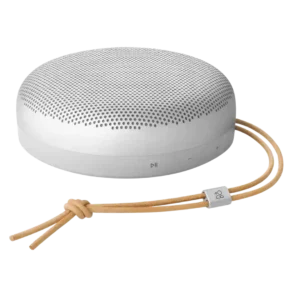
The leather strap looks and feels premium and makes carrying or hanging the speaker easy.
P2
Product 2: Soundcore Boom 2 Plus Portable...
4.6
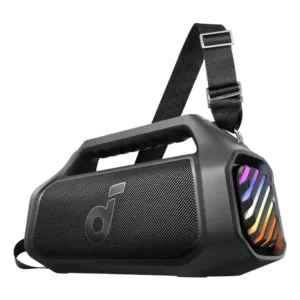
Handle and strap quality is consistently positive. Reviewers praise the molded or grippy handle, included shoulder strap, and general carry convenience for an eight-pound-plus speaker.
Inter-speaker connectivity
P1Product 1: Bang & Olufsen Beosound A1...
No score yet
P2
Product 2: Soundcore Boom 2 Plus Portable...
4.3
Inter-speaker connectivity is well documented through PartyCast 2.0 and TWS references. Most reviews discuss the feature as supported; a few did not test it, while one YouTube review reports reliable multi-speaker use.
Latency with TV (lip sync)
P1Product 1: Bang & Olufsen Beosound A1...
No score yet
P2
Product 2: Soundcore Boom 2 Plus Portable...
4.4
Latency evidence is limited but favorable. Reviewers mention low or acceptable Bluetooth lag, including use for movie audio behind a tablet or laptop.
LED lighting effects
P1Product 1: Bang & Olufsen Beosound A1...
No score yet
P2
Product 2: Soundcore Boom 2 Plus Portable...
4.2
LED lighting is widely discussed and generally considered fun, customizable, and party-friendly. A few reviewers call it gimmicky or poorly synced, so the score varies by review.
Lighting effects
P1Product 1: Bang & Olufsen Beosound A1...
No score yet
P2
Product 2: Soundcore Boom 2 Plus Portable...
4.3
Lighting effects are a visible differentiator, with multiple presets, custom colors, and beat-sync behavior. Reception is positive overall, though some reviewers view the feature as decorative rather than essential.
Loudness / maximum volume
P1
Product 1: Bang & Olufsen Beosound A1...
4.1
It gets impressively loud for a compact speaker and can fill a room or hotel space, but it is not the brute-force outdoor party option and some reviewers wanted more outright volume for the price.
P2
Product 2: Soundcore Boom 2 Plus Portable...
4.8
Maximum volume is a major strength. Across written and video reviews, the Boom 2 Plus is described as very loud, outdoor-capable, and able to fill rooms or parties with strong bass-backed output.
Low-volume performance
P1Product 1: Bang & Olufsen Beosound A1...
No score yet
P2
Product 2: Soundcore Boom 2 Plus Portable...
4.2
Low-volume evidence is limited but positive where mentioned. Reviewers note that bass can still be felt at lower levels and that the speaker can work at reasonable indoor volumes, though its main purpose remains loud party playback.
Microphone
P1Product 1: Bang & Olufsen Beosound A1...
No score yet
P2
Product 2: Soundcore Boom 2 Plus Portable...
2.5
Microphone evidence is contradictory. Some reviews say there is no microphone or no call support, while SoundGuys reports a built-in microphone with decent clarity, so the overall support is mixed.
Multi-speaker pairing reliability
P1
Product 1: Bang & Olufsen Beosound A1...
4.6
Stereo pairing is a genuine strength. Reviews say it is easy to set up and useful in practice, including pairing with a 2nd-gen A1 in several cases.
P2
Product 2: Soundcore Boom 2 Plus Portable...
4.3
Multi-speaker pairing is repeatedly supported through PartyCast 2.0 and TWS references. The feature promises large Soundcore speaker groups or stereo pairing, but many reviews describe it rather than fully testing reliability.
Multipoint connectivity
P1
Product 1: Bang & Olufsen Beosound A1...
4.7
Multipoint support is a real plus and reviewers found switching between two devices simple and reliable.
P2
Product 2: Soundcore Boom 2 Plus Portable...
4.0
Multipoint evidence is mixed. PCMag and some video reviews report pairing with two devices, while Sound & Vision says it cannot pair more than one phone.
Omnidirectional sound
P1
Product 1: Bang & Olufsen Beosound A1...
4.6
Sound disperses broadly and works well for room or table listening, though not every reviewer agrees it is truly 360-degree audio.
P2Product 2: Soundcore Boom 2 Plus Portable...
No score yetOn-device controls
P1Product 1: Bang & Olufsen Beosound A1...
No score yet
P2
Product 2: Soundcore Boom 2 Plus Portable...
4.5
On-device controls are strong. Reviewers highlight physical buttons for playback, volume, Bluetooth, lights, PartyCast, and BassUp, reducing the need to reach for the app for common functions.
Power bank function
P1Product 1: Bang & Olufsen Beosound A1...
No score yet
P2
Product 2: Soundcore Boom 2 Plus Portable...
4.6
Power-bank functionality is consistently praised. Reviews mention USB-C device charging, phone top-ups, and 30W power delivery as useful for long outdoor sessions.
Price / value for money
P1Product 1: Bang & Olufsen Beosound A1...
No score yet
P2
Product 2: Soundcore Boom 2 Plus Portable...
4.5
Price and value are generally positive, especially around $249 or sale pricing. Some reviewers note stiff competition, but many describe it as strong value for loudness, bass, water resistance, and features.
Privacy and data
P1Product 1: Bang & Olufsen Beosound A1...
No score yet
P2
Product 2: Soundcore Boom 2 Plus Portable...
4.6
Privacy and data evidence is minimal but favorable where discussed: one review praises the app for not requiring an email account. The reviews do not provide deeper privacy analysis.
Setup simplicity
P1
Product 1: Bang & Olufsen Beosound A1...
4.6
Pairing and setup are straightforward, helped by Fast Pair or Swift Pair support and a clean companion app.
P2
Product 2: Soundcore Boom 2 Plus Portable...
4.8
Setup is consistently described as simple and fast, with easy Bluetooth pairing and app onboarding. Reviewers generally characterize first use as intuitive.
Smart assistant integration (Alexa
P1
Product 1: Bang & Olufsen Beosound A1...
1.5
Gen 3 drops Alexa entirely, which reduces smart-speaker appeal versus Gen 2, even if several reviewers said they did not miss it.
P2
Product 2: Soundcore Boom 2 Plus Portable...
1.5
Smart assistant integration appears weak or absent in the available reviews. The clearest evidence says there is no microphone for calls or voice assistant support.
Speakerphone quality
P1
Product 1: Bang & Olufsen Beosound A1...
4.5
Speakerphone performance is generally good, with clear calls and solid voice pickup, though some reviewers heard slightly processed edges to voices.
P2
Product 2: Soundcore Boom 2 Plus Portable...
2.3
Speakerphone evidence is inconsistent. Some reviewers say the Boom 2 Plus lacks speakerphone or microphone support, while one reports usable call clarity through a built-in microphone.
Status indicators
P1
Product 1: Bang & Olufsen Beosound A1...
3.8
The status LEDs work, but they are fairly subtle, and a couple of reviewers wanted them larger or more obvious.
P2
Product 2: Soundcore Boom 2 Plus Portable...
3.3
Status indication is only adequate. Reviewers note app battery readouts and a low-battery red light, but one specifically criticizes the lack of a physical battery-level indicator.
Stereo imaging accuracy
P1Product 1: Bang & Olufsen Beosound A1...
No score yet
P2
Product 2: Soundcore Boom 2 Plus Portable...
4.3
Stereo imaging evidence is modest. Reviewers note stereo output, soundstage size, and TWS pairing potential, but the product is still reviewed mainly as a loud boombox rather than an imaging-focused speaker.
Subwoofer
P1Product 1: Bang & Olufsen Beosound A1...
No score yet
P2
Product 2: Soundcore Boom 2 Plus Portable...
4.6
Low-end hardware is a strength. Reviewers cite dual woofers, built-in subwoofers, passive radiators, and deep 40Hz bass, all reinforcing its bass-first party role.
Sustainability
P1
Product 1: Bang & Olufsen Beosound A1...
4.9
Sustainability stands out for the category thanks to repairability, a replaceable battery and Cradle to Cradle certification.
P2Product 2: Soundcore Boom 2 Plus Portable...
No score yetUSB-C charging
P1Product 1: Bang & Olufsen Beosound A1...
No score yet
P2
Product 2: Soundcore Boom 2 Plus Portable...
4.5
USB-C charging is consistently supported, with USB-C-to-USB-C cables, fast charging, and a port that can also power external devices.
Value for money
P1
Product 1: Bang & Olufsen Beosound A1...
3.6
Value for money is the most debated part of the A1 3rd Gen. Many think the sound, materials and longevity justify the premium, but value-minded reviewers still see better sound-per-dollar from cheaper JBL and other larger rivals.
P2
Product 2: Soundcore Boom 2 Plus Portable...
4.3
Value-for-money evidence is positive overall, especially when reviewers compare loudness and feature count against more expensive speakers. A few caution that rivals may offer better protection or bass for slightly more money.
Voice assistant responsiveness
P1Product 1: Bang & Olufsen Beosound A1...
No score yet
P2
Product 2: Soundcore Boom 2 Plus Portable...
1.5
Voice-assistant responsiveness is not a strength because the clearest direct evidence says there is no voice-assistant microphone support. No review provides positive voice-assistant performance evidence for the Boom 2 Plus.
Voice clarity
P1Product 1: Bang & Olufsen Beosound A1...
No score yet
P2
Product 2: Soundcore Boom 2 Plus Portable...
4.0
Voice clarity is generally acceptable but not the product’s focus. Reviewers mention clear vocals in some tracks and podcasts, while others report muffled vocals or reduced midrange detail when bass dominates.
Water resistance rating
P1
Product 1: Bang & Olufsen Beosound A1...
4.8
Its IP67 rating is consistently treated as trustworthy for poolside, shower and beach use, and several reviewers mention quick dunk-style tests without issue.
P2
Product 2: Soundcore Boom 2 Plus Portable...
5.0
Water resistance is one of the best-supported strengths. Reviews repeatedly cite IPX7 protection, successful splashing, rinsing, submersion, pool use, and wet outdoor operation.
Weight convenience
P1
Product 1: Bang & Olufsen Beosound A1...
4.3
It is portable enough for bags and travel, with reassuring heft, but it is not featherlight or pocket-sized.
P2
Product 2: Soundcore Boom 2 Plus Portable...
3.9
Weight convenience is mixed. Reviewers appreciate the handle and strap and often call it manageable for its output, but its size and weight make it less suitable for backpacks, planes, or long walks.
Wired input
P1
Product 1: Bang & Olufsen Beosound A1...
4.7
USB-C works for both charging and wired audio, giving the A1 more flexibility than many Bluetooth-only rivals. USB-C wired playback is more than a checkbox feature. Reviews that tried it reported extra clarity, punch and definition compared with Bluetooth.
P2
Product 2: Soundcore Boom 2 Plus Portable...
4.5
Wired input support is clearly documented through the 3.5mm auxiliary input. Reviewers mention aux playback for parties, DJ/projector use, and wired listening.