App reliability is generally reported as solid for EQ and firmware updates, but a few reviewers mention sluggish performance or account/login friction.
Battery life lands between acceptable and very good, with several reports near the 20-hour claim and others closer to 16 to 17 hours in real use.
Most reviews cite a 24-hour rating at moderate volume; real-world results range from roughly 10–13 hours at loud levels with bass boost to around 20–22 hours at saner volume settings.
Codec support is a point of disagreement in the reviews, ranging from claims of LDAC and aptX-class support to complaints about only SBC and AAC, so expectations here should stay cautious.
Codec support is basic (commonly AAC and SBC), with multiple reviewers calling out the lack of higher-end codecs.
Most reports describe stable day-to-day playback once connected, though one review noted frustrating pairing behavior with a Pixel phone.
Bluetooth stability is usually praised as rock-solid, with only occasional hiccups reported during early multipoint pairing or before a reset.
Wireless reach is a recurring strength, with cited ranges up to 165 feet and at least one real-world test holding through multiple walls.
Range is strong for a small speaker; reports span roughly 60 feet indoors through walls to well over 100 feet outdoors in open space.
Fast charging is a consistent plus, with repeated claims of about two hours for a full charge and roughly four hours of playback from a short top-up.
Charging is commonly reported at about four hours from empty via the rear USB-C port.
When two speakers are paired, reviewers describe the overall presentation as well integrated, natural, and musically satisfying despite the compact scale.
When dialed in, the speaker presents a cohesive, full-bodied sound, but several reviews note that genre-hopping often requires changing EQ to keep tracks sounding their best.
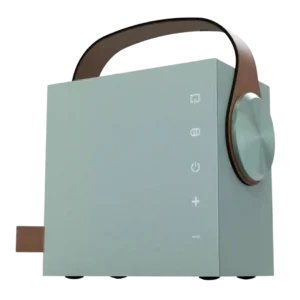
Physical buttons feel solid and tactile when pressed, even if the hidden-through-grille layout is not always intuitive.
Button responsiveness is mostly good (including single-press power), but a couple of reviews mention needing the app to fully power down or that rapid repeated presses feel less satisfying.
Design is one of the strongest areas, with near-universal praise for the finish quality, compact hi-fi look, and broad choice of colors.
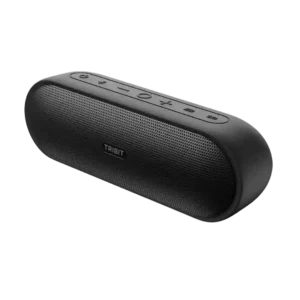
The design is generally described as minimalist and conservative, often limited to black, with a rubberized body and metal grille.
Detail is decent to strong for the class, with stereo use in particular revealing subtle textures, though bass-heavy tuning can obscure finer information on some material.
Detail retrieval is commonly considered strong for the price, with reviewers noting it retains clarity even when you are off-axis.
Limited evidence suggests TV dialogue is clear in small spaces, particularly over AUX, but this is not the speaker's primary use case.
Single-speaker listening can sound strained or boomy at louder levels in some reviews, but others say it stays composed better than expected, especially in stereo or at moderate distances.
High-volume distortion reports vary: some hear audible strain or driver overdrive near the top of the dial, while others find it controlled; most agree it sounds best below max.
Build durability feedback is mixed: some reviewers report it shrugging off bumps and drops, while others say it feels less rugged than adventure-focused rivals.
Dust protection is a weak spot: multiple reviews emphasize it is not dustproof, so it is less ideal for beach sand or gritty trails.
Dynamic punch is one of the speaker's highlights, with multiple reviews praising its ability to sound energetic and expressive for such a small cabinet.
Dynamic punch is a strength at normal listening levels, though pushing volume and bass boost hard can reduce headroom and introduce strain.
Lack of app-based EQ is a recurring complaint, leaving listeners stuck with Morel's fixed tuning unless they adjust sound on the source device.
EQ flexibility is a core differentiator: hardware presets plus app-based multi-band EQ and saved custom profiles are frequently described as key to getting the best sound.
A few sources report it can float, but visibility and stability in water are not great, so retrieval can be tricky.
Consensus is a warm, bass-forward tuning with crisp highs and solid mids; some reviewers find it balanced and engaging, while others think the low end overpowers subtler detail.
Tonal balance is described as energetic and bass-capable, but not perfectly neutral; treble can sound thin or sharp on some tracks and sub-bass is limited, making EQ adjustments beneficial.
The faux-leather handle is sturdy and useful for carrying, though some reviewers think it dominates the look or leaves unattractive holes if removed.
The strap/lanyard is convenient but divisive: some like it for carrying, others call it flimsy for the speaker’s weight.
It can work as a small-room TV speaker, especially via AUX or as a stereo pair, but it lacks the connectivity and low-latency polish of purpose-built TV audio gear.
Inter-speaker connectivity (stereo pairing/party mode) is widely praised for being quick to link and noticeably improving scale and soundstage.
Latency is typically acceptable for casual video; the AUX input is mentioned as the better option when you need lower-latency playback.
Reviews consistently say Biggie plays surprisingly loud for its size and can fill rooms or patios, though that output often comes with extra bass weight rather than pure refinement.
Nearly every review calls out surprisingly high max volume for the size, easily filling small-to-medium rooms and working well outdoors.
At least one review found the lowest volume step still too loud and bass-heavy for discreet listening.
Low-volume clarity is generally good, and voice-focused modes (like Audiobook) are frequently cited as helpful for podcasts and spoken content.
Stereo and TWS pairing are described as easy and transformative when two units are used, with several reviewers strongly preferring the pair over a single speaker.
Pairing reliability is generally strong, but most sources note practical limits: party/stereo functionality is typically capped at two speakers.
Multipoint support is a useful perk, though some note you may need to pause on one device before switching or reset once to stabilize it.
The control scheme is functional but divisive: buttons themselves feel decent, yet hiding them behind the grille and using awkward battery shortcuts hurts usability.
On-device controls cover power, pairing, volume, playback, EQ, and speaker linking; most find them intuitive, with a few ergonomic complaints.
The USB-C port is presented as capable of topping up a phone, but one reviewer could not get it working reliably, so this feature looks inconsistent.
Simple Bluetooth and AUX operation is a clear strength; setup is generally fast and low-friction, and stereo pairing is described as straightforward.
Setup is typically described as straightforward with quick pairing and simple day-to-day use.
Biggie deliberately keeps features minimal, which some reviewers enjoy for the simplicity and others see as a major weakness next to smarter rivals.
Speakerphone/mic quality is described as usable but not a standout; fine for quick calls, less ideal for privacy or noisy environments.
The LED battery indication is widely criticized as imprecise, awkward to activate, and occasionally glitchy.
Small indicator lights help confirm EQ modes and button states, though they are not as prominent as backlit controls.
One Biggie is mono, but paired units earn strong marks for precise placement, separation, and a surprisingly convincing stereo spread.
Stereo imaging improves markedly when you use two speakers in stereo mode; a single unit has limited separation due to closely spaced drivers.
USB-C charging is standard and generally praised for convenience, though it is used for power rather than digital audio input.
USB-C charging is standard; several reviewers liked the modern port but noted the included cable is often USB-A to USB-C rather than USB-C to USB-C.
Value depends on priorities: supporters see premium build and sound as worth $299, while critics think cheaper rivals deliver better portability and features.
Across sources, the value proposition is a major strength, often framed as JBL Flip-style performance for significantly less money.
Reviews that focused on vocals describe a clear vocal band with good breath detail, especially when two speakers are used.
Reviewers repeatedly note there is no meaningful water protection, making the speaker a poor fit for poolside, beach, or rough outdoor use.
IPX7 water resistance is a consistent highlight, making it well suited to poolside, shower, and rainy-day use when the port cover is closed.
At about 5.7 pounds, Biggie is portable in theory but widely seen as better suited to desk, shelf, or patio duty than true travel use.
Portability is good for the class, but at roughly 0.8 kg it has noticeable heft compared with lighter pocket speakers.
The 3.5 mm AUX input is consistently noted as a welcome fallback for wired playback, even if it does not materially upgrade sound quality.
A 3.5mm AUX input is frequently noted, adding a reliable wired backup and the option for lower-latency audio. Wired playback is mainly framed as practical: it works as a backup connection and can reduce lip-sync issues compared with Bluetooth.