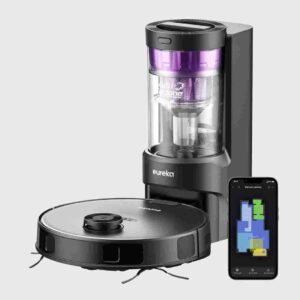
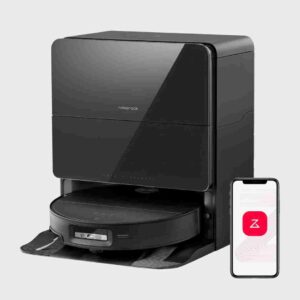
Eureka e10s Robot Vacuum
Where It Has the Edge
No clear scored advantage over the other product.
No clear scored advantage over the other product.
AdaptiLift is one of the defining features: it can raise the chassis to clear thresholds and help traverse thicker rugs, and some reviews describe adaptive lifting at different points for awkward obstacles. It also ties into improved reach and reduced stuck events.
Fit and finish are often called sleek and premium, and the dock design is frequently described as unusually low and tidy for a full-feature base station. Some note fingerprint-prone surfaces, but overall aesthetics score high.
Smart features cover the basics: scheduling, room selection, no-go zones, and carpet mode; AI object recognition is not a strength, and some users note occasional app quirks.
Smart features are a centerpiece, including advanced scheduling, room-by-room automation, object recognition, and configurable mop/vac sequences. Several reviews also mention helpful app intelligence like stuck-spot logging and smart-plan cleaning adjustments.
Transitions over rugs are usually manageable and carpet mode helps; thick fringes, edges, and clutter still increase the chance of snags or stalls.
Rug handling is generally confident, including the ability to lift the mop or avoid wet contact by changing mop workflows. A few reviewers still recommend tuning carpet/rug settings to prevent dampness in homes with many area rugs.
Setup is usually quick: unbox, charge, and connect the app; occasional friction comes from Wi-Fi pairing or dialing in maps and no-go zones.
Setup is repeatedly described as straightforward: charge, connect in-app, and run a quick mapping pass. Dock assembly and filling tanks are treated as simple, with most friction coming later from fine-tuning no-go zones for tricky furniture.
Battery life is commonly praised for the class, with long runs and reliable recharging; performance varies by suction mode and carpet use.
Battery life is generally viewed as sufficient for a flagship robot, with one lab-style test landing around two hours and other reviews reporting smooth recharge-and-resume behavior. Actual runtime depends on suction level, mopping intensity, and home size.
Bagless self-empty is a major plus, with an easy-to-dump canister and no recurring bag purchases; capacity is fine for routine upkeep but still benefits from regular emptying and cleaning.
Dust collection is dock-based with bag use mentioned in several reviews, emphasizing cleaner emptying and longer intervals between disposal. The bag-and-bin approach is positioned as low-mess and hands-off.
Build quality feels decent for a budget robot with a compact dock and generally solid plastics; not everyone expects years of abuse, but it does not come across as flimsy.
High-pile and shag carpet performance is limited; when discussed, reviewers treat it as a weak spot for this budget robot.
High-pile carpet performance is better than average for a hybrid robot, aided by AdaptiLift to keep the robot moving and cleaning. Some reviews still note slower run times on carpet compared with the quickest competitors.
Low-pile rugs and basic carpet maintenance are usually fine, but it is not a deep-clean replacement.
Low-pile carpet pickup is typically strong and reliable, with good traction and coverage. It performs best when paired with appropriate power levels and when mop detaching or lifting is used to keep carpets dry.
On medium-pile carpet, reviews generally indicate strong pickup paired with stable navigation. Performance is helped by high suction and adaptive behaviors, though some testing suggests cleaning runs can take longer than a few competitors.
When mentioned, child lock is treated as a useful safety and accidental-start feature, but it is not a major buying driver.
Most reviewers report normal operation without frequent clogs, though hair and heavier debris still require periodic brush and channel cleaning.
In comparisons, it often punches above its price on mapping and everyday pickup, but falls behind pricier models on avoidance, deep carpet, and more polished software.
Comparisons are frequent: Saros 10 is often positioned as stronger at vacuuming and scrubbing pressure than some rivals, while competitors can beat it on obstacle avoidance or mopping style (for example, roller-mop or dual-spinning designs). Saros 10R is repeatedly framed as the better avoider, while Saros 10 can leave floors a bit cleaner in certain dried-mess scenarios.
Controls are straightforward through the app and onboard buttons; the UI is functional rather than polished, and a few users mention quirks when maps or settings reset.
The UI experience is widely praised through the Roborock app, which centralizes maps, settings, and cleaning plans in a clear way. Reviewers also mention useful visualizations like obstacle markers and stuck-location suggestions.
Corner reach is average for a single side brush; it cleans along edges reasonably but may leave tight corners untouched.
Corner performance is improved by extending tools and side mopping coverage, and multiple reviews specifically mention better reach into corners than older designs. It is not perfect in every layout, but generally performs well along tight edges.
A light or illumination feature is mentioned as helpful for spotting dust in darker corners, improving perceived coverage in low-lit rooms. It is a nice-to-have rather than a core cleaning driver.
Docking and auto-empty are generally convenient, though some mention occasional docking misses or emptying quirks; the bagless design is appreciated but noisy.
Dock reliability and automation are consistently highlighted: auto-emptying, heated pad washing, warm-air drying, detergent dosing, and base self-cleaning reduce manual maintenance. The dock is often described as both capable and unusually space-conscious for the feature set.
For tougher marks, results are mixed but often strong when settings are maximized: some reviews credit stain-focused behaviors and added pressure for better scrubbing. At least one stress test found it can smear sticky spills, so performance depends heavily on mess type.
Day-to-day use is easy once mapped thanks to simple scheduling and hands-off emptying; occasional app/map hiccups are the main friction.
Edge work is frequently called out as a strength, driven by an extending side-brush approach and side mopping coverage along walls. Owners who care about baseboards and perimeter dust tend to be satisfied.
Edge tracking is generally competent with decent wall and baseboard coverage, though not as tight or consistent as premium bots.
Bagless emptying reduces day-to-day mess, but auto-empty and dumping the canister can still create a dust plume for some users.
Filtration is basic but serviceable with routine filter cleaning; bagless emptying can kick up some dust if you are sensitive.
Hair pickup on carpet is adequate for maintenance, but long hair and dense pet hair can require follow-up passes.
Carpet hair pickup is generally strong, especially for pet hair, and improves further when paired with higher suction levels. It can still be limited by debris type and run time compared with specialized deep-clean passes.
Hair pickup on hard floors is a consistent strength, especially in pet homes. Reviewers highlight fewer hair clumps left behind and less manual post-cleaning.
Hair-wrap resistance is mixed: some tests show partial tangling (often on bearings or ends) even when pickup is good, so regular brush checks are part of ownership.
Tangle resistance is one of the most praised elements, with the split-brush design frequently credited for channeling hair into the suction path and reducing wrap at the ends. A few users still mention occasional tangles with long hair plus certain carpet fabrics, but overall performance is above average.
Fine dust pickup is generally acceptable for routine cleaning, though some tests suggest it may take an extra pass for powdery debris.
Fine dust pickup on hard floors is consistently described as excellent, helped by strong suction and efficient pathing. Homes with visible dust and pet dander report noticeably cleaner floors.
Does well with everyday crumbs and larger debris in many tests, but can scatter or leave some heavier items like litter depending on settings and brush contact.
Large debris intake on hard floors is generally strong, with reviewers citing confident pickup of everyday crumbs and heavier pet-hair clumps. Performance holds up well in mixed runs when the robot is not over-wet from mopping.
For the budget tier, the bagless self-empty dock and mop-lift feature feel unusually advanced even if the rest of the system stays fairly simple.
Innovation is mainly tied to the retracting navigation module plus an adaptive lifting chassis and upgraded sonic mopping. Reviews frame these as practical innovations that expand where the robot can go and how hands-off the cleaning loop can be.
Low-profile claims are helped by a compact body, but the LiDAR turret adds height; it fits under many pieces, yet some low-clearance furniture can block it.
Low-profile design is a headline feature, with multiple reviews citing an ultra-slim height enabled by the retracting navigation module. This improves access under beds and cabinets and is one of the clearest differentiators versus bulkier flagships.
Expect standard upkeep: brush and roller cleaning, filter maintenance, and periodic dock/bin cleaning; hair tangles can make maintenance more frequent.
LiDAR mapping is a highlight, with fast mapping and efficient room coverage; a few reviewers warn that moving the robot or errors can cause map confusion or resets.
Mapping and pathing are widely praised as fast and accurate, with efficient room coverage and solid navigation logic. However, at least one timed test found slower completion on some carpet routines compared with specific rivals, even when pickup was strong.
Mop lift is a standout feature at this price, raising the pad slightly over low-pile rugs to reduce wetting while vacuuming.
Carpet protection is a strength: the mop can lift over carpet, and several reviews note workflows that detach or leave the mop bracket at the dock for dry vacuuming. This helps prevent damp pad drag and improves mixed-floor routines.
Mopping is best for light everyday refreshes with limited scrubbing and stain removal; reviewers expecting true mop results often come away disappointed.
Mopping performance is the most polarized area: many reviews praise everyday cleaning, configurable water levels, and better results on dried messes when settings are maxed. However, at least one lab-style scrubbing test found it underwhelming versus roller or dual-spinning systems, with smearing on sticky spills.
Robot running noise is usually described as moderate-to-quiet, but the self-empty cycle is widely called loud and attention-grabbing.
Noise is generally rated as controlled for a flagship robot, with at least one review noting extremely quiet operation in mop-only mode. Dock cycles can still be noticeable, but in-room cleaning noise is usually described as manageable.
Obstacle avoidance is basic and often described as bumper-based; cords, small items, and pet waste are common failure points.
Obstacle avoidance is competent but not uniformly best-in-class. Some reviews praise strong recognition and real-world avoidance, while others report patchy performance, occasional bumping or pushing items, and weaker results on cluttered carpets compared with top rivals.
Overall, it is a good budget mapped cleaner with a convenient bagless dock, held back by basic obstacle avoidance and only light-duty mopping.
Generally handles pet fur and dander on hard floors and rugs, but is not a safe choice for homes with pet mess risks; several reviewers note litter or larger pet debris can be left behind or pushed around.
Pet-focused performance is a highlight: multiple reviews mention strong pet-hair pickup and an anti-tangle brush design that reduces hair wrapping, making it well-suited to homes with shedding pets.
Most reviews frame the E10s as strong value in the budget class thanks to LiDAR mapping and a self-empty dock; value drops if you expect premium avoidance or strong mopping.
Value is the main friction point: the Saros 10 is firmly priced as a premium flagship. Several reviews say the cost makes sense only if you will use the hands-off dock and low-profile reach, while others point to cheaper rivals with stronger mopping or avoidance.
Privacy-related notes center on the camera and remote-view features, including an audible announcement when the camera is active. Reviewers generally present this as a thoughtful safeguard rather than a full privacy control suite.
Many reviews cite long runtimes (sometimes around 180 minutes claimed), helping it finish larger areas in fewer sessions. In higher suction modes, runtime drops as expected; most treat turbo as a spot tool rather than an all-home default.
Measured runtime in at least one timed test was about 118 minutes, with runtime varying widely by power level and mopping intensity. Recharge-and-resume helps cover larger homes over multiple passes.
Self-cleaning behavior is a major part of the ownership story: the dock can wash mop pads with heated water, dry them with warm air, and clean the wash base. Most reviews treat this as a big win, though one stress test noted pad washing can struggle with very sticky residues.
Software features are framed as a long-term strength, including over-the-air updates that can improve AI behaviors and navigation features over time. Reviewers also highlight advanced scheduling and smart-plan automation.
The dock-based detergent and solution system is a common highlight, with reviews mentioning automatic detergent dosing and a dedicated reservoir. It reduces manual mixing and helps keep mopping more consistent across runs.
Mopping can leave light streaking or uneven wetness on hard floors, reinforcing that it is a light-mop system.
Residue control is mixed: light maintenance mopping can look clean and streak-free, but at least one stress test found smearing and sticky transfer on tougher spills. Results improve with proper water settings and avoiding combo runs on messy debris.
Getting stuck is a recurring theme around cords, clutter, and tight furniture; virtual walls help, but it still benefits from some pre-tidying.
It avoids getting trapped better than many robots thanks to low-profile navigation and chassis adjustments, but it is not immune. Multiple reviewers mention occasional hang-ups under certain couches or cluttered areas, and recommend using app no-go zones where it repeats.
Suction is generally solid for the price (often cited around 4,000Pa), with acceptable day-to-day pickup; some tests note it can need extra passes on heavier debris or deeper carpet.
Vacuuming is repeatedly described as flagship-level, with very high suction specs and strong real-world pickup on pet hair, fine dust, and larger debris. A lab-style review called suction best-in-class, while others note it stays competitive across mixed flooring.
Works well in apartments and smaller layouts thanks to mapping and a compact dock; larger, cluttered homes may see more rescues and refills.
Reliability feedback is mixed: many units run fine once set up, but there are reports of map resets, getting stuck, and occasional defect or return experiences.
Can reach under many couches and beds, but the LiDAR turret means clearance matters and some low furniture may be off-limits.
Under-furniture reach is a standout advantage, repeatedly credited to the retractable navigation module and low chassis height. That said, some owners report it can still get caught under certain couches with tricky geometry, making no-go zones helpful.
Dock water management is a major convenience, with reviews citing dual tanks (clean and dirty) and automated washing workflows. Tank sizes vary by source, but the overall theme is fewer manual mop tasks.