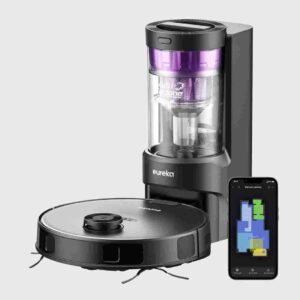

Eureka e10s Robot Vacuum
Where It Has the Edge
- Runtime is rated 3.8 while the other product has no score yet. Many reviews cite long runtimes (sometimes around 180 minutes claimed), helping it finish larger areas in fewer sessions....
Reviews report a complete kit—dock/ramp, side brush, mop pads, a cleaning brush/tool, manuals, and (in some cases) spare dust bags—so it’s ready to run out of the box.
The square-ish robot and two-tone/shiny-matte styling get favorable comments, and reviewers like the LED accents. The base station looks modern but is fairly large and visually prominent.
Smart features cover the basics: scheduling, room selection, no-go zones, and carpet mode; AI object recognition is not a strength, and some users note occasional app quirks.
The app supports mapping, room/zone cleaning, schedules, no-go/no-mop zones, multi-floor maps, and smart behaviors like stain/spot cleaning. Reviewers praise the feature depth and automation, though it can feel like “a lot” at first.
Transitions over rugs are usually manageable and carpet mode helps; thick fringes, edges, and clutter still increase the chance of snags or stalls.
The robot transitions well onto rugs, can lift the mop to keep fabrics dry, and is reported to pull debris from rug fibers effectively in test scenarios.
Setup is usually quick: unbox, charge, and connect the app; occasional friction comes from Wi-Fi pairing or dialing in maps and no-go zones.
Setup is generally described as straightforward: attach the ramp, fill tanks, dock the robot, pair it in the app, and let it map. Printed quick-start guides are repeatedly praised, though the number of in-app options can slow first-time configuration.
Battery life is commonly praised for the class, with long runs and reliable recharging; performance varies by suction mode and carpet use.
Battery is often cited around 5,200 mAh with auto recharge-and-resume. Runtime varies widely by mode (some note ~90–120 minutes typical, others quote much longer), but most reviewers find it adequate once recharge/resume is enabled.
Bagless self-empty is a major plus, with an easy-to-dump canister and no recurring bag purchases; capacity is fine for routine upkeep but still benefits from regular emptying and cleaning.
The robot collects debris in an onboard bin and auto-empties into a disposable bag in the dock. Bags are described as large and easy to access behind a front panel, supporting multi-week intervals between changes.
Build quality feels decent for a budget robot with a compact dock and generally solid plastics; not everyone expects years of abuse, but it does not come across as flimsy.
Perceived build is solid for the price—often positioned above budget models and closer to mid/high-end competitors. Long-term durability isn’t proven, but day-one fit/finish and component access (tray, tanks, bin) are well regarded.
High-pile and shag carpet performance is limited; when discussed, reviewers treat it as a weak spot for this budget robot.
It can clean thicker rugs, but very long fibers/threads (e.g., shag) can still snag and challenge the brush even with anti-tangle tools—expect more monitoring or extra passes on high-pile rugs.
Low-pile rugs and basic carpet maintenance are usually fine, but it is not a deep-clean replacement.
No summary yet.
When mentioned, child lock is treated as a useful safety and accidental-start feature, but it is not a major buying driver.
A child lock option (along with toggles like do-not-disturb) is available in the app, which reviewers appreciated for family homes.
Most reviewers report normal operation without frequent clogs, though hair and heavier debris still require periodic brush and channel cleaning.
No summary yet.
In comparisons, it often punches above its price on mapping and everyday pickup, but falls behind pricier models on avoidance, deep carpet, and more polished software.
Reviewers compare it favorably to older iRobot/entry models and say it competes with pricier flagships on suction and mopping. It’s generally viewed as a step below the very best in obstacle avoidance and some premium convenience features.
Controls are straightforward through the app and onboard buttons; the UI is functional rather than polished, and a few users mention quirks when maps or settings reset.
UI feedback is mixed: several reviewers find the app well-designed and easy, while at least one found certain layouts confusing despite being tech-savvy. Expect a learning curve if you plan to tweak every setting.
The dock includes built-in cable routing/wrap options that reviewers found convenient for a cleaner setup.
Corner reach is average for a single side brush; it cleans along edges reasonably but may leave tight corners untouched.
The robot’s shape and edge-focused mop extension help it reach corners better than many round bots, though some reviewers still wish for an extending side brush for even deeper corner reach.
Docking and auto-empty are generally convenient, though some mention occasional docking misses or emptying quirks; the bagless design is appreciated but noisy.
Docking and automatic emptying are widely seen as dependable, with the robot reliably returning for emptying and mop service. App settings let you tune emptying/washing frequency to match your routine.
The auto-empty cycle can be noisy on higher settings, but some reviewers highlight a quieter/“soft” emptying option that reduces sound at the cost of a longer cycle.
Reviews report good results on tougher or dried messes, helped by repeat passes, targeted spot cleaning, and hot-water mop-pad servicing through the dock.
Day-to-day use is easy once mapped thanks to simple scheduling and hands-off emptying; occasional app/map hiccups are the main friction.
Once mapped, day-to-day use is mostly press-and-go via presets and schedules. Minor friction points include one-time toggles for max modes/hair-cutting strength and the occasional need to do simple maintenance (tray rinse, pad swap).
No summary yet.
Edge tracking is generally competent with decent wall and baseboard coverage, though not as tight or consistent as premium bots.
Edge tracking is repeatedly described as very tight, with the extending mop pad keeping minimal distance from walls for more complete edge coverage.
Bagless emptying reduces day-to-day mess, but auto-empty and dumping the canister can still create a dust plume for some users.
Filtration is basic but serviceable with routine filter cleaning; bagless emptying can kick up some dust if you are sensitive.
Reviews note a HEPA-style filter plus mesh/foam elements that capture fine dust; filters can be tapped out and some parts rinsed, but they need periodic upkeep to stay effective.
Hair pickup on carpet is adequate for maintenance, but long hair and dense pet hair can require follow-up passes.
Hair-wrap resistance is mixed: some tests show partial tangling (often on bearings or ends) even when pickup is good, so regular brush checks are part of ownership.
FlexiRazor hair-cutting and comb detangling reduce wrap significantly and are often cited as best-in-class among comb-style systems. It’s not completely tangle-free with extremely long strands, and some “strong” settings aren’t always-on by default.
Fine dust pickup is generally acceptable for routine cleaning, though some tests suggest it may take an extra pass for powdery debris.
Reviews describe effective pickup of fine dust and dirt, aided by filtration that captures small particles. Routine filter care still matters for consistent fine-dust performance.
Does well with everyday crumbs and larger debris in many tests, but can scatter or leave some heavier items like litter depending on settings and brush contact.
Large debris (crumbs, cereal, pet food, small bits) is generally handled in one or a few passes, with smart behavior that helps avoid scattering and a strong suction/brush combo.
Front LEDs help the camera see in dim areas and are also called out as a nice design touch. Light toggles exist in the app on some builds.
For the budget tier, the bagless self-empty dock and mop-lift feature feel unusually advanced even if the rest of the system stays fairly simple.
Extending edge mop, hair-cutting detangling, and a wash/dry dock are cited as “flagship” innovations at a lower price tier. Missing features like detergent auto-dosing, extending side brush reach, or certain brush-lift systems keep it from being the most advanced option.
When run in quieter modes, reviewers describe it as household-friendly and less disruptive for families, though max-power vacuuming will still be audible.
Low-profile claims are helped by a compact body, but the LiDAR turret adds height; it fits under many pieces, yet some low-clearance furniture can block it.
Expect standard upkeep: brush and roller cleaning, filter maintenance, and periodic dock/bin cleaning; hair tangles can make maintenance more frequent.
The hands-free dock reduces daily chores (auto-empty, mop washing/drying), but you’ll still rinse the dock tray, replace bags, and occasionally swap/clean mop pads. Compared with the Pro Ultra, the Ultra is often noted as missing a truly self-cleaning dock tray and some fully-automated extras.
LiDAR mapping is a highlight, with fast mapping and efficient room coverage; a few reviewers warn that moving the robot or errors can cause map confusion or resets.
Mapping is frequently described as fast and accurate, with editable room divisions and multi-level support. Cleaning paths are generally systematic (back-and-forth/crisscross options) rather than random.
Mop lift is a standout feature at this price, raising the pad slightly over low-pile rugs to reduce wetting while vacuuming.
Auto mop lifting (often cited around ~12 mm) helps prevent wet carpets/rugs and enables seamless vacuum-then-mop workflows. Lift height is generally considered sufficient for common rugs and carpets.
Mopping is best for light everyday refreshes with limited scrubbing and stain removal; reviewers expecting true mop results often come away disappointed.
Two spinning pads with downward pressure create a scrubby mop action that reviewers say resembles “real mopping” more than basic drag pads. Returning to the dock to wash pads and focusing on stains improves consistency on mixed messes.
Robot running noise is usually described as moderate-to-quiet, but the self-empty cycle is widely called loud and attention-grabbing.
Noise impressions vary: some call it very quiet in normal use, while measured max-power runs are above average and not ideal for TV/nap time in the same room. Noise is highly mode-dependent.
Obstacle avoidance is basic and often described as bumper-based; cords, small items, and pet waste are common failure points.
Object recognition/avoidance is generally strong and can label common obstacles, but it’s not flawless—dark rooms and soft items like socks can still cause issues. Several reviewers say it’s good for the price but not quite top-tier.
Hot-air mop drying (and frequent pad washing) helps prevent mildew and “smelly mop” issues, which reviewers see as a hygiene advantage over simpler docks.
Overall, it is a good budget mapped cleaner with a convenient bagless dock, held back by basic obstacle avoidance and only light-duty mopping.
Unboxing impressions are positive, with organized packaging and clearly separated parts/literature.
Generally handles pet fur and dander on hard floors and rugs, but is not a safe choice for homes with pet mess risks; several reviewers note litter or larger pet debris can be left behind or pushed around.
Pet-focused touches include strong pet-hair handling, anti-tangle cutting, obstacle detection for toys, optional “pet mode” settings, and camera viewing for checking on pets.
Most reviews frame the E10s as strong value in the budget class thanks to LiDAR mapping and a self-empty dock; value drops if you expect premium avoidance or strong mopping.
Consistently framed as a strong value: many reviews call it one of the best feature-to-price options in the ~$600–$700 range, especially given hot-water mop washing and advanced edge mopping.
Remote video/patrol features are praised for utility, and some reviews mention privacy/security certification. Others still flag general concerns about any internet-connected camera, so comfort level and opting out of camera features matter.
Many reviews cite long runtimes (sometimes around 180 minutes claimed), helping it finish larger areas in fewer sessions. In higher suction modes, runtime drops as expected; most treat turbo as a spot tool rather than an all-home default.
Automated mop-pad washing with hot water and hot-air drying is consistently highlighted as a key convenience feature, keeping pads cleaner between runs and improving hygiene.
Firmware updates are available through the app. Reviewers note updates as a plus and hope they can refine obstacle avoidance and smart behaviors over time, but there’s no guarantee of major feature expansion.
Multiple reviews point out the lack of a detergent/solution tank or automatic dosing—most filling is water-only. Some also note limited fine-grain water-level controls for mopping compared with certain competitors.
Mopping can leave light streaking or uneven wetness on hard floors, reinforcing that it is a light-mop system.
Auto washing during/after jobs helps reduce dirty streaks on floors, but residue can accumulate on the dock tray and needs occasional rinsing to keep everything clean.
Getting stuck is a recurring theme around cords, clutter, and tight furniture; virtual walls help, but it still benefits from some pre-tidying.
It usually navigates cleanly, but at least one review reports occasional snagging on socks in dark rooms that requires intervention. No-go zones and better obstacle avoidance tuning can reduce interruptions.
Suction is generally solid for the price (often cited around 4,000Pa), with acceptable day-to-day pickup; some tests note it can need extra passes on heavier debris or deeper carpet.
The headline 19,000 Pa suction is repeatedly praised, and reviewers report strong pickup across debris sizes. A few notes suggest performance gains don’t scale linearly with the spec and that non-max modes can feel less punchy than some rivals.
Works well in apartments and smaller layouts thanks to mapping and a compact dock; larger, cluttered homes may see more rescues and refills.
Reliability feedback is mixed: many units run fine once set up, but there are reports of map resets, getting stuck, and occasional defect or return experiences.
Can reach under many couches and beds, but the LiDAR turret means clearance matters and some low furniture may be off-limits.
Despite being slightly taller than some newer low-profile bots, reviewers report it routinely fits under beds, cabinets, and low overhangs to reach debris others miss.
The dock’s separate clean/dirty tanks are large, lift out easily, and have clear handles/indicators. Capacity is frequently described as enough for multi-day to multi-week mopping, depending on how often you run it.