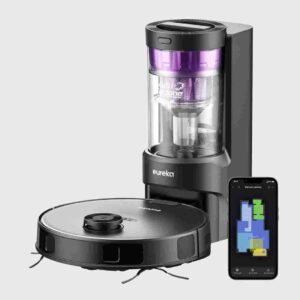
Eureka e10s Robot Vacuum
Where It Has the Edge
- Runtime is rated 3.8 while the other product has no score yet. Many reviews cite long runtimes (sometimes around 180 minutes claimed), helping it finish larger areas in fewer sessions....
Included essentials (spare bag/manuals/mop cloth) are generally described as sufficient to get started immediately. Some wish for more extras, but most consider the in-box kit practical rather than lavish.
Design is repeatedly described as sleek and modern, with finishes that blend well in living spaces. Some owners note glossy surfaces can show scratches over time, depending on use and contact with furniture.
Smart features cover the basics: scheduling, room selection, no-go zones, and carpet mode; AI object recognition is not a strength, and some users note occasional app quirks.
The app and automation features are repeatedly cited as a core strength: scheduling, room/zone routines, no-go zones, and customization are robust. Voice-assistant integration and detailed controls improve hands-off ownership, though some wish for more granular dock behavior options.
Transitions over rugs are usually manageable and carpet mode helps; thick fringes, edges, and clutter still increase the chance of snags or stalls.
Area rugs are handled well thanks to carpet detection and automatic power adjustments, and the mop-lift helps avoid wetting rugs in mixed runs. Some advise refining carpet boundaries in-app for best results.
Setup is usually quick: unbox, charge, and connect the app; occasional friction comes from Wi-Fi pairing or dialing in maps and no-go zones.
Setup is widely described as quick and straightforward, often guided smoothly by the app. Dock assembly is simple (screws/driver included) and initial mapping tends to be fast.
Battery life is commonly praised for the class, with long runs and reliable recharging; performance varies by suction mode and carpet use.
Battery life is generally strong for the class, with long runs possible in quieter/low modes and smart recharge-and-resume behavior when needed. High-power modes shorten runtime, but coverage remains competitive.
Bagless self-empty is a major plus, with an easy-to-dump canister and no recurring bag purchases; capacity is fine for routine upkeep but still benefits from regular emptying and cleaning.
The bin/bag system is a convenience win: the dock bag can last around seven weeks to up to roughly two months in lighter use. A few point out the onboard dustbin is relatively small, but that’s typical for a self-emptying model.
Build quality feels decent for a budget robot with a compact dock and generally solid plastics; not everyone expects years of abuse, but it does not come across as flimsy.
Build quality is frequently praised, with tight fit/finish and a sturdy overall feel. Testers describe materials and assembly as top-notch for the category.
High-pile and shag carpet performance is limited; when discussed, reviewers treat it as a weak spot for this budget robot.
High-pile carpet performance is serviceable but can require extra passes and still leave some debris in deeper fibers. Owners with lots of plush carpet may want a more carpet-specialized robot or supplement with a full-size vacuum.
Low-pile rugs and basic carpet maintenance are usually fine, but it is not a deep-clean replacement.
Low-pile carpet pickup is strong for maintenance, with good surface cleaning and hair removal. Deep extraction is less emphasized than pathing and consistency.
Medium-pile carpet results are generally good for surface cleaning, though at least one test notes deeper debris can remain and multiple passes may be needed. It’s strong for maintenance, less so for restorative carpet cleaning.
When mentioned, child lock is treated as a useful safety and accidental-start feature, but it is not a major buying driver.
Child lock support is viewed as a thoughtful, effective safety feature that prevents accidental button presses. Families and pet owners mention it as a practical safeguard.
Most reviewers report normal operation without frequent clogs, though hair and heavier debris still require periodic brush and channel cleaning.
Dual rubber rollers earn praise for reducing hair tangles and clogs versus bristle rollers. Hair can still collect on the roller ends, but maintenance is usually easy.
In comparisons, it often punches above its price on mapping and everyday pickup, but falls behind pricier models on avoidance, deep carpet, and more polished software.
Compared to prior generations and several competitors, reviewers often call the S8+ a meaningful step up in everyday vacuuming and navigation. Some still rate certain older flagships or specific rivals higher in edge cases like obstacle differentiation or deep carpet extraction.
Controls are straightforward through the app and onboard buttons; the UI is functional rather than polished, and a few users mention quirks when maps or settings reset.
Corner reach is average for a single side brush; it cleans along edges reasonably but may leave tight corners untouched.
Corner performance is above average for a round robot thanks to effective edge behavior, but it still can’t fully reach tight 90-degree corners. Side-brush behavior can leave small leftovers at the very edge in some cases.
Crevice and groove pickup is adequate but not class-leading in a controlled gap test, where the robot struggled to pull debris from deeper/narrower channels. For everyday seams, performance is still solid.
Docking and auto-empty are generally convenient, though some mention occasional docking misses or emptying quirks; the bagless design is appreciated but noisy.
Docking and auto-empty reliability is mostly good, with strong performance on typical dust, sand, and hair. A more rigorous test indicates the dock can struggle with some larger mixed debris loads, making it best for routine maintenance rather than big chunky spills.
Dock emptying is consistently described as loud, even when the robot itself is relatively quiet. Owners often schedule emptying when they’re out or accept the brief noise as the tradeoff for convenience.
Day-to-day use is easy once mapped thanks to simple scheduling and hands-off emptying; occasional app/map hiccups are the main friction.
Everyday usability is excellent: setup is easy, controls are intuitive, and app workflows make it simple to run whole-home, room, or zone cleans. Most users describe a low-friction, set-and-forget routine once maps are built.
Edge and baseboard cleaning is a standout strength in multiple reviews, with notably better pickup along walls than many competitors. A mopping-focused test still observes a typical unclean band near baseboards during wet cleaning.
Edge tracking is generally competent with decent wall and baseboard coverage, though not as tight or consistent as premium bots.
Bagless emptying reduces day-to-day mess, but auto-empty and dumping the canister can still create a dust plume for some users.
Auto-emptying significantly reduces mess and day-to-day bin handling. Some owners prefer triggering emptying manually to avoid noise or frequency, and performance can vary with certain larger debris mixes.
Filtration is basic but serviceable with routine filter cleaning; bagless emptying can kick up some dust if you are sensitive.
Filtration and dust containment are viewed positively, with HEPA-style filtering and effective containment during auto-emptying. Washable filters and lifespan counters are appreciated, though consumables still need periodic replacement.
Hair pickup on carpet is adequate for maintenance, but long hair and dense pet hair can require follow-up passes.
Carpet hair pickup is strong for many users, with some reviewers calling it among the best they’ve tested for surface hair. A stricter lab test still finds room for improvement in deep carpet fibers.
Hard-floor hair pickup is consistently praised, especially paired with the dual-roller design that avoids spreading clumps. Pet and human hair are typically collected cleanly into the bin.
Hair-wrap resistance is mixed: some tests show partial tangling (often on bearings or ends) even when pickup is good, so regular brush checks are part of ownership.
Tangle resistance is a major highlight: the rubber dual rollers greatly reduce wrap and jamming. Hair may collect at roller ends, but removal is quick and doesn’t usually interrupt cleaning.
Fine dust pickup is generally acceptable for routine cleaning, though some tests suggest it may take an extra pass for powdery debris.
Hard-floor fine dust pickup is very strong, with tests showing high efficiency on smooth surfaces. Minor residual dust can remain near edges or in the middle of a test lane depending on pass patterns.
Does well with everyday crumbs and larger debris in many tests, but can scatter or leave some heavier items like litter depending on settings and brush contact.
Large debris intake on hard floors is usually excellent for typical crumbs and tracked-in grit. One dock-focused test found the system can be less consistent when dealing with certain bulky mixed debris during auto-empty.
For the budget tier, the bagless self-empty dock and mop-lift feature feel unusually advanced even if the rest of the system stays fairly simple.
Low-profile claims are helped by a compact body, but the LiDAR turret adds height; it fits under many pieces, yet some low-clearance furniture can block it.
The low-profile form factor helps under-furniture access, and reviewers note fewer worries about the top module catching. It won’t fit everywhere, but clearance is competitive.
Expect standard upkeep: brush and roller cleaning, filter maintenance, and periodic dock/bin cleaning; hair tangles can make maintenance more frequent.
Routine maintenance is manageable: rollers and filters are easy to clean, and consumable tracking helps. Mop pads and filters still require regular attention, especially with frequent mopping.
LiDAR mapping is a highlight, with fast mapping and efficient room coverage; a few reviewers warn that moving the robot or errors can cause map confusion or resets.
LiDAR-based mapping is consistently praised for accuracy, speed, and room/zone control. Most reviewers highlight strong pathing efficiency, editable maps, and useful visualization (2D/3D).
Mop lift is a standout feature at this price, raising the pad slightly over low-pile rugs to reduce wetting while vacuuming.
Mop lifting works well for mixed hard-floor and rug homes, reducing accidental wetting. The lift height isn’t the largest in the category, so very thick carpets may still benefit from avoidance settings.
Mopping is best for light everyday refreshes with limited scrubbing and stain removal; reviewers expecting true mop results often come away disappointed.
Mopping is better than many drag-pad hybrids thanks to sonic/vibration scrubbing, and it can handle light stains and surface grime. The common limitation is sticky/set-in messes and zone/edge precision, sometimes requiring multiple runs or a manual follow-up.
Robot running noise is usually described as moderate-to-quiet, but the self-empty cycle is widely called loud and attention-grabbing.
Most reviewers find the robot itself fairly quiet in normal operation, with louder sound mainly tied to higher suction modes. Several call it quieter than some premium peers, but volume rises noticeably when you push max power.
Obstacle avoidance is basic and often described as bumper-based; cords, small items, and pet waste are common failure points.
Obstacle avoidance is generally strong for common items like shoes and cords, with reliable navigation even in low light. A tough-case test shows occasional misses (including a pet mess scenario on a first pass), so basic floor tidying still helps.
Ongoing costs are a notable consideration: bags, brushes, filters, and mop pads add recurring spend. Owners generally accept the costs as the price of convenience, but it should be budgeted.
Overall, it is a good budget mapped cleaner with a convenient bagless dock, held back by basic obstacle avoidance and only light-duty mopping.
Overall sentiment is strongly positive for vacuum-first performance, mapping, and convenience. Common reservations center on mopping limitations, price, and the loud dock emptying cycle.
Generally handles pet fur and dander on hard floors and rugs, but is not a safe choice for homes with pet mess risks; several reviewers note litter or larger pet debris can be left behind or pushed around.
Most reviews frame the E10s as strong value in the budget class thanks to LiDAR mapping and a self-empty dock; value drops if you expect premium avoidance or strong mopping.
Value is strong if you prioritize automation and vacuum performance, but many flag the price as premium for a dock that only self-empties (not full wash/refill). Sales pricing helps the proposition; budget buyers may find it overkill.
Privacy opinions are helped by the lack of a live-view surveillance camera feature. Some see that as a downside for remote viewing, while others prefer it for privacy.
Many reviews cite long runtimes (sometimes around 180 minutes claimed), helping it finish larger areas in fewer sessions. In higher suction modes, runtime drops as expected; most treat turbo as a spot tool rather than an all-home default.
Scratch resistance is mixed: some users see cosmetic scuffs on glossy areas after months of use. Functionality is unaffected, but appearance-focused buyers may notice wear.
Mopping can leave light streaking or uneven wetness on hard floors, reinforcing that it is a light-mop system.
Getting stuck is a recurring theme around cords, clutter, and tight furniture; virtual walls help, but it still benefits from some pre-tidying.
The robot is rarely reported as getting stuck, and reviewers note solid threshold handling and sensible no-go/avoidance tools. Messy floors (wires, socks) can still trigger occasional issues.
Suction is generally solid for the price (often cited around 4,000Pa), with acceptable day-to-day pickup; some tests note it can need extra passes on heavier debris or deeper carpet.
Reviews consistently praise strong pickup and suction, especially for routine dust and pet hair. A lab-style test notes deep-in-fiber and tight crevice extraction can lag behind the very best, even if overall cleaning remains strong.
Works well in apartments and smaller layouts thanks to mapping and a compact dock; larger, cluttered homes may see more rescues and refills.
Reliability feedback is mixed: many units run fine once set up, but there are reports of map resets, getting stuck, and occasional defect or return experiences.
Reliability feedback is largely positive: good day-to-day consistency, solid docking behavior, and few reported operational issues. Long-term confidence is tempered by consumables, occasional large-debris dock struggles, and the usual robot-vac edge cases.
Can reach under many couches and beds, but the LiDAR turret means clearance matters and some low furniture may be off-limits.
The water tank approach works for routine wet cleaning, but several reviewers want an official cleaning-solution option and note tank capacity/cloth management can limit larger jobs. Users who pre-wet or refresh the pad mid-clean get better results.