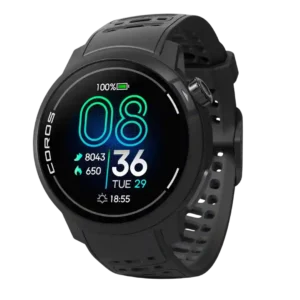
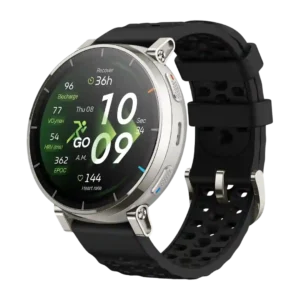
Auto-detection is mixed: one review reports recognition for 25 strength movements and 8 sports, while another explicitly notes missing automatic workout detection.
Reviews cite route syncing and imports from Komoot, Strava, Ride With GPS, AllTrails, Gaia GPS, plus a web dashboard, giving the Pace 4 a solid training ecosystem.
One reviewer highlights access to more than 400 apps, indicating a broader app catalog than the price suggests.
Band feedback is positive but material-dependent: reviewers like the included silicone band’s feel and practicality, while noting nylon can feel lighter.
Battery life is repeatedly described as a strength, with reviewers reporting roughly five days always-on, about 15 days mixed use, and strong GPS endurance for a small AMOLED watch.
Battery life is a recurring strength, with 12-day typical-use claims and real-world reports ranging from strong week-plus use to shorter endurance under heavier testing.
The watch is described as including SpO2 or blood oxygen hardware, though reviews focus more on its presence than deep testing.
Blood oxygen monitoring is repeatedly listed among the watch’s core all-day health sensors.
Reviews confirm Bluetooth headphone playback and Bluetooth heart-rate broadcasting, with no major connection complaints in the cited tests.
Bluetooth phone linkage is supported for core smartwatch functions such as calls and syncing.
The AMOLED display is described as bright enough outdoors, with reviewers highlighting strong brightness and easy readability in sunny conditions.
Screen brightness is praised across reviews, with multiple mentions of strong clarity and easy visibility in bright conditions.
Build impressions are mixed: reviewers like the overall design, but several still describe the chassis as budget-feeling plastic rather than premium.
Build quality is framed as premium for the price, with repeated mentions of stainless steel, sapphire protection, and a durable feel.
Button control feedback is mixed: the shortcut or action button is useful in activities, but the digital dial can also be annoying while running.
The four-button layout is consistently highlighted as a practical control advantage, especially during workouts or sweaty use.
Multiple reviews explicitly note that the Pace 4 has no speaker and is not built for handling calls.
Reviews describe wrist-based calling support over Bluetooth as part of the watch’s smart feature set.
The watch tracks active calories alongside steps and floors, giving basic daily calorie data rather than especially deep calorie guidance.
Charging is generally convenient thanks to the compact adapter and keyring approach, though reviewers do not describe it as a fast-charging standout.
Reviews highlight structured workouts, virtual pacing, training plans, and race-oriented tools that make the Pace 4 useful for guided training.
Coaching features are a major selling point, with Zepp Coach, guided workouts, structured plans, and beginner-friendly training support mentioned across reviews.
Comfort is one of the Pace 4’s clearest strengths, with reviewers repeatedly describing it as light enough to forget and easy to wear all day and overnight.
Comfort is a strong point for everyday running use, with reviewers calling out the watch’s light feel and approachable presentation.
The COROS app is consistently described as easy to use, with helpful workout logging, transcription, and activity summaries.
The Zepp companion app is generally well received for detail, clarity, and practical presentation of health and training data.
Reviews explicitly call out the absence of NFC or contactless payment support.
Contactless payments are supported, though one review notes bank support can still be limited in some regions.
The watch is described as supporting both iPhone and Android phones.
Cross-platform support exists, but reviewers note smoother integration can vary by phone and some features are platform-specific.
Customization is solid, with reviewers noting customizable watch faces, reorderable widgets, and editable activity or data-field setups.
Customization is supported through adjustable training plans and user-tailored screens or levels.
Display quality is widely praised, with reviewers repeatedly calling the AMOLED panel bright, sharp, colorful, and a major upgrade over the Pace 3.
Display quality earns consistent praise for a bright, sharp AMOLED presentation that looks more premium than the price suggests.
Durability appears decent rather than rugged: wet-condition use holds up fine, but reviewers do not frame the Pace 4 as especially tough or premium-built.
Durability is supported mainly by sapphire-glass protection and repeated references to a robust, scratch-resistant build.
Fit is broadly praised, with reviewers saying the watch sits well, stays comfortable, and avoids irritation during long wear.
Fit is positively described, with at least one reviewer specifically saying the watch fits very well on wrist.
Across reviews, the Pace 4 is described as accurately tracking pace, cadence, distance, and other core workout metrics.
General fitness tracking is described as accurate in broad use, including positive feedback on activity tracking and gym performance.
GPS accuracy is a major strength, with repeated praise for clean tracks, reliable placement, and strong performance across runs and rides.
GPS performance is usually described as good or accurate in typical conditions, but not class-leading for tougher trail or dense-cover scenarios.
Health tracking is generally viewed as reliable for big-picture use, though not positioned as class-leading or medical-grade analysis.
Heart-rate results are mostly positive for running and steady efforts, but several reviews still note inconsistencies in tougher or non-running workouts.
Heart-rate accuracy is mixed: some reviewers saw notable issues, while others found results much stronger or close to chest-strap readings.
Materials are functional but modest, with reviewers noting compromises in glass and finish rather than premium hardware throughout.
Materials quality stands out for the price thanks to repeated references to sapphire glass and stainless steel components.
Menu and navigation handling is generally easy and practical, though breadcrumb-only guidance limits context compared with full maps.
Menu navigation is functional but not fully streamlined, with one reviewer calling out extra steps to reach some mapping tools.
Music control support looks mixed across reviews and firmware timing: some describe useful phone control, while earlier impressions say it was still missing or pending.
Music controls are present as part of the everyday smartwatch feature set.
The Pace 4 supports onboard MP3 storage, but reviews emphasize its limits: no streaming integration and modest usable space.
Onboard storage is a clear feature, with 4GB used for maps, playlists, podcasts, and other offline content.
The overall operating experience is simple and easy to grasp, but intentionally plain rather than flashy.
The Zepp OS experience is presented as familiar and serviceable, with standard Amazfit behavior and features.
Outdoor visibility is a standout, with reviewers repeatedly saying the screen remains clear and readable in sunlight and varied conditions.
Outdoor visibility is a strong suit, with reviewers specifically noting easy readability outdoors and in bright sun.
Pairing and external-sensor support look solid, with reviewers noting successful accessory support including external heart-rate straps.
Pairing appears straightforward, with at least one reviewer describing setup as quick and successful.
Recovery-related features are well represented through recovery scores, percentages, and post-workout note logging, giving useful feedback without overcomplicating things.
Recovery insights are a repeated theme, including rest guidance, recovery indicators, and post-workout recovery estimates.
General reliability is strong, with reviewers repeatedly describing the watch as solid, dependable, and consistently good in day-to-day use.
Safety-style tools are basic but present, including flashlight-style screen use and alert-type functions rather than full emergency hardware.
Size flexibility is a weakness because reviewers explicitly note the Pace 4 is only offered in a single smaller case size.
Sleep tracking is serviceable but uneven: several reviews say sleep timing is usually close, while others note missed segments or overly generous scoring.
Sleep tracking is one of the strongest-reviewed areas, with reviewers praising wake detection, detail, and overall accuracy.
Notifications are available, but reviewers often describe them as basic and hard to read at a glance.
Smartphone notifications are supported for calls, texts, and apps.
Smartwatch features cover the basics, but multiple reviews say they remain limited compared with more general-purpose smartwatches.
Smartwatch features are broad for the price, including maps, phone tools, health widgets, and navigation extras.
Software smoothness is widely praised, with reviewers describing the Pace 4 as responsive, snappy, and lag-free in normal use.
Software smoothness is positively described, with one reviewer noting little lag in day-to-day use.
Step counts are described as lining up well with Garmin and Apple devices.
Stress tracking is part of the Pace 4’s broader recovery and wellness picture and is generally treated as useful for day-to-day context.
Stress tracking is included as part of the watch’s standard health-monitoring suite.
Design feedback is positive overall: reviewers call the Pace 4 clean, sharp, and easy to wear, even if it is still clearly a sports-first watch.
Style and design get generally positive reactions for looks and premium feel, though at least one reviewer wanted more refined styling options.
Third-party media and app support is limited; route integrations exist elsewhere, but Spotify and Apple Music support are explicitly absent.
Third-party platform support is mixed overall: some reviews cite integrations like Strava or TrainingPeaks, while another notes missing links with some training apps.
Touchscreen behavior is mostly good and responsive, though accidental input can still happen in some conditions.
Touch interaction appears responsive, with low-lag behavior noted during use.
The user interface is generally praised for being simple and easy to use, even if it is not the most polished in the category.
The user interface is generally described as clear, self-explanatory, and practical for beginners.
Value for money is one of the Pace 4’s strongest themes, with multiple reviews calling it one of the best-value running watches available.
Value for money is one of the clearest strengths, with reviewers repeatedly calling the watch unusually capable and affordable for under $170.
The microphone does not function as a voice-assistant interface, and reviews explicitly note that you cannot use it to talk to a phone assistant.
Voice assistant support is present for commands and quick interactions, and reviewers treat it as a useful added smart feature.
Watch-face support is decent, with some praise for the included designs and customization, though reviewers also say it is less flexible than some rivals.
Watch face quality is the one design area with a clearer complaint, as one reviewer questioned the look of some faces.
Water resistance is solid for routine use, with reviewers citing 5 ATM protection and suitability for wet conditions or pool swimming.
Water resistance is supported by repeated 5 ATM references and positioning for swimming or shower use.
Wellness insights combine stress, HRV, sleep, and recovery-style feedback to offer useful daily readiness context.
Wellness insights go beyond raw metrics, with recurring praise for detailed sleep data, BioCharge, and readiness-style context.
Wi-Fi support looks limited, with one reviewer explicitly noting map transfers rely on Bluetooth instead of Wi-Fi.
Workout coverage is broad, with reviewers highlighting major sports modes, multisport capability, and more than 50 activity profiles.
Workout coverage is broad, with repeated mentions of hybrid training support, 170-plus sports modes, and many trackable activities.