Gemini features are a major draw for this doorbell, with richer descriptions, search, and familiar-face tools, but reviews were split on how consistently accurate the AI felt.
Human-focused detection is repeatedly highlighted as a strength, with reviewers praising on-device human detection that reduces false alerts and avoids paywalled AI features common on competing systems.
The Google Home app is a clear strength thanks to intuitive controls, guided setup, and smooth firmware/setup handling.
The Eufy Security app is described as straightforward to set up and feature-rich (modes, recording length, zones, tones). A recurring theme is that settings choices (especially notification style) materially change responsiveness.
Two-way audio is consistently usable, with clear visitor voices and reliable conversation quality across reviews.
Audio and talkback are generally considered clear enough for conversations, though one reviewer notes a delay and another dislikes that only the doorbell side of a two-way conversation is recorded.
Google Home automation adds practical flexibility, including motion-triggered actions with other smart devices.
Reviewers show multiple security modes (home/away/disarmed), scheduling, geofencing, and the ability to have the chime act as an alarm, offering decent flexibility for basic automations inside the Eufy ecosystem.
Google speakers and Nest Hub displays integrate well for announcements, live view, and voice interaction.
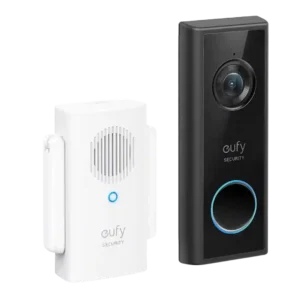
The included Wi-Fi chime can act like a mini hub for local storage, and some reviewers compare it to (or pair with) HomeBase-style hubs. A consistent caution is that multiple hubs or standalone devices can feel cluttered if you already own other Eufy bases.
Battery life is commonly framed as roughly 3–4 months in light use, with reviewers emphasizing it varies by motion activity and clip length. The recharge process is presented as manageable but unavoidable for battery-only kits.
The doorbell works with existing wired chimes and Google speakers/displays, though there is no included standalone chime.
The indoor chime is generally seen as useful (tones, volume controls, microSD slot), and some reviewers also use Echo devices as supplemental chimes. Minor friction shows up in configuration when too many chime endpoints ring until settings are tuned.
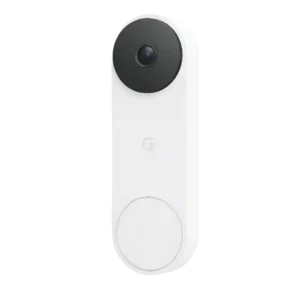
Buyers get three finish choices, and reviewers consistently noted the available color options.
Color availability is mentioned as a practical plus, with reviewers noting at least black and white options for matching different doors and trim.
Multiple reviews say the box includes the core mounting and wiring accessories needed for installation.
Unboxings consistently show a well-rounded kit with mounts, wedge, screws/anchors, a chime, and a removal pin/tool. Multiple reviewers remind that you still need to supply your own microSD card for local recording.
Status LEDs and button lighting provide clear visual feedback for setup and recording states.
Users can toggle status LEDs, adjust volumes, and change alert behaviors, and reviewers call out these small controls as helpful for reducing nuisance or making the doorbell more discreet.
The app exposes at least a basic low-bandwidth mode, giving some control over data use.
Package monitoring is a real feature here, with reviewers noting package detection and accurate delivery callouts.
Design is one of the most consistently praised aspects, with reviewers describing the doorbell as especially attractive and premium-looking.
Build quality is generally viewed positively, with reviewers mentioning a solid feel and clean fit/finish. One reviewer notes a shiny face that may be fingerprint-prone, but it is not presented as a dealbreaker.
Included wedges, mounting plates, and install accessories help adapt the doorbell to different mounting situations.
Familiar-face detection can be impressive when it works, but at least one review still saw recognition misses.
The square 1:1 framing and wide field of view give a broad head-to-toe porch view, with several reviewers praising better left-right coverage and package visibility.
The 4:3 framing is repeatedly praised because it captures more vertical context than 16:9, helping you see faces up close and packages near the door threshold.
Installation is widely praised, especially the app guidance and the easy upgrade path for existing Nest owners.
No summary yet.
Wired responsiveness is a real upgrade in use, with one reviewer calling the faster screen load a major improvement.
Live view is described as loading quickly with some expected latency; motion alerts can have noticeable delay when rich notifications are enabled, but several reviewers report improvement after switching to more efficient notification settings.
Reviewers noted only mild barrel or fisheye distortion, and generally treated it as an acceptable tradeoff for wider framing.
A reviewer covering a fisheye-style Eufy doorbell notes being pleasantly surprised by how much they could see, implying acceptable distortion tradeoffs for wider coverage in doorbell use.
The status light can be adjusted between high, auto, and low.
Night performance is a strong point, with good contrast and visibly better low-light clarity than older Nest models.
Night vision is generally viewed as strong for the price, with reviewers showing usable black-and-white night footage and improved visibility when porch lights are on. The consensus is that nighttime clarity is better than many expect from an entry-level option.
Motion alerts were described as quick and accurate in testing.
Motion detection is reported to be reliable in typical porch approaches, with fewer false alerts when set to human-only. Some reviewers still experience a short delay before the motion alert arrives on the phone, depending on notification settings. Reviewers demonstrate activity zones, human-only toggles, sensitivity control, and re-trigger/cool-off timing. The ability to tune notification style (efficient vs thumbnail) is repeatedly cited as a key customization that changes perceived speed.
Multi-user support is described as straightforward, including access on multiple phones and shared use cases for families or home businesses.
Alerts are usually fast and detailed, but one review found Gemini-written descriptions inaccurate enough to weaken trust.
Doorbell-press notifications are often described as near-instant. Motion notifications range from fast to noticeably delayed, with multiple reviewers attributing the difference to whether thumbnails/rich effects are enabled.
Recognition of people, pets, vehicles, and packages is treated as one of the standout detection strengths.
Person/human detection is repeatedly emphasized as effective and valuable, especially because reviewers contrast it with competitors that require subscriptions for similar person-detection features.
Ongoing ownership cost is a weak point because the best Gemini and history features push buyers toward pricey monthly plans.
Ongoing costs are repeatedly framed as low because local storage and core features work without monthly fees. Cloud plans are mentioned as optional rather than required.
At least one review directly frames the doorbell as a strong home-security device that adds reassurance.
Users can personalize zoom defaults, themes, and other behavior more than with a bare-bones video doorbell.
Personalization options are repeatedly shown: selectable chime tones, volume controls, app alert tones, LED toggles, and custom quick responses, letting users tailor how intrusive the system feels.
Being wired limits flexibility somewhat, but reviewers confirm compatibility with standard doorbell transformers and even plug-in adapters.
Several reviewers stress that the 1080p battery kit lacks wiring terminals, so it is battery-only and must be recharged. Other Eufy doorbells discussed in the review set can use existing doorbell wiring, which may confuse shoppers unless they confirm the exact model.
One review explicitly notes some pre-recording before detected motion events.
At least one reviewer points out that tapping a motion alert can open buffered footage rather than only live view, suggesting a helpful event context around the trigger depending on settings.
Hardware value is generally good for buyers who want a premium Google doorbell, but subscription pricing weakens the value story.
Value is a consistent highlight: reviewers repeatedly frame it as a budget-friendly option that still delivers practical video, local storage, and human detection without forcing subscription fees.
The app includes straightforward privacy control such as turning the camera off when needed.
Reviewers repeatedly like the local-storage approach and call out encryption, expressing comfort that footage is not inherently cloud-dependent and can remain in-home on microSD or a hub.
Pre-recorded replies are handy and easy to trigger, but the fixed message set is limited because custom responses are not available.
Quick responses are shown as useful for common doorstep interactions, with preloaded replies plus the ability to record a short custom response for deliveries or when you cannot come to the door.
Quiet time is easy to set and can mute ringing for up to three hours.
Snooze or temporary mute controls are highlighted as practical, letting users suppress motion or chime alerts for set periods (for example during yard work or installing decorations).
Reviewers broadly recommend it for buyers who want a premium Google-first video doorbell, with clear caveats around subscriptions and ecosystem fit.
Free event history is more generous than some rivals, and premium tiers add longer clips and 24/7 history, but local recording is absent.
Recording behavior is presented as configurable, including clip length and re-trigger timing. Reviewers show that recordings can be stored locally and accessed via an events timeline in the app.
Core operation felt dependable in testing, with quick detection and working voice/display integrations.
Reliability sentiment is generally positive in these reviews, including at least one buyer switching from a competing doorbell due to repeated disconnects and reporting better stability with Eufy so far.
The doorbell fits best inside Google’s ecosystem, but reviewers note Google’s broader security stack is less complete than some rivals.
Reviewers who already own Eufy gear like the idea of one app for multiple devices and show integrations across cameras, locks, and doorbells. A recurring complaint is that Eufy hubs and standalone devices can feel fragmented unless configured carefully.
The wired third gen is relatively slim and slightly smaller than the battery model it resembles.
Size and shape are described as compact, with comparisons noting the 1080p unit can be smaller than some 2K versions. The included wedge helps adapt the form factor to tighter porch angles.
Integration is strongest with Google and basic Alexa support, while HomeKit-style flexibility is absent.
Alexa and Google Assistant integrations are demonstrated, including streaming to smart displays and using Echo devices for announcements. HomeKit support is explicitly called out as missing by at least one reviewer.
Rich preview notifications can surface the event visually without needing to open the app first.
Snapshots and thumbnail-style notifications are highlighted as convenient for quickly seeing who is at the door. Several reviewers note that enabling thumbnails can slow down alert delivery compared with a more efficient notification mode.
Cloud-only storage and the lack of local storage are repeated complaints across reviews.
Local storage is consistently described as a core advantage, typically via microSD in the indoor chime (or a HomeBase-style hub on other variants). Reviewers repeatedly stress that no SD card means no event history, so supplying one is important.
Subscriptions unlock many of the most appealing features, and several reviews call the pricing expensive or frustrating.
No-monthly-fee usage is repeatedly celebrated, with reviewers framing subscriptions as optional rather than required. This is contrasted with competitors where key features often sit behind a paywall.
As a doorbell it can feel like a complete package, but Google’s missing wider sensor and monitoring pieces keep the broader system from feeling fully rounded.
As a self-contained doorbell kit, reviewers generally feel it covers the essentials (doorbell, chime/hub, app control, local recording capability). The main completeness caveat is that some setups require adding your own microSD card and accepting battery recharging if you choose the battery-only kit.
Included security hardware adds a basic tamper-resistance step during installation.
Anti-theft value is emphasized via local storage that remains indoors (chime/hub) even if the outdoor unit is stolen, plus a keyed/pin release mechanism that makes quick removal harder.
The third gen looks like a worthwhile upgrade mainly for better video, wider framing, and an easy swap-in installation path.
Reviews consistently describe sharp, detailed 2K footage, with meaningful clarity gains over prior Nest models.
No summary yet.
Users can save or download clips, with longer exports available on premium plans.
The hardware is built for outdoor use, with IP65 protection and a defined cold-to-hot operating range.
Weather handling is generally treated as solid, with reviewers referencing waterproofing and durability. One installer suggests sealing around the unit to protect wiring when the doorbell is exposed to the elements.
Review evidence points to fast loading and stable live access, though range itself was not deeply tested.
The chime/hub placement advice (between router and doorbell) appears repeatedly, and at least one reviewer notes a weaker signal versus a full HomeBase. Overall stability is acceptable, but placement and which hub you use can matter.
Motion and activity zones are available and easy to configure.