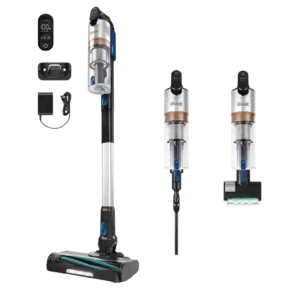
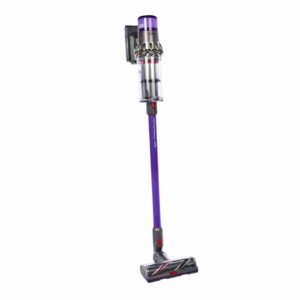
The included tool set is simple but useful, usually centered on a crevice tool or brush plus a mini motorized or upholstery tool and wall mount.
The accessory set is generally praised for covering common jobs (crevice, combo/brush tools, mini motorized/pet tools), though at least one review notes that some included tools can feel redundant depending on your cleaning habits.
Styling is functional rather than premium: one reviewer found it plain, while another preferred the LVAC-300's color scheme.
Design and finish are frequently described as premium-looking, with multiple colorway/finish options mentioned across model variants.
Smart automation is a defining feature: the Dynamic Load Sensor detects floor resistance and automatically adjusts suction, while the screen updates estimated runtime in real time.
In the available evidence, emptying created minimal upward dust blowback.
A few reviews note that the standard head can blow or fling light debris on hard floors before it is captured, especially compared with a dedicated soft roller head.
The limited area-rug evidence is positive, including one review that said it handled a sheepskin rug well without stalling.
Setup is repeatedly described as quick and uncomplicated, usually involving little more than snapping parts together and charging the battery.
Setup is typically described as straightforward: unbox, charge, and click the chosen head or tool into place without complex assembly.
Battery performance is solid rather than class-leading: several reviews cite around 40 minutes of floorhead use, removable battery charging, and roughly three-hour charge times.
Battery performance is widely praised, including long Eco runtimes and (in some variants) a click-in removable battery; charging is commonly described around a 4.5-hour full charge.
The bagless bin is easy to remove and empty, but one reviewer says the canister can fill relatively quickly.
Bin capacity is typically described as generous for the stick format (around 0.2 gallons in several writeups), while Outsize variants are noted for dramatically larger capacity; some users report hair can clump or stick in the bin.
Build impressions are mixed: some reviewers call the materials average or cheap-feeling, while others say the parts feel solid and secure in use.
Build quality impressions are generally premium and well-constructed in testing, but at least one long-term owner reported key component failures, creating a mixed durability picture.
High-pile or thicker carpet remains a weaker area, with multiple reviews reporting reduced pickup versus hard floors or thinner rugs.
High-pile carpet performance is generally excellent, with strong agitation and suction, though very thick carpet can sometimes feel harder to push due to the vacuum grabbing the pile.
Low-pile carpet performance is generally positive for regular cleaning and routine debris pickup.
Low-pile carpet cleaning is repeatedly near-flawless in lab-style tests and comparisons, often achieving very high debris removal percentages.
In the available controlled test, medium-pile carpet deep-clean performance was excellent.
Medium-pile carpet performance is consistently near the top of the category in these reviews, including deep-clean style tests where embedded debris removal is extremely high.
Clog resistance is not flawless; one review says the filters clog quickly and another notes hair going into the wheel area.
Clogging is not a dominant theme in testing, but a few notes appear around debris or hair sticking in the bin and the importance of clearing blockages when alerted.
Compared with the LVAC-200 and category averages, the LVAC-300 shows a clear power advantage, though its value edge is less absolute at higher prices.
In head-to-head comparisons, the V11 line is frequently positioned as among the best performing cordless vacuums and able to compete closely with corded models for many cleaning tasks.
Controls are simple and easy to understand, with useful status info on the display, but some reviewers dislike that it defaults back to Eco mode.
Controls are widely praised for the LCD readout and mode selection, including a runtime countdown and alerts; the main ergonomic complaint is the trigger that must be held during cleaning.
It converts effectively between full stick and handheld use, broadening what it can clean around the home.
Convertible handheld use is a recurring benefit, enabling quick transitions from floors to couches, cars, and detail cleaning with motorized and brush attachments.
Cordless operation is a major convenience point for fast room-to-room cleanup and homes where cords are a hassle.
Cordless convenience is repeatedly framed as a major benefit for quick daily cleaning and for areas like stairs where cords are a hassle.
One review specifically says it pulled fine dust from grooves between floor planks.
Crevice and groove pickup on hard floors is consistently reported as a strength, supported by strong airflow and good sealing, especially on higher power modes or with the appropriate tool.
Cyclone-based separation is frequently mentioned (including multi-cyclone designs), and is associated with strong, consistent pickup and dust capture in the reviews that discuss it.
The front LEDs do more than light the path; reviewers say they help reveal hidden dust and show what debris is left behind.
Ease of use is one of the strongest recurring positives, with reviewers calling the vacuum simple, intuitive, and low-fuss.
Ease of use is generally high due to cordless mobility, strong cleaning in fewer passes, and a clear runtime display; negatives include trigger-hold ergonomics and occasional heaviness for extended above-floor work.
Edge cleaning is a clear strength, with reviews highlighting strong pickup along baseboards, corners, and room edges.
Edge and baseboard cleaning is often addressed via crevice tools and brush design; reviewers frequently mention strong corner and detail pickup when using the right attachment.
Emptying is generally clean and controlled, with reviewers noting low mess and minimal dust blowback.
The point-and-shoot style emptying is commonly viewed as hygienic and easy, but a few users note hair clumps can catch inside the bin and occasionally require manual clearing.
The display-based reminders and alerts for filter cleaning are frequently cited as helpful for staying on top of upkeep and maintaining performance.
Filtration is a recurring strength, with several reviews citing 5-stage or HEPA-style capture and generally clean air output, although one test said the system was only partially sealed.
Multiple reviews emphasize a sealed, whole-machine filtration system (often framed as HEPA-level performance) that keeps fine particles contained rather than leaking back into the room.
The multi-surface floorhead is a core part of the design, with anti-tangle elements, debris channels, and easy roller access for maintenance.
The Torque Drive head and related V11 floorhead designs are praised for multi-surface performance and adjustable gates that help with larger debris, though some note the head can be wide for tight areas or less ideal than a soft roller on hard floors.
Several tests highlight a strong seal on hard floors that supports effective crevice pickup, but performance can vary with gate position and some users prefer a dedicated soft-roller head for the smoothest hard-floor results.
Despite the anti-tangle claims, a couple of reviews still report hair tangling or hair entering the wheel area.
On carpet, hair pickup is decent on easier surfaces, but thicker carpet is still more challenging.
Available evidence points to good hair pickup on hard floors, including pet-hair cleanup.
Hair-wrap resistance is mostly good, but not perfect: many reviewers praise the anti-tangle design, while a few still report long-hair tangling or hair entering the wheel area.
Tangle resistance is usually rated above average, with some reviews reporting little to no tangling on pet hair; however, very long strands can still wrap around the brush in certain scenarios.
Hard-floor fine-dust pickup is one of the strongest repeated positives, although a little residue can remain on some textured surfaces.
Hard-floor fine dust pickup is typically excellent in testing, helped by strong suction and sealing, but some reviewers note a soft-roller head can be gentler and reduce debris scatter compared with the standard Torque Drive head.
Large debris pickup on hard floors is mixed; some reviewers report easy pickup, while others saw snowplowing or needed to adjust the head.
Large debris pickup on hard floors is generally strong, with adjustable gates and head design helping reduce snowplow behavior, though a few notes mention occasional debris flinging on smooth surfaces.
LED headlights are consistently described as useful for spotting dust under furniture and in dim areas.
One review explicitly praises how flat the vacuum can lie for low-clearance cleaning.
Maintenance is simple overall because parts and filters are washable, but one reviewer did encounter quick filter clogging.
Maintenance is usually described as simple (empty bin, wash filter), but filter drying time can be inconvenient and some owners recommend keeping a spare filter to avoid downtime.
Handling is a major strength, with repeated praise for low weight, agile steering, and easy one-handed use around furniture.
Handling is generally reported as agile and easy to maneuver with a pivoting head and good under-furniture reach, but very thick carpet can feel resistant due to high suction and wider heads are less nimble in tight spaces.
Measured noise sits roughly in the low-60s to high-60s dB range, and reviewers generally call it quieter than many cordless vacuums.
Noise is commonly reported in the 70–80 dB range depending on mode; it is not whisper-quiet, but many reviewers consider it acceptable given the cleaning power, with Boost or max being the loudest.
Onboard accessory storage is a weakness; reviewers say there is nowhere on the vacuum itself to keep the extra tools.
Onboard or near-vac tool storage is partially addressed via wand clips and wall mounts, but several reviewers still suggest you may need separate storage for extra tools beyond what the mount can hold.
There are no bag costs, but spare filters and batteries are extras, and washable filters help reduce recurring spend.
Ongoing costs can be meaningful: replacement batteries and parts are described as expensive, and repair-center accessibility can affect the true cost of ownership.
Longevity sentiment is mixed: some testers report stable performance over extended use, but one owner experience and broader commentary raise concerns that failures can occur within a few years.
Overall sentiment is positive: most reviewers frame it as a capable, practical everyday cordless vacuum with a few clear limitations.
Overall sentiment is strongly positive in most professional tests and comparisons, with the main dissent coming from price sensitivity and a long-term ownership report that experienced failures after the warranty period.
Packaging is described as compact, protective, and efficiently packed, though one reviewer noted it was not biodegradable.
Pet-focused evidence is positive: reviewers mention anti-tangle design, pet-hair-friendly attachments, and useful cleaning for pet homes, especially on upholstery and hard floors.
Pet-focused performance is a consistent highlight: reviewers report strong fur pickup on carpet and upholstery, and pet-oriented motorized tools are frequently called out as especially effective.
Value is generally rated as good to fair, especially when discounted, though a few reviewers think the midrange price brings tougher competition.
Value is polarizing: many reviewers argue the performance and features justify the premium, while others feel the price is hard to swallow given durability questions and cheaper alternatives that perform well.
Real-world runtime usually lands around 40 to 45 minutes with the floorhead in lower modes, while highest-power cleaning tends to fall around 10 to 17 minutes.
Default or Eco runtimes are often reported around an hour and can be longer in some tests, with Auto or normal modes commonly landing around the mid-40-minute range depending on surfaces and head used. Boost or max power runtimes are short by design: reports range from about five minutes to around ten minutes, delivering intense suction but draining the battery quickly.
A few reviewers warn the brush can be aggressive on hard floors at higher power, so care is needed to avoid potential scratching or overly harsh contact on delicate surfaces.
The light body and mini motorized tool make it useful on stairs and other elevated cleaning spots.
Stair cleaning is commonly cited as a strong use case thanks to cordless operation and compact motorized tools designed for steps and upholstery.
Its self-standing design stands out across reviews, making pauses, storage, and upright parking easier than on many stick vacuums.
Storage is often via a wall mount, which keeps the vacuum compact, but it does not stand on its own and the mount can be placement-sensitive (needs an outlet, ideally studs).
Reviews consistently describe strong suction for the class, with above-average measured suction in controlled tests and good everyday airflow, though it is not sold as a premium deep-clean powerhouse.
Across tests and long-term use reports, suction is repeatedly described as class-leading for a cordless stick, with strong airflow and carpet agitation that can rival some corded cleaning performance.
Several reviewers say it is best for everyday or in-between cleaning rather than replacing a stronger full-size vacuum for heavy deep-clean jobs.
Its compact, self-standing form makes it easier to store and use in smaller homes or apartments.
Reliability and support are a key tradeoff: some sources mention reliability concerns and limited post-warranty repair convenience, even though customer service interactions can be positive during troubleshooting.
One review says the brush-style surface tool works well on delicate surfaces.
Tool changes are quick and straightforward, with reviewers highlighting easy snap-on swapping and simple roller removal for cleaning.
Tool swaps are repeatedly described as quick and simple, with click-in attachments making it easy to move between floor cleaning and detail tools.
Its flat-laying or low-profile head helps it reach under sofas and similar low-clearance furniture.
Under-furniture reach is frequently praised because the vacuum can recline low and the head can pivot, making it easier to clean under beds and furniture compared with bulkier uprights.
Above-floor cleaning is a real strength thanks to the mini motorized tool and handheld format for sofas, bedding, curtains, car interiors, and upholstery.
Above-floor and upholstery cleaning are generally strong when using the mini motorized and brush tools, though the main floorhead can feel oversized for car interiors and the handheld weight may fatigue some users.
Reviewers use it across mixed floors, upholstery, cars, and everyday household messes, making it more versatile than a floor-only stick vac.
Reviewers commonly highlight versatility: it transitions between floors, stairs, cars, and above-floor dusting with attachments and handheld mode.
The LVAC-300 is repeatedly described as lightweight, with assembled weights around the mid-6-pound range in several reviews.
Weight is a frequent consideration: the V11 is often described as heavier than many cordless rivals (and Outsize variants are heavier still), yet several reviewers still find it manageable for floor cleaning; extended handheld use can be more tiring.