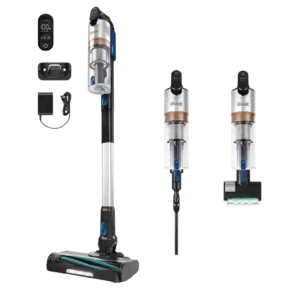
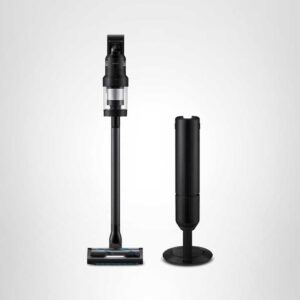
The included tool set is simple but useful, usually centered on a crevice tool or brush plus a mini motorized or upholstery tool and wall mount.
The accessory bundle is frequently praised: multiple floorheads, pet tools, crevice tools, and flex/joint parts (plus a mop head in some bundles). Tool quantity and usefulness are strengths, though a few pieces (stands or extendible tools) can feel less premium.
Styling is functional rather than premium: one reviewer found it plain, while another preferred the LVAC-300's color scheme.
The vacuum and Clean Station are frequently praised for sleek, designer-appliance styling that looks good left out. The dock is still physically large, so aesthetic appeal doesn’t fully offset footprint concerns in small spaces.
AI floor detection and SmartThings features are viewed as nice-to-have by some, and unnecessary or unreliable by others. Reported limitations include inconsistent adjustments on mixed surfaces/edges, slower “reconfiguration,” and AI/app usefulness that depends on how you clean.
In the available evidence, emptying created minimal upward dust blowback.
The limited area-rug evidence is positive, including one review that said it handled a sheepskin rug well without stalling.
Setup is repeatedly described as quick and uncomplicated, usually involving little more than snapping parts together and charging the battery.
Physical assembly/unboxing is generally described as straightforward, with accessories organized for setup. SmartThings/Bluetooth pairing is mixed—easy for some via QR, frustrating for others depending on connection conditions.
Obstruction detection and on-screen guidance are described as helpful when a floorhead gets blocked (for example by a bath mat). Reviewers who mention it view diagnostics/alerts as a meaningful usability feature.
Multiple reviews mention it automatically lowers power when lifted, which can save battery and reduce unwanted suction events. In quick spot cleans, that automatic behavior can feel like an extra step or delay.
When discussed, bag-full notifications/indicators (LEDs or on-screen alerts) are appreciated for reducing guesswork. Not every review mentions it, but those that do consider it helpful for hands-off ownership.
Battery performance is solid rather than class-leading: several reviews cite around 40 minutes of floorhead use, removable battery charging, and roughly three-hour charge times.
Dual swappable batteries and charging via the dock (plus a separate charger in some bundles) are repeatedly praised. Reviewers consistently call the battery system a standout feature for larger homes or longer cleaning sessions.
The bagless bin is easy to remove and empty, but one reviewer says the canister can fill relatively quickly.
The onboard bin is relatively small, but the dock’s larger sealed bag effectively increases system capacity and reduces manual emptying. The tradeoff is switching to consumable bags rather than purely bagless operation.
Build impressions are mixed: some reviewers call the materials average or cheap-feeling, while others say the parts feel solid and secure in use.
Overall build is described as premium and sturdy (some even call it sturdier than Dyson). A recurring nit is that certain accessory stands/cradles can feel flimsier than the vacuum itself.
High-pile or thicker carpet remains a weaker area, with multiple reviews reporting reduced pickup versus hard floors or thinner rugs.
Several reviewers report strong deep-clean ability on thick rugs and ground-in hair. A critical perspective argues high-pile can still leave fine debris out of reach due to head design, despite the high motor power on paper.
Low-pile carpet performance is generally positive for regular cleaning and routine debris pickup.
Low-pile carpet pickup is largely described as excellent and fast. Where complaints arise, they tend to be about push resistance rather than inability to collect debris.
In the available controlled test, medium-pile carpet deep-clean performance was excellent.
Medium-pile pickup is repeatedly rated top-tier in standardized tests (including hair and litter). AI floor-type detection often responds to transitions here, though consistency varies by reviewer and surface mix.
Clog resistance is not flawless; one review says the filters clog quickly and another notes hair going into the wheel area.
Compared with the LVAC-200 and category averages, the LVAC-300 shows a clear power advantage, though its value edge is less absolute at higher prices.
Often compared favorably to Dyson/Shark for raw suction and the sealed auto-empty dock. However, some reviewers prefer Dyson for precision/laser visibility or argue rivals offer similar overall outcomes for significantly less money.
Controls are simple and easy to understand, with useful status info on the display, but some reviewers dislike that it defaults back to Eco mode.
The on-handle display and mode controls are widely praised for clarity (battery %, remaining runtime, alerts). Some dislike fast on-screen onboarding prompts or view call/message mirroring as a gimmick rather than a core benefit.
It converts effectively between full stick and handheld use, broadening what it can clean around the home.
Handheld conversion is widely used for tight spaces and spot cleaning. Some reviewers note handheld use can feel heavier during extended overhead tasks, depending on user comfort and tool choice.
Cordless operation is a major convenience point for fast room-to-room cleanup and homes where cords are a hassle.
Cordless freedom is a major highlight for quick whole-home cleans, stairs, and cars. Convenience depends on keeping both batteries charged and choosing sensible power modes for the task.
One review specifically says it pulled fine dust from grooves between floor planks.
Crevice tools (including extendible options) are frequently used for gaps beside appliances and other tight areas. A noted downside is that extendible designs can feel wobbly when fully extended.
The front LEDs do more than light the path; reviewers say they help reveal hidden dust and show what debris is left behind.
Dock emptying is usually described as a short but noticeable burst of noise—generally tolerable, but not subtle. This matters most if the station is near bedrooms or used late at night.
Often praised as agile for a high-powered cordless vacuum, with a flexible head and good ergonomics. Several reviewers say it can feel resistant or harder to change direction on carpet compared to some competitors.
Ease of use is one of the strongest recurring positives, with reviewers calling the vacuum simple, intuitive, and low-fuss.
Many reviewers find it intuitive and comfortable, and the auto-empty dock reduces chores. Reported frictions include occasional “pushiness” on carpet, wobble in extendible tools, and auto-empty running when you only did a quick pickup.
Edge cleaning is a clear strength, with reviews highlighting strong pickup along baseboards, corners, and room edges.
Edge performance is mixed: some tests show decent pickup, but multiple sources note inconsistent AI edge behavior and the need for manual touch-ups along borders. Many rely on the crevice tool for perfect edges/baseboards.
Emptying is generally clean and controlled, with reviewers noting low mess and minimal dust blowback.
The All-in-One Clean Station is widely celebrated for hygienic, low-mess emptying into a sealed bag and automatic charging. Downsides include the dock’s footprint and the fact that some reviewers wish auto-empty could be turned off for quick jobs.
Filter-clean/change alerts are cited as useful for keeping performance consistent. Combined with washable filters, reminders can make routine upkeep more predictable.
Filtration is a recurring strength, with several reviews citing 5-stage or HEPA-style capture and generally clean air output, although one test said the system was only partially sealed.
Multi-layer HEPA-style filtration plus the sealed bag dock are repeatedly framed as excellent for allergies and pet dander. Several sources cite very high particle-capture claims, though most reviewers rely on observed dust containment rather than lab verification.
The multi-surface floorhead is a core part of the design, with anti-tangle elements, debris channels, and easy roller access for maintenance.
The Jet Dual Brush-style head is praised for multi-surface convenience and reduced need to swap heads. However, at least one critical reviewer says the unpowered front roller and wide opening can cause plowing and limit hard-floor debris pickup.
Several reviews credit the head design with strong sealing for hard-floor performance. Others note certain debris sizes can still be pushed around, implying seal quality doesn’t guarantee perfect intake for all debris types.
Despite the anti-tangle claims, a couple of reviews still report hair tangling or hair entering the wheel area.
On carpet, hair pickup is decent on easier surfaces, but thicker carpet is still more challenging.
Hair pickup on carpets is generally strong, especially with pet tools, but experiences differ: some report near-perfect results while others see hair tangling during longer sessions. Performance can depend on tool choice and frequency of roller cleaning.
Available evidence points to good hair pickup on hard floors, including pet-hair cleanup.
Hair pickup on hard floors is typically described as effective in demos/tests. Any weaknesses tend to stem from hair wrap on rollers rather than lack of suction.
Hair-wrap resistance is mostly good, but not perfect: many reviewers praise the anti-tangle design, while a few still report long-hair tangling or hair entering the wheel area.
Hair-wrap performance is one of the most divided topics. Some reviews say rollers stay clear or that the pet tool is anti-tangle, while others report rapid tangling on main floorheads and mini motorized tools—especially with long hair.
Hard-floor fine-dust pickup is one of the strongest repeated positives, although a little residue can remain on some textured surfaces.
Fine dust tests (flour/sugar/tea) are generally strong, often clearing in a single pass. Some note pooling or leftover dust when pulling the head backward or on certain edge scenarios.
Large debris pickup on hard floors is mixed; some reviewers report easy pickup, while others saw snowplowing or needed to adjust the head.
Large-debris pickup is frequently praised (granola/cereal/litter), but not unanimously: some reviews report occasional pushing/plowing of larger pieces tied to floorhead geometry and direction of travel.
LED headlights are consistently described as useful for spotting dust under furniture and in dim areas.
LED headlights (and Slim LED heads) are often valued for illuminating corners and helping spot dust, though reviewers say they don’t reveal dirt like Dyson’s laser. One older Bespoke Jet review lists no headlight, suggesting variation across versions or bundles.
One review explicitly praises how flat the vacuum can lie for low-clearance cleaning.
Maintenance is simple overall because parts and filters are washable, but one reviewer did encounter quick filter clogging.
Maintenance is generally lower-effort than typical stick vacs thanks to auto-emptying and washable parts. Still, hair tangles and periodic bag replacement mean it’s “low effort,” not “no effort.”
Handling is a major strength, with repeated praise for low weight, agile steering, and easy one-handed use around furniture.
Some bundles include a mop-style attachment and present the system as vacuum + mop capable. Few reviews actually test mopping effectiveness, so mopping should be treated as a bonus feature that depends on the specific bundle.
Measured noise sits roughly in the low-60s to high-60s dB range, and reviewers generally call it quieter than many cordless vacuums.
No summary yet.
Onboard accessory storage is a weakness; reviewers say there is nowhere on the vacuum itself to keep the extra tools.
Accessory cradles/trees help keep tools organized and encourage using the right attachment. The tradeoff is added footprint, and at least one reviewer found the stand material flimsier than expected.
There are no bag costs, but spare filters and batteries are extras, and washable filters help reduce recurring spend.
Ongoing costs include dock bags and (optionally) pricey spare batteries; views vary on how painful this is. Some reviews say bags are affordable and easy to source, but others flag consumables as an important consideration at this price tier.
Expectations for longevity are generally high (and some markets cite long warranties), but not all reviewers had true long-term ownership time. Roller cleaning and consumables can influence how “like-new” it feels over time.
Overall sentiment is positive: most reviewers frame it as a capable, practical everyday cordless vacuum with a few clear limitations.
Most reviews frame this as a top-tier cordless stick thanks to strong cleaning and the Clean Station convenience, with some calling it “best in class.” A minority view argues the floorhead/AI behavior and the price premium make it harder to justify.
Packaging is described as compact, protective, and efficiently packed, though one reviewer noted it was not biodegradable.
Packaging is described as large but thoughtfully organized, with accessories layered and easy to unpack. It can be bulky to move, though handles and internal organization help.
Pet-focused evidence is positive: reviewers mention anti-tangle design, pet-hair-friendly attachments, and useful cleaning for pet homes, especially on upholstery and hard floors.
Pet tools and strong suction make it appealing for pet homes, and the sealed dock helps with allergen containment. Still, some pet-tool/floorhead designs can tangle with hair, so periodic maintenance remains part of ownership.
Value is generally rated as good to fair, especially when discounted, though a few reviewers think the midrange price brings tougher competition.
Universally expensive. Some reviewers accept the cost as a luxury, “no-compromises” system (especially with the dock), while others call it overpriced unless discounted—particularly if the AI doesn’t add meaningful benefit.
Real-world runtime usually lands around 40 to 45 minutes with the floorhead in lower modes, while highest-power cleaning tends to fall around 10 to 17 minutes.
On low/AI or standard modes, reviews commonly cite very long runtimes (often up to ~100 minutes on the larger battery plus a second battery). Runtime drops substantially with motorized heads and higher modes, so best results come from matching mode to task. Boost/Jet mode runtimes are the biggest runtime drawback: at least one test reports only a couple minutes at max power with certain tools. Expect to use mid/AI most of the time to balance cleaning power and endurance.
The light body and mini motorized tool make it useful on stairs and other elevated cleaning spots.
Stair cleaning is highlighted as easier thanks to cordless handheld use and targeted tools. Comfort depends on perceived weight and how long you’re holding it in handheld mode.
Its self-standing design stands out across reviews, making pauses, storage, and upright parking easier than on many stick vacuums.
The Clean Station and accessory storage can require a dedicated corner and add noticeable footprint. One review notes the dock fit/stability can be fussy (no magnetic/click-in lock), increasing the importance of placement.
Reviews consistently describe strong suction for the class, with above-average measured suction in controlled tests and good everyday airflow, though it is not sold as a premium deep-clean powerhouse.
Suction is repeatedly described as extremely powerful (often citing 400W / ~280AW class claims) and capable of one-pass cleans in multiple tests. One critical take argues the floorhead geometry can prevent that power from translating into pickup in certain scenarios.
Several reviewers say it is best for everyday or in-between cleaning rather than replacing a stronger full-size vacuum for heavy deep-clean jobs.
With strong suction, a high-capacity dock bag, and two batteries enabling long total runtime, it’s frequently positioned as ideal for large homes and frequent cleaning. Heavy-duty use can increase bag consumption and the need for roller de-tangling.
Its compact, self-standing form makes it easier to store and use in smaller homes or apartments.
While the cordless vacuum itself suits apartments, the Clean Station and accessory tree can be bulky in tight homes. Several reviews explicitly caution small-space buyers to measure and plan storage before committing.
Warranties mentioned vary by review/region, but are generally multi-year for the vacuum and shorter for batteries. Spare batteries are cited as costly, which can matter if you plan to extend the system over time.
One review says the brush-style surface tool works well on delicate surfaces.
Most attachments are treated as safe for standard cleaning, but at least one review warns the pet tool can damage delicate surfaces if left spinning in one spot. Users should keep motorized tools moving and avoid lingering on fragile finishes.
Tool changes are quick and straightforward, with reviewers highlighting easy snap-on swapping and simple roller removal for cleaning.
Tool swapping is generally simple, supporting quick changes between floorheads and detail tools. Minor complaints include wobble in extendible tools and occasional debris falling out during head removal in one review.
Its flat-laying or low-profile head helps it reach under sofas and similar low-clearance furniture.
Reviews mention good reach under furniture and into awkward areas (including radiators) with flexible heads and reach accessories. Some competitors’ folding wands may still offer easier ultra-low clearance access.
Above-floor cleaning is a real strength thanks to the mini motorized tool and handheld format for sofas, bedding, curtains, car interiors, and upholstery.
Above-floor performance is generally strong thanks to high suction and motorized mini tools. Some reviewers report the mini pet tool works well but can tangle with hair, requiring occasional cleaning.
Reviewers use it across mixed floors, upholstery, cars, and everyday household messes, making it more versatile than a floor-only stick vac.
Frequently described as a whole-home solution that can switch between hard floors, carpets, and handheld cleaning with minimal fuss. Bundle-dependent extras like mopping expand versatility but aren’t central to most reviewers’ evaluations.
The LVAC-300 is repeatedly described as lightweight, with assembled weights around the mid-6-pound range in several reviews.
Frequently described as lighter than some premium competitors and easier for overhead/spot jobs, but not universally “ultralight.” Some reviews still note fatigue in handheld mode or extra effort required when pushing on carpet.