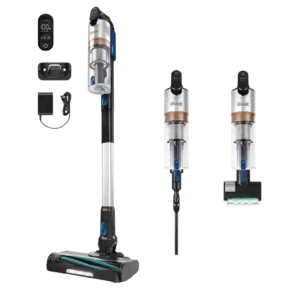
The included tool set is simple but useful, usually centered on a crevice tool or brush plus a mini motorized or upholstery tool and wall mount.
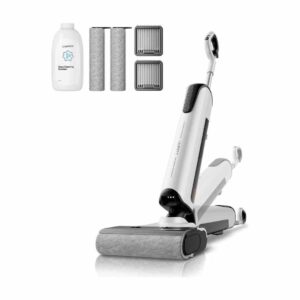
Most reviewers highlight a generous box for the price: docking base, at least one spare roller, spare filter(s) (often HEPA), a cleaning brush/tool, and a bottle of cleaning fluid/solution.
Styling is functional rather than premium: one reviewer found it plain, while another preferred the LVAC-300's color scheme.
Multiple reviews call the D100 sleek/modern and compact-looking. The styling is generally viewed as functional and “nice looking,” rather than premium-luxury.
Smart mode uses sensors to adjust power/water based on detected dirt; reviewers see it ramp up on heavier messes. There’s no recurring mention of an app, but the automation itself is appreciated for day-to-day cleaning.
In the available evidence, emptying created minimal upward dust blowback.
A recurring downside is blowback/scatter on very light debris (e.g., cat hair or some cereal) before pickup, especially at the start of a pass. Most reviewers still consider it manageable with technique/mode choice.
The limited area-rug evidence is positive, including one review that said it handled a sheepskin rug well without stalling.
On carpets/rugs the consensus is “limited”: it’s mainly for sealed hard floors, but a few reviewers say it can handle low-pile rugs or doormats in dry mode with modest results.
Setup is repeatedly described as quick and uncomplicated, usually involving little more than snapping parts together and charging the battery.
Setup is repeatedly described as quick and tool-free: attach the handle, assemble the two-piece base, plug in, and charge. Several note the battery often arrives partially charged.
At least one tester reports the unit detecting a clog and warning the user to check the roller/pipe, preventing continued operation until addressed.
One reviewer notes it won’t run unless the head is lowered into the cleaning position, which helps prevent accidental spinning while upright.
Battery performance is solid rather than class-leading: several reviews cite around 40 minutes of floorhead use, removable battery charging, and roughly three-hour charge times.
Battery life is reported as “enough” for kitchens/entryways and smaller homes, but not long. Reported Smart runtimes range roughly from the low‑20 minutes to ~35 minutes; Turbo/Power mode is often ~16–18 minutes. Charging is widely criticized as slow in some tests (~6+ hours), though at least one reviewer reports closer to ~4 hours.
The bagless bin is easy to remove and empty, but one reviewer says the canister can fill relatively quickly.
Build impressions are mixed: some reviewers call the materials average or cheap-feeling, while others say the parts feel solid and secure in use.
Build quality is generally described as solid for the price, with praise for the stable lay-flat mechanism and waterproof/washable chassis/motor design (IPX-style). Minor negatives include occasional leakage reports and a small learning curve with docking alignment.
High-pile or thicker carpet remains a weaker area, with multiple reviews reporting reduced pickup versus hard floors or thinner rugs.
Low-pile carpet performance is generally positive for regular cleaning and routine debris pickup.
In the available controlled test, medium-pile carpet deep-clean performance was excellent.
Clog resistance is not flawless; one review says the filters clog quickly and another notes hair going into the wheel area.
Normal household messes don’t appear to clog it often, but thick mixtures (like flour plus liquid) can clog the tube and require rinsing/cleanout. The included cleaning tool and washable design help recovery.
Compared with the LVAC-200 and category averages, the LVAC-300 shows a clear power advantage, though its value edge is less absolute at higher prices.
In comparisons, the D100 is framed as a value leader rather than the absolute “best regardless of price.” Reviewers often contrast it with premium brands, noting it offers many flagship-style features for less money.
Controls are simple and easy to understand, with useful status info on the display, but some reviewers dislike that it defaults back to Eco mode.
Controls are typically simple (power + mode) with a clear display and voice prompts. Users like having water-output and volume controls, but at least one tester couldn’t fully mute voice prompts and others mention a small learning curve for self-cleaning workflows.
It converts effectively between full stick and handheld use, broadening what it can clean around the home.
Cordless operation is a major convenience point for fast room-to-room cleanup and homes where cords are a hassle.
Cordless operation is a consistent quality-of-life win—no dragging a cord while mopping. The push-in dock/parking style also supports quick grab-and-go use.
One review specifically says it pulled fine dust from grooves between floor planks.
The front LEDs do more than light the path; reviewers say they help reveal hidden dust and show what debris is left behind.
Dried coffee/ketchup style tests suggest it can lift set-in stains, but may require repeated passes—performance is better on fresh spills than on fully dried, sticky stains.
Ease of use is one of the strongest recurring positives, with reviewers calling the vacuum simple, intuitive, and low-fuss.
Day-to-day use is mostly praised (roll off the dock, press power, clean). Pain points include a tight, suction-y tank lid for some users (especially with hand strength/arthritis) and occasional learning curve around docking/self-cleaning steps.
Edge cleaning is a clear strength, with reviews highlighting strong pickup along baseboards, corners, and room edges.
Edge cleaning is a major strength: multiple reviewers call it edge-to-edge/dual-edge and show it cleaning close to baseboards. One measured the real gap at ~5–6 mm from the wall (still better than many, but not as tight as some marketing claims).
Emptying is generally clean and controlled, with reviewers noting low mess and minimal dust blowback.
Emptying is usually straightforward and some reviews highlight solid/liquid separation that makes disposal cleaner (dump solids first, then pour liquid). The main mess risk comes from soggy mixed debris when doing wet + dry together.
Filtration is a recurring strength, with several reviews citing 5-stage or HEPA-style capture and generally clean air output, although one test said the system was only partially sealed.
HEPA/air filtration is referenced in multiple reviews, with filters catching noticeable pet hair and fine debris. Users emphasize keeping the filter clean/dry for best performance.
Multiple reviewers note it leaves only light moisture and floors dry quickly after a pass; water-output adjustment helps balance cleaning strength versus dry time.
The multi-surface floorhead is a core part of the design, with anti-tangle elements, debris channels, and easy roller access for maintenance.
Fresh spills (water, coffee, milk) are often shown being removed in one or two passes in demos/tests, with the unit automatically increasing effort in Smart mode on wetter areas.
Despite the anti-tangle claims, a couple of reviews still report hair tangling or hair entering the wheel area.
On carpet, hair pickup is decent on easier surfaces, but thicker carpet is still more challenging.
Available evidence points to good hair pickup on hard floors, including pet-hair cleanup.
Pet hair pickup on hard floors is frequently praised (dog/cat homes). Hair is often visible in the tank/filter after a pass, suggesting strong real-world performance.
Hair-wrap resistance is mostly good, but not perfect: many reviewers praise the anti-tangle design, while a few still report long-hair tangling or hair entering the wheel area.
Anti-tangle design and scrapers/comb features generally keep long hair from wrapping tightly. Stress tests show hair may stick temporarily, but it’s usually easy to remove and often ends up trapped in the tank filter instead.
Hard-floor fine-dust pickup is one of the strongest repeated positives, although a little residue can remain on some textured surfaces.
Fine debris like dust and small particles is generally collected well, but one reviewer warns that very large amounts of powder (e.g., flour) mixed with liquid can form paste and cause issues.
Large debris pickup on hard floors is mixed; some reviewers report easy pickup, while others saw snowplowing or needed to adjust the head.
It handles larger debris and mixed messes (cereal, sauce, even spaghetti in one demo) better than many expect. However, very light pieces can scatter, and at least one reviewer saw eggshell not picked up in a specific mode/test.
LED headlights are consistently described as useful for spotting dust under furniture and in dim areas.
Noted innovations versus peers include push-in docking, a fully washable/waterproof motor/chassis, electrolyzed-water cleaning claims, a combined dual-compartment tank, and an adjustable/swiveling handle.
One review explicitly praises how flat the vacuum can lie for low-clearance cleaning.
The ultra-thin/flat form factor (often cited around 13.5 cm) is a standout design point and is frequently compared favorably to bulkier competitors.
Maintenance is simple overall because parts and filters are washable, but one reviewer did encounter quick filter clogging.
The self-clean routine reduces hands-on scrubbing, but ownership still involves emptying/ rinsing tanks, cleaning filters, and occasionally clearing thicker debris. Reviewers mention mixed wet+dry sludge can be unpleasant to dump, and long drying beeps (in some units) add annoyance to the maintenance loop.
Handling is a major strength, with repeated praise for low weight, agile steering, and easy one-handed use around furniture.
Handling is generally described as smooth and nimble, helped by the light weight and a flexible/swiveling handle. One reviewer notes the forward “thrust” can feel tiring over long sessions and that backward passes can smear more than some competitors.
Mopping results are consistently positive for everyday grime, muddy footprints, and mixed wet messes. Tough, dried-on spills can take multiple passes, but most reviewers still report a clean finish.
Measured noise sits roughly in the low-60s to high-60s dB range, and reviewers generally call it quieter than many cordless vacuums.
Operating noise varies by mode—Turbo is described as noticeably louder. Several measure/describe the drying airflow as relatively quiet (low‑40 dB in one test), but repeated beeps during drying and voice prompts can be more annoying than the fan noise itself.
Odor prevention is repeatedly credited to the deodorizing rod plus heated drying; one reviewer left dirty water in the tank for ~24 hours and reported no bad smell. Heated drying is also cited as reducing mildew/mold risk.
Onboard accessory storage is a weakness; reviewers say there is nowhere on the vacuum itself to keep the extra tools.
There are no bag costs, but spare filters and batteries are extras, and washable filters help reduce recurring spend.
Overall sentiment is positive: most reviewers frame it as a capable, practical everyday cordless vacuum with a few clear limitations.
Overall sentiment is strongly positive: most reviewers recommend it, especially for hard-floor homes wanting a one-pass vacuum+mop workflow and minimal roller-touching cleanup.
Packaging is described as compact, protective, and efficiently packed, though one reviewer noted it was not biodegradable.
Pet-focused evidence is positive: reviewers mention anti-tangle design, pet-hair-friendly attachments, and useful cleaning for pet homes, especially on upholstery and hard floors.
Pet households specifically like the combination of strong hair pickup, anti-tangle brush design, and odor mitigation (deodorizer + heated drying). Several reviewers explicitly recommend it for homes with shedding pets.
Value is generally rated as good to fair, especially when discounted, though a few reviewers think the midrange price brings tougher competition.
Value is the dominant theme: many call it the best value-for-money wet/dry vacuum in its segment, often citing prices around ~$289–$320 (or sales near ~$299) while offering features found on pricier competitors.
Real-world runtime usually lands around 40 to 45 minutes with the floorhead in lower modes, while highest-power cleaning tends to fall around 10 to 17 minutes.
Sanitizing claims come from electrolyzed-water/“sterilization” language and heated drying. Some reviewers run informal bacteria comparisons that look promising, but most acknowledge true disinfection levels aren’t lab-verified in these reviews.
The rinse + hot/warm-air dry routine is a headline feature and widely praised for reducing manual roller washing. Reported drying is often ~1 hour at ~60°C, leaving the roller mostly dry (sometimes not 100%). A major complaint is persistent beeping during the drying phase in at least one long-term test.
Several reviewers describe it as self-propelled or at least strongly assisted by brush traction, which reduces pushing effort. A minority find that same pull can feel a bit too forceful over long cleans.
Reviewers like the adjustable water-output options and the ability to use cleaning solution; some highlight electrolyzed-water operation as a differentiator. A common request is easier filling, and there’s no consistent mention of automatic solution dosing.
The light body and mini motorized tool make it useful on stairs and other elevated cleaning spots.
Its self-standing design stands out across reviews, making pauses, storage, and upright parking easier than on many stick vacuums.
The push-in base makes parking easier than lift-on docks and reviewers like the compact footprint. Some note it’s happiest when docked against a wall and that occasional alignment/positioning habits help.
Some users report an even, streak-free finish and visibly shinier floors, while another notes that backward movement can smear more than with some competing wet/dry vacs (consistent with many floor washers being optimized for forward passes).
Reviews consistently describe strong suction for the class, with above-average measured suction in controlled tests and good everyday airflow, though it is not sold as a premium deep-clean powerhouse.
Pickup power is repeatedly described as strong, especially for a budget wet/dry unit. Reviews show it handling liquids and common household debris well, though very light debris can sometimes get pushed ahead before being captured.
Several reviewers say it is best for everyday or in-between cleaning rather than replacing a stronger full-size vacuum for heavy deep-clean jobs.
Its compact, self-standing form makes it easier to store and use in smaller homes or apartments.
Its compact body, flexibility, and lay-flat reach make it easy to store and to use in tighter rooms (kitchens, entryways, around furniture legs).
Only a small number of reviews mention after-purchase support details; one cites a 2‑year warranty and a 30‑day return policy. Broader reliability feedback is limited beyond short-term use.
One review says the brush-style surface tool works well on delicate surfaces.
Tool changes are quick and straightforward, with reviewers highlighting easy snap-on swapping and simple roller removal for cleaning.
Roller removal and routine access are often tool-free and quick. The main exception is the dirty-tank lid/fit, which can require a firm pull/wiggle and may be difficult for users with limited hand strength.
Its flat-laying or low-profile head helps it reach under sofas and similar low-clearance furniture.
Lay-flat/180° cleaning is one of the most praised features, letting the head reach under tables, chairs, and some low furniture. Extremely low clearances can still be limiting, but it’s more capable than many alternatives.
Above-floor cleaning is a real strength thanks to the mini motorized tool and handheld format for sofas, bedding, curtains, car interiors, and upholstery.
Reviewers use it across mixed floors, upholstery, cars, and everyday household messes, making it more versatile than a floor-only stick vac.
Versatility is strong for hard-floor households thanks to Smart/Turbo/Dry (suction-only) modes and adjustable water output. Most reviewers caution it’s not meant to be a primary carpet cleaner, though low-pile rugs/mats can work in a pinch.
The D100’s water system is often described as a dual-compartment or “two-in-one” tank that keeps clean and dirty water separated. Capacity is cited anywhere from ~650 ml fresh/~700 ml dirty to about ~1 liter total. Tanks are generally easy to remove, but filling access and the tight lid/fit draw some complaints.
The LVAC-300 is repeatedly described as lightweight, with assembled weights around the mid-6-pound range in several reviews.
Across reviews the D100 is repeatedly called lightweight and easy to lift/steer, with reported weights around ~4.1–4.3 kg.