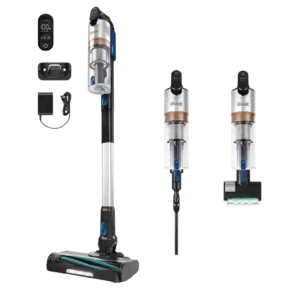

The included tool set is simple but useful, usually centered on a crevice tool or brush plus a mini motorized or upholstery tool and wall mount.
The included set (commonly crevice + upholstery/brush tools) covers basic needs well, and several reviews like that the station keeps tools accessible; at least one reviewer wished for a motorized upholstery tool like premium competitors include.
Styling is functional rather than premium: one reviewer found it plain, while another preferred the LVAC-300's color scheme.
Several reviews describe the vacuum and station as sleek/modern and nice-looking enough to leave out, with a tidy, integrated charging/parking setup.
In the available evidence, emptying created minimal upward dust blowback.
The limited area-rug evidence is positive, including one review that said it handled a sheepskin rug well without stalling.
Rug pickup is generally positive, especially when switching up to higher power, with reviewers noting it stays easy to move and cleans well.
Setup is repeatedly described as quick and uncomplicated, usually involving little more than snapping parts together and charging the battery.
Setup is described as tool-free and straightforward: components click together, the station assembles in a couple pieces, and docking begins charging right away.
A bag-full indicator light on the dock is repeatedly mentioned as a helpful reminder to change the dust bag (and may also alert to airflow issues/obstructions per one reviewer).
Battery performance is solid rather than class-leading: several reviews cite around 40 minutes of floorhead use, removable battery charging, and roughly three-hour charge times.
The removable battery and dock charging are frequently praised, with multiple reviews citing ~4–6 hours for a full/initial charge; one reviewer notes it’s unclear how to charge a spare battery without inserting it into the vacuum/dock.
The bagless bin is easy to remove and empty, but one reviewer says the canister can fill relatively quickly.
The onboard dust cup is repeatedly called small with a low max-fill line, but the bagged station (often cited around 2.5–3 L) greatly reduces how often you deal with debris; a few reviewers note bag shape/availability could matter long-term.
Build impressions are mixed: some reviewers call the materials average or cheap-feeling, while others say the parts feel solid and secure in use.
High-pile or thicker carpet remains a weaker area, with multiple reviews reporting reduced pickup versus hard floors or thinner rugs.
Thick/high-pile carpet performance is described as decent but not effortless: one reviewer noticed some motor bogging on very thick carpet, suggesting it’s better on hard floors and rugs than plush carpeting.
Low-pile carpet performance is generally positive for regular cleaning and routine debris pickup.
In the available controlled test, medium-pile carpet deep-clean performance was excellent.
Clog resistance is not flawless; one review says the filters clog quickly and another notes hair going into the wheel area.
Compared with the LVAC-200 and category averages, the LVAC-300 shows a clear power advantage, though its value edge is less absolute at higher prices.
Compared with cheaper stick vacs (and even some premium brands), reviews generally place performance as competitive for the price; one comparison-heavy review notes slightly below-average deep-clean scores but a standout feature set for the cost.
Controls are simple and easy to understand, with useful status info on the display, but some reviewers dislike that it defaults back to Eco mode.
Controls are repeatedly described as simple: a power button (no trigger hold) plus a mode button with light-color indicators for low/medium/high; reviewers find it easy to understand and operate.
It converts effectively between full stick and handheld use, broadening what it can clean around the home.
The vacuum’s modular design allows it to convert quickly into a handheld for quick pickups, stairs, upholstery, and car interiors by removing the wand/head and attaching tools.
One setup-focused review notes the base station power cord is about 57 inches long, which may require placing the dock near an outlet.
Cordless operation is a major convenience point for fast room-to-room cleanup and homes where cords are a hassle.
Cordless use is widely appreciated for quick cleanups and room-to-room mobility without unplugging, especially when paired with a dock that also stores the vacuum.
The dock’s cable management is praised: the cord can be wrapped/stowed neatly and routed out either side for cleaner placement.
One review specifically says it pulled fine dust from grooves between floor planks.
At least one reviewer explicitly notes cyclonic filtration and believes it helps keep suction steadier by reducing how quickly the filter clogs.
The front LEDs do more than light the path; reviewers say they help reveal hidden dust and show what debris is left behind.
Self-empty noise is generally described as reasonable—one reviewer was impressed by how quiet it is, while another says it’s comparable to a robot vacuum’s self-empty sound, so it’s noticeable but brief.
Ease of use is one of the strongest recurring positives, with reviewers calling the vacuum simple, intuitive, and low-fuss.
Edge cleaning is a clear strength, with reviews highlighting strong pickup along baseboards, corners, and room edges.
Emptying is generally clean and controlled, with reviewers noting low mess and minimal dust blowback.
The bagged emptying station is repeatedly called the headline feature because it reduces mess and contact with dust; most reviewers describe an empty cycle triggered by pressing a button, and some wish it emptied automatically on docking.
Filtration is a recurring strength, with several reviews citing 5-stage or HEPA-style capture and generally clean air output, although one test said the system was only partially sealed.
Reviews mention HEPA filtration (in the station and/or vacuum) and generally report good dust containment, especially when using the bagged emptying system; several call out multi-stage filtration and fewer dust clouds when emptying.
The multi-surface floorhead is a core part of the design, with anti-tangle elements, debris channels, and easy roller access for maintenance.
The powered floorhead is noted for swivel flexibility, helpful wheels, and easy-access brush-roll removal for cleaning; multiple reviewers also highlight a lay-flat style design that improves reach.
Despite the anti-tangle claims, a couple of reviews still report hair tangling or hair entering the wheel area.
On carpet, hair pickup is decent on easier surfaces, but thicker carpet is still more challenging.
Carpet hair pickup is described as strong enough to lift out hidden pet hair and dust, though results may vary with thicker carpets.
Available evidence points to good hair pickup on hard floors, including pet-hair cleanup.
Multiple reviews mention strong pet-hair pickup on hard floors, with hair pulled in quickly rather than scattering.
Hair-wrap resistance is mostly good, but not perfect: many reviewers praise the anti-tangle design, while a few still report long-hair tangling or hair entering the wheel area.
The anti-tangle system is widely praised for reducing hair wrap, particularly with pet hair; a few users still found some long hair/threads collecting near the roller center or edges, so it’s improved but not perfect.
Hard-floor fine-dust pickup is one of the strongest repeated positives, although a little residue can remain on some textured surfaces.
Large debris pickup on hard floors is mixed; some reviewers report easy pickup, while others saw snowplowing or needed to adjust the head.
Real-world demos show it can handle larger debris like crumbs and kids’ snack messes on hard floors in about one to two passes.
LED headlights are consistently described as useful for spotting dust under furniture and in dim areas.
Built-in LEDs/headlights are repeatedly highlighted as bright and genuinely useful for spotting debris in darker areas and under furniture.
One review explicitly praises how flat the vacuum can lie for low-clearance cleaning.
A slim, low-profile build is repeatedly cited, helping the vacuum fit into tighter spaces and lay low to the ground during cleaning.
Maintenance is simple overall because parts and filters are washable, but one reviewer did encounter quick filter clogging.
Maintenance is described as manageable: filters are washable (with drying time), the brush roll can be removed for cleaning, and the bagged dock reduces frequent manual emptying; some mention multiple filters to rinse periodically.
Handling is a major strength, with repeated praise for low weight, agile steering, and easy one-handed use around furniture.
Handling is generally praised as light and smooth, helped by swivel steering and small wheels; it glides easily on hard floors and rugs, though very thick carpet can make the motor work harder for some users.
Measured noise sits roughly in the low-60s to high-60s dB range, and reviewers generally call it quieter than many cordless vacuums.
Noise is typical for a cordless stick at higher power; one measured test reported peak loudness around the low‑80 dB range on max, which is slightly below average but still noticeable.
Onboard accessory storage is a weakness; reviewers say there is nowhere on the vacuum itself to keep the extra tools.
Integrated tool storage on the base station is a recurring convenience point, keeping attachments and (in some cases) the wand/parts organized and easy to grab.
There are no bag costs, but spare filters and batteries are extras, and washable filters help reduce recurring spend.
Overall sentiment is positive: most reviewers frame it as a capable, practical everyday cordless vacuum with a few clear limitations.
Packaging is described as compact, protective, and efficiently packed, though one reviewer noted it was not biodegradable.
Unboxing impressions are positive, with reviewers noting parts arrived well-protected and securely packed.
Pet-focused evidence is positive: reviewers mention anti-tangle design, pet-hair-friendly attachments, and useful cleaning for pet homes, especially on upholstery and hard floors.
Value is generally rated as good to fair, especially when discounted, though a few reviewers think the midrange price brings tougher competition.
Overall value is a recurring theme—multiple reviewers call it a strong deal for the features (especially the bagged empty station), often citing prices around ~$198 on sale while noting higher listings elsewhere.
Real-world runtime usually lands around 40 to 45 minutes with the floorhead in lower modes, while highest-power cleaning tends to fall around 10 to 17 minutes.
Reported low/medium runtimes are commonly cited around ~60 minutes (low) and ~40 minutes (medium), with at least one review mentioning up to ~70 minutes on low; many users say that’s enough for whole-home cleaning. High/turbo runtime is commonly cited around ~15 minutes, which reviewers frame as suitable for quick, intense cleanups rather than full-home sessions.
The light body and mini motorized tool make it useful on stairs and other elevated cleaning spots.
Stair cleaning is frequently called convenient because the wand can be removed for handheld use or the powered head can be used directly depending on preference.
Its self-standing design stands out across reviews, making pauses, storage, and upright parking easier than on many stick vacuums.
The vacuum is often stored on the base station, which functions as a stand and charger; one reviewer notes the stick does not free-stand upright on its own, so you rely on the dock or an “easy rest” lean feature.
Reviews consistently describe strong suction for the class, with above-average measured suction in controlled tests and good everyday airflow, though it is not sold as a premium deep-clean powerhouse.
Suction is consistently described as strong for everyday cleaning, with reviewers noting it pulls fine dust, crumbs, and pet hair effectively on hard floors and rugs; one test-style review cites above-average suction metrics and solid deep-clean scores for the price.
Several reviewers say it is best for everyday or in-between cleaning rather than replacing a stronger full-size vacuum for heavy deep-clean jobs.
Its compact, self-standing form makes it easier to store and use in smaller homes or apartments.
One review says the brush-style surface tool works well on delicate surfaces.
Soft-bristle and dusting-style tools are described as gentler around delicate items and furniture surfaces, reducing the risk of scratching or knocking things over.
Tool changes are quick and straightforward, with reviewers highlighting easy snap-on swapping and simple roller removal for cleaning.
Attachments and the wand/head are described as quick to swap thanks to push-button latches, making it easy to switch from floors to crevices, stairs, or furniture.
Its flat-laying or low-profile head helps it reach under sofas and similar low-clearance furniture.
Under-furniture reach is repeatedly praised: reviewers show it fitting under low cabinets and lying very flat to reach deep under beds and furniture, helped by the flexible head/neck design.
Above-floor cleaning is a real strength thanks to the mini motorized tool and handheld format for sofas, bedding, curtains, car interiors, and upholstery.
Above-floor cleaning gets good feedback with the upholstery/brush tools, including picking up fine pet hair on furniture and cleaning car interiors; a few note it can feel tiring to hold up for extended periods.
Reviewers use it across mixed floors, upholstery, cars, and everyday household messes, making it more versatile than a floor-only stick vac.
Reviewers use it in multiple configurations—floors, stairs, furniture, and cars—highlighting the modular design plus the dock as a “grab-and-go” setup.
The LVAC-300 is repeatedly described as lightweight, with assembled weights around the mid-6-pound range in several reviews.
Weight impressions are positive overall, with reviewers calling it light and manageable (often cited around ~6–7.5 lb depending on model/measurement), helping reduce arm fatigue during floor cleaning.