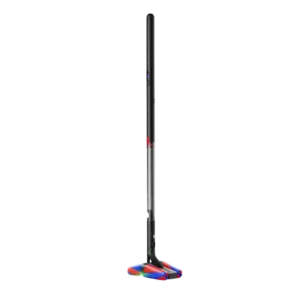
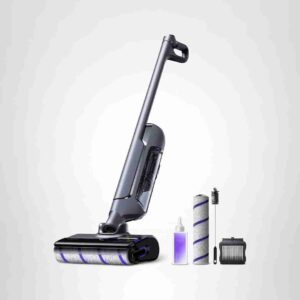
The included accessory set is minimal but useful, centering on a combi/crevice-style tool for corners, cobwebs, and tighter spaces.
Several reviews highlight a well-rounded in-box kit, commonly including a spare roller, spare filter, cleaning brush, and a bottle of Narwal cleaning solution. This reduces immediate add-on purchases and helps with early maintenance.
The PencilVac is repeatedly described as slim, stylish, futuristic, and technically impressive in a way that feels more design-forward than a typical stick vacuum.
Multiple reviewers call the S20 Pro sleek and premium-looking, with a clean gray finish and a modern base station. Fit-and-finish impressions are consistently positive in the video and article reviews.
The connected features are present but limited, with reviews describing the app as mostly useful for maintenance prompts, setup, or updates rather than advanced automation.
Smart dirt sensing and automatic adjustment are repeatedly mentioned, including blue-light style DirtSense indicators and posture detection features. A missing app connection is noted by at least one reviewer, but many still feel the on-device automation and modes cover most needs.
One review found it workable on a flatweave area rug, but only as a limited exception rather than a true rug-cleaning strength.
Setup is consistently described as fast and straightforward, with simple assembly and very little packaging complexity to sort through.
Setup is consistently described as quick, typically involving attaching the handle, charging, and filling the clean tank and solution reservoir. Several reviewers note it feels close to pre-assembled out of the box.
One review noted that the vacuum automatically shuts off when caught on a rug edge, indicating some obstruction protection.
Auto pause or standby when the unit is stood upright is appreciated for quick interruptions without dripping or running unnecessarily. This feature is treated as a practical convenience during room-to-room cleaning.
Battery design gets credit for being removable/swappable, but real-world runtime remains a frequent compromise and charging times vary across reviews.
Battery life is described as competitive for a wet-dry machine, but recharge time is called out as long by some reviewers, with one citing about a 3-hour full recharge. Buyers with very large areas may need to plan around recharge and tank refills.
The dust bin is tiny by design, but multiple reviews said the compression system lets it hold more than expected; capacity still remains a recurring tradeoff.
Reviews praise the dirty tank design for separating solids from liquids and keeping disposal relatively tidy, helped by tight seals and a removable debris basket. Wet debris can still take some manual brushing or scraping to fully remove.
Build impressions are split: one reviewer praised the overall build quality, while another criticized thin, flimsy-feeling plastic parts.
Most impressions point to solid construction and good sealing around the tanks and head, supporting a premium feel. One hands-on reviewer experienced dripping and questioned long-term reliability, suggesting quality control could vary.
High-pile or general carpet cleaning is a recurring weakness, with reviewers saying it bogs down, stalls, or simply is not meant for carpet use.
Low-pile and flatweave performance is only modestly acceptable: several reviews say it can handle surface debris on mats or low pile, but not much more.
One review explicitly found mid-pile carpet pickup weak, with fine debris still visible after several passes.
Clogging is a meaningful downside in tougher scenarios, with reviews citing blockage errors or inlet struggles on flour, larger debris, or heavier messes.
Design elements like a lower-positioned water system, one-way flow, and dual-direction brush action are credited with reducing clogs and keeping debris moving into the tank. Reviews also connect this to better handling of hair and chunky food bits without the head jamming.
At least one reviewer directly preferred a conventional Dyson alternative for whole-home cleaning and stronger suction.
In head-to-head and multi-model comparisons, the S20 Pro is often ranked at or near the top for overall package, especially on hard floors and for its drying system. Competitors may beat it on reverse pickup, rugs, or certain niche features, but the Narwal is frequently framed as the most complete option.
Controls are simple and easy to understand, with basic buttons and a small display for mode and remaining runtime.
The on-handle LCD and voice prompts are widely praised for clarity, showing mode, battery, alerts, and sometimes detergent status or timers. Some note the screen is small, but still informative and easy to follow during cleaning and self-clean cycles.
Only one review gives a specific number, citing a 6-foot power cord for the dock, which influences where the base can sit. It is described as usable but not especially long.
Its grab-and-go format makes it easy to keep nearby for fast cordless spot cleaning instead of dragging out a larger machine.
Where mentioned, reviewers appreciate dock-side cord routing or a cord holder that keeps the charging base tidy. This helps reduce clutter around the storage station.
One testing-focused review said crevice pickup underperformed relative to category expectations.
The dual front-and-rear dust illumination is one of the most praised features, repeatedly called useful for revealing debris that would otherwise be missed.
Dried coffee and similar stains are often removed with a pass or two, and reviewers credit scrubbing pressure and a boost mode for tougher spots. Very sticky or thick dried sauces like ketchup may require multiple passes, and some note the dehydrating dry-down can leave color residue that needs manual roller cleaning.
Once users adjust to the broom-like grip, ease of use is widely praised for quick daily cleaning and touch-ups.
Ease of use is a recurring positive: light weight, clear on-screen prompts, and one-button self-cleaning make daily cleanup straightforward. A few critiques relate to learning how to avoid backward passes and keeping up with tank emptying for best results.
Edge cleaning is mixed but often good: several reviews praise baseboard and side-edge pickup, while others note the pointed front head cannot always sit flush to walls.
Edge performance is repeatedly called exceptional, with reviewers describing near-zero gaps along baseboards and strong cleaning at the front edge as well. This is one of the most consistently praised differentiators versus competing wet-dry models.
Emptying gets mixed feedback: some reviewers call it clean and hygienic, while others say the sliding system can feel messy or overcomplicated.
Reviewers like the way the dirty tank separates solids, which helps keep emptying neater and reduces splashy cleanup. However, wet debris can adhere inside the tank and may need periodic scrubbing for a truly clean reset.
App alerts can notify users about filter cleaning, but this feature is described as basic rather than especially advanced.
Where reviewers tested or cited it, filtration was a strength, with sealed capture claims and one fog test reported as a clear pass.
Filtration is generally handled by a washable filter in or near the dirty-water tank; reviewers note it needs rinsing and fully drying before reuse. Some packages include a spare filter, which helps reduce downtime.
Floors are often left reasonably dry after a pass, especially compared with older wet mops, and the heated roller drying helps after-use drying. One reviewer still observed dripping and wet roller marks when the unit was set down, so drying outcomes can depend on handling and mess type.
The Fluffycones floorhead stands out for its multidirectional movement and unusual geometry, but the same design also creates edge and carpet tradeoffs.
Fresh spills and wet messes are commonly cleaned in a single forward pass, including coffee, soda, cereal milk, and yogurt-like messes. Reverse-pass pickup is reported as weaker in at least one test, so best results come from forward cleaning.
A recurring complaint is that hair can form clumps and get ejected or left at the side of the head instead of being fully sucked in.
Hair pickup on hard floors is generally good for visible surface hair, but some reviews note limits with thicker bundles or leftover clumps.
Hair pickup on hard floors is consistently positive in demonstrations, and reviewers say hair is carried into the tank rather than staying on the roller. Results are especially strong when paired with the anti-tangle roller design.
The conical rollers are widely credited with resisting hair wrap, making tangling much less of an issue than on traditional brush bars.
Anti-tangle performance is a consistent highlight, with multiple long-hair tests reporting zero wrap thanks to dual comb and dual rotation design choices. This is repeatedly positioned as a major improvement over wet-dry competitors that require cutting hair off the roller.
Fine-dust pickup on hard floors is usually a strong point, though one lab-style review reported poor flour performance and blockages, so the praise is not universal.
Reviews show strong pickup of fine particles like dust and flour on hard floors in forward passes. Performance can drop when cleaning backward, where some fine debris may be left behind.
Large-debris pickup is mixed: some reviewers were impressed by cereal or similar debris on hard floors, while others said bigger messes quickly exposed the tiny bin or caused blockages.
Large debris like cereal, rice, chips, and pet food is generally handled well, often with minimal scatter when moving forward. Backward passes can be less reliable, with some debris getting pushed or caught behind the wheels.
The front-and-rear floor lights were specifically praised for making hidden dust much easier to see during cleaning.
A frequent complaint is the lack of built-in headlights, which can make it harder to spot debris in dim rooms or under furniture. Reviewers generally treat this as a convenience miss rather than a deal-breaker.
Multiple reviews frame the PencilVac as a genuine engineering departure from typical stick vacuums and one of Dyson’s more distinctive ideas.
One review said children were eager to use it, largely because it is light and visually satisfying to clean with.
The slim, low-profile design helps it slide under furniture and work in tight, low-clearance areas.
The low profile when laid flat helps it reach under toe-kicks and furniture, and reviewers repeatedly point to this as a practical advantage. It pairs well with posture detection that helps prevent water leaks when the unit is lowered.
Routine upkeep looks manageable, usually centering on filter care, rinsing, and occasional cleaning rather than constant maintenance.
Maintenance is generally reduced by the automated wash and heated dry, but users still need to empty the dirty tank and rinse and dry filters regularly. Neglecting post-clean tank care can cause odors, and some wish the self-clean used more water for an even cleaner reset.
Maneuverability is the clearest consensus strength: reviewers repeatedly describe it as nimble, light, smooth-swiveling, and unusually easy to guide around furniture and tight spaces.
Handling is a standout theme: reviewers consistently call the unit light, easy to steer, and comfortable thanks to a pivoting head and low center of gravity. Lay-flat movement and swivel action make it feel less fatiguing than many wet-dry rivals.
Most reviews show strong one-pass vacuum-and-mop results on typical spills and tracked-in dirt, with multiple modes to tailor water and suction. Heavy muddy sludge or cleaning while pulling backward can expose weaknesses, including streaking or debris left behind in a few accounts.
Measured noise was described as a typical high-pitched cordless-vacuum hum rather than an unusually quiet or loud standout.
Cleaning and especially the drying cycle are often described as unusually quiet for the category, with some reviewers measuring roughly 39 to 43 dB during roller drying. Quiet mode cleaning is also noted as comfortable for home use.
Heated drying and a fully dried roller are credited with minimizing musty odors between uses. At the same time, reviewers warn that leaving dirty water or neglecting tank cleaning can still create lingering smells.
At least one review praised the dock for giving the crevice tool a dedicated storage spot.
One review flagged extra-battery pricing as a notable ongoing cost if you need more runtime.
Overall sentiment is positive when the PencilVac is judged as a lightweight hard-floor touch-up tool, but much more mixed when price, whole-home use, or broader capability are considered.
Across the set of reviews, overall sentiment is strongly positive, with several reviewers ranking it as a top pick for hard floors. The most negative feedback comes from one reviewer who saw streaking and dripping during a heavy muddy test and withheld a recommendation, plus recurring complaints about reverse pickup and missing headlights.
One review praised the packaging as compact, clearly labeled, and easy to unpack.
Pet use is mixed: one review criticized the lack of a mini motorized pet tool, while another found it picked up visible pet hair well on hard floors.
Value is one of the biggest sticking points: most reviewers call it expensive for a niche hard-floor cleaner, though a few felt the price made sense if you want this exact form factor.
Value is usually framed as strong given the feature set and performance on hard floors, especially when discounted from the roughly 499 USD list price. Value perception drops if reverse cleaning, missing headlights, smaller tanks, or longer recharge time are major pain points.
One review criticized the app for pushing for permanent location access during setup.
Runtime is one of the most common compromises. Reviewers say it is usually enough for quick cleans or smaller spaces, but not generous for larger homes or whole-house runs.
Runtime in everyday or smart-style modes is described as strong, with one measured test around 39 minutes in smart mode and multiple claims of up to about 60 minutes in quieter settings. Actual coverage depends heavily on mode choice and how dirty the floors are.
High-temperature self-cleaning and heated drying are repeatedly positioned as a hygiene advantage that reduces bacterial growth and keeps the roller fresher. Reviewers treat it as more sanitary than air-drying rollers that stay damp.
The self-clean and heated self-dry base is one of the biggest strengths, with multiple reviewers saying the roller comes out genuinely dry. Drying time is often described as sensor-controlled (roughly 30 to 80 minutes), though a few reviewers wish the wash used more water or note that strongly colored sauces may require extra manual cleaning.
One review described the floorhead as creating a self-propelling feel that makes the vacuum easier to guide.
Several reviewers describe helpful push-pull assistance that makes the unit feel self-propelled, especially in smart modes. One review notes there are no dedicated self-propulsion wheels, suggesting the assistance may come from roller traction and can feel different than true powered drive.
App-based firmware support exists, but the cited benefits are modest and focused more on updates and maintenance reminders than major new functionality.
The separate detergent reservoir and auto-dosing system are frequently praised, often described as lasting up to about 40 days and allowing solution on or off control. Reviewers also like having a suction-only mode for liquid pickup without spraying detergent.
Its low weight and long reach make it useful for stairs and baseboards, especially for quick touch-up cleaning.
The magnetic/freestanding dock is usually seen as convenient and compact, though a few reviewers found the base flimsy or not especially space-saving versus a normal stick vac.
The dock base needs an outlet nearby, so placement can be less flexible in some rooms, and a few reviewers mention keeping it close to a plug. Most still find the storage setup straightforward once a spot is chosen.
Most demos show clean-looking passes, but one reviewer reported visible streaks and a failed white-glove test after cleaning a heavy muddy mess. This suggests residue can occur in extreme grime or if the machine is set down while the roller is still wet.
Reviews describe suction as sufficient for hard-floor touch-ups but clearly weaker than fuller-power stick vacuums and a poor fit for carpets or heavier messes.
Most reviewers describe strong hard-floor pickup and cite about 20,000 Pa suction, with convincing performance on mixed dry and wet messes. A recurring caveat is that pickup is weaker when pulling the unit backward, where debris can get caught near the wheels.
Heavy-duty cleaning is not its lane; one review explicitly says it is only for small, light cleans.
Review evidence consistently points to small apartments and smaller hard-floor homes as the most natural fit for this vacuum.
Support and reliability feedback is mixed: one review flags stock availability and a short warranty, while another reports dripping or leaking after a heavy muddy cleanup. Most other reviews do not report failures, but these flags add some risk for cautious buyers.
One review specifically said the soft floorhead can get close to hard floors without risking scratches.
One review said the attachments clip in and out easily, suggesting quick tool changes once you know the system.
Its ability to lie flat or reach deep under furniture is a real advantage in everyday use.
The ability to recline fully and clean under beds, couches, and cabinets is frequently praised, aided by a low profile in the laid-flat posture. Some reviews also mention automatic power changes when going flat to maintain pickup.
Above-floor cleaning is a mixed bag: the long wand is great for high cobwebs, baseboards, and awkward gaps, but several reviewers found close-range handheld-style jobs awkward.
Versatility is limited. Reviewers repeatedly frame it as a specialized hard-floor cleaner rather than a true whole-home or all-surface vacuum.
Tank sizes are described as adequate for routine cleaning, with published or reviewer-cited capacities around 0.79 L clean and 0.67 L dirty. Some reviewers feel the clean tank is on the smaller side and one test required emptying the dirty tank after about 20 minutes, so large homes may need mid-clean stops.
Low weight is a major selling point, with repeated references to roughly 4 lb / 1.8 kg handling.
Many reviews call out the low weight, commonly around 9 to 9.5 pounds, making it easier to carry upstairs and less tiring to push. Weight is often cited as one reason it feels more agile than rivals.