Reviews explicitly note there is no ANC on the OpenFit 2.
Active noise cancellation is not included, and reviewers frame that as expected for open-ear earbuds but still a limitation for commuters who want quiet. Because ANC is absent, there is no meaningful noise-cancellation adjustment beyond managing your own listening volume.
At least one review explicitly notes companion-app support on Android.
Android support is strong, especially because Android users can access LDAC and app features; iOS works well too, but without LDAC.
The app is widely seen as useful for EQ, controls, and setup, though one review says it is not especially deep.
The Soundcore companion app is consistently recommended for setup and daily use, enabling control remapping, EQ tweaks, device management, and extra modes like gaming and 3D surround.
One review says codec support is limited to SBC and AAC, so aptX support is not indicated.
One review reports no lip-sync delay when watching video.
Gaming or low-latency modes are mentioned as helpful for video and games, with generally positive expectations for sync, though deep testing details are limited.
Bass is repeatedly described as improved, richer, and stronger for an open-ear design, but reviewers still note it cannot match the punch of good in-ear earbuds.
Bass is improved versus many open-ear designs and benefits from precise driver positioning and EQ, but deep low-end remains limited and can feel woolly or cause vibration at higher volumes.
Battery life is one of the clearest strengths, with repeated 11-hour and 48-hour figures and several reviewers saying it easily lasts through long days or multiple workouts.
Battery life is a standout on paper and often in use: multiple reviews cite long single-charge runtime and strong total runtime with the case, but at least one review questions the headline numbers at high volume, and LDAC can shorten runtime.
Bluetooth 5.4 is repeatedly cited, with reviewers describing stable connections and strong behavior in busy signal environments.
Bluetooth stability is generally positive, aided by Bluetooth 5.4, with few complaints about dropouts in the reviews.
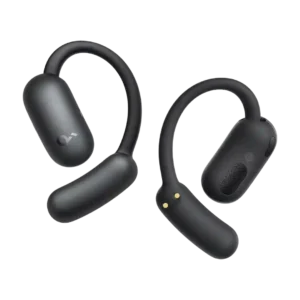
One review highlights the upgraded flexible nickel-titanium ear-hook construction as a build improvement.
Build quality impressions are strong, with soft silicone materials and a generally well-finished feel suitable for workouts.
Physical buttons are one of the most praised upgrades, with reviewers repeatedly calling them easier and more reliable than touch-only controls.
Reviewers find the case functional and generally good, though it is not highlighted as a standout feature.
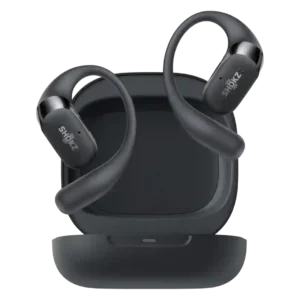
The charging case is often described as large or wide, sometimes awkward for pocket carry or for inserting the earbuds, though it is generally sturdy and functional.
Quick charging is a real plus, with reviews repeatedly citing roughly 2 hours of playback from a short top-up.
Charging is consistently strong, with fast-charge claims (about 4 hours from a short top-up) and broad praise for the convenience of the charging case.
One review explicitly says codec support is limited to SBC and AAC.
Codec support is solid for the category, commonly noted as SBC/AAC plus LDAC for compatible Android devices.
Comfort is one of the strongest themes, with many reviewers saying they can wear the OpenFit 2 all day or through very long workouts.
Multiple reviewers highlight all-day comfort with the adjustable ear hooks, including extended sessions (4+ hours) without hot spots, and good comfort even with glasses.
The design gets positive marks for looking premium or refined rather than flashy.
Design feedback is mostly positive, including color options and a visible case light bar, but the overall size and open-ear form factor mean it does not disappear when worn.
Reviews consistently confirm app-based EQ customization, including manual adjustment and control setup.
EQ customization is a key value add, with an 8-band EQ that can noticeably reshape the sound and help compensate for open-ear limitations.
Earbud-finding features exist in the app, but reviewers note the feature is limited and does not fully solve case-finding.
Find features are basic: some mention a beep-to-locate function in the app, but there is no full network tracking experience like platform-level find services.
Measured commentary in one review suggests the tuning tracks fairly close through the midrange, with restrained treble.
Objective measurements and listening notes point to a compromised frequency response typical of open-ear designs, with especially limited low-frequency output compared with sealed earbuds.
One review notes that a USB-C cable is included in the box, but bundled extras appear minimal.
Reviewers say the dual-driver approach helps vocals, instruments, guitars, and acoustics sound more defined than before.
With LDAC and good recordings, separation and stereo imaging can be quite enjoyable, though the open design still limits fine nuance compared to sealed earbuds.
Reviews confirm integrated microphones and call controls are built in.
One review says codec support is limited to SBC and AAC, so LDAC support is not indicated.
LDAC support is repeatedly praised for added clarity and detail on Android, but it can reduce battery life and may force you to give up multipoint.
It can stay fairly clear at moderate to high volume, but several reviews still mention distortion or muddiness once volume is pushed too hard.
Multiple reviews say the microphones do a good job reducing background noise during calls or voice notes.
Background noise handling is mixed: it can keep voices intelligible in office or windy conditions, yet does not fully suppress surrounding noise.
Call quality is repeatedly described as clear and usable, including outdoors and during movement.
Call quality is generally usable, with voices staying clear in ideal or moderate noise, but it is not consistently best-in-class.
Mids are regularly described as clearer and more detailed than before, helping vocals and general listening come through more cleanly.
Midrange is generally smooth and listenable, though some reviews say it lacks standout detail compared with the best open-ear competitors.
The OpenFit 2 is used successfully across phones, laptops, watches, and other wearables, suggesting broad everyday compatibility.
Across reviews, AeroFit 2 is used with both Android phones and iPhones, and it is positioned as broadly compatible for music, calls, and workouts.
Multipoint is a major strength, with repeated praise for quick and reliable switching between two connected devices.
Multipoint is supported and useful, but several reviewers note a tradeoff: enabling LDAC or certain features (like translation) can disable multipoint.
Passive isolation is intentionally minimal, keeping ears open rather than blocking outside noise.
Passive isolation is essentially nonexistent by design, so outside noise freely reaches your ears.
The case is described as easy to carry or pocketable, even if open-ear designs are not ultra-compact.
Portability is acceptable but not class-leading, mainly due to the comparatively bulky case despite some notes that it is flat enough to pocket.
Preset EQ modes are useful, with Standard, Bass Boost, and Vocal options specifically called out, though some reviewers still preferred Standard.
Preset EQ quality is mixed: there are many options, but several presets are described as overly similar or poorly tuned, so custom EQ tends to deliver the best results.
Multiple reviews call out the lack of wear detection, making sensor features a weak spot.
Comfort sensors are limited: multiple reviewers note there is no wear detection, so audio does not auto-pause when you remove an earbud.
One review says the light-colored case picks up dirt quickly, though marks can be wiped away.
Pairing and initial setup are described as quick, easy, and friendly even for less technical users.
Pairing and setup are described as straightforward, and most features are easy to find once the app is installed.
Leakage is improved and often limited at normal volume, but several reviews still report audible bleed at higher levels or in quieter spaces.
Reviews consistently describe the OpenFit 2 as a clear upgrade in sound, with richer, clearer audio than earlier OpenFit models, though it still does not beat strong sealed in-ear earbuds.
Overall sound is widely considered good for the price in the open-ear category, but still limited by the form factor; it can be enjoyable for music, podcasts, and video, yet it trails top-tier open-ear rivals in balance and detail.
One reviewer describes the presentation as wide and open for this style of earbud.
Soundstage is frequently described as robust for open-ear earbuds, contributing to an enjoyable, spacious presentation in quiet environments.
One review explicitly says there is no 3D or spatial audio feature on the OpenFit 2.
Spatial or 3D surround features are included, but several reviewers say the effect is subtle and not a major reason to buy.
Fit security is excellent in review after review, with the buds staying put for running, workouts, and daily movement.
Fit security is a major strength: the adjustable speaker module helps align sound with the ear canal and keeps the buds stable during runs and workouts, though a few note the fit is not perfect for very jumpy activity.
Touch input is more limited than the physical buttons and can be finicky for some reviewers, though others say it works once configured.
Touch controls are functional but divisive: some praise quick, reliable taps, while others report overly sensitive surfaces that trigger accidental commands, especially during fit adjustments or in rain.
A dedicated transparency mode is not present; awareness comes from the open-ear design instead.
Environmental awareness is excellent, letting you hear traffic, conversations, and other surroundings clearly, which is the main benefit of the open-ear design.
Treble is generally described as crisper and restrained enough to avoid harshness or sibilance.
Treble performance varies by tuning: some find it slightly dark or lacking sparkle, while certain presets can push treble too far; careful EQ helps maintain clarity without harshness.
USB-C charging is explicitly confirmed in reviews.
USB-C charging is present and commonly noted as the primary wired charging method for the case.
Value is mixed: some reviewers think the performance justifies the price, while others see the regular model as harder to recommend near the 2+ or discounted rivals.
Voice assistant support exists, but activation is button or touch based rather than truly hands-free, so the implementation feels basic.
Voice assistant control is supported via customizable gestures, letting you summon your assistant hands-free once configured.
The OpenFit 2 gets notably louder than the original and louder than many open earbuds, which helps outdoors.
Volume output is strong for open-ear earbuds, with comfortable listening possible at moderate device volume, but multiple reviewers caution against cranking volume in noisy environments for hearing safety.
The IP55 rating is repeatedly called out as enough for sweat, rain, and workout use.
IP55 is repeatedly cited as good protection for sweat, splashes, and dust, but it is not intended for submersion.
Reviewers describe the buds as light or light-feeling on the ear, with weight distributed comfortably for longer wear.
Weight is generally described as light and unobtrusive for an open-ear design, contributing to long-wear comfort.