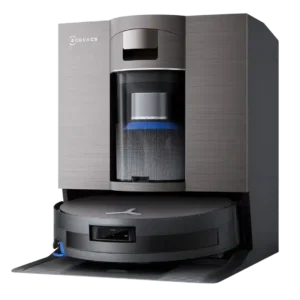
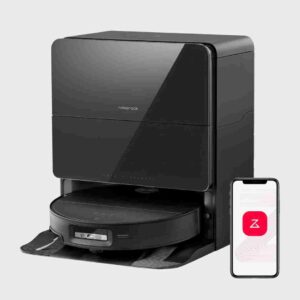
Average score
P1
Product 1: Ecovacs Deebot X11 OmniCyclone
3.9
P2
Product 2: Roborock Saros 10 Robot Vacuum...
4.2
Accessories and Tools
P1
Product 1: Ecovacs Deebot X11 OmniCyclone
2.8
Accessory feedback was mixed: some appreciated the included cleaning brush, but several reviews criticized the lack of spare brushes, filters, mops, or sample solution.
P2Product 2: Roborock Saros 10 Robot Vacuum...
No score yetAdaptive chassis lift
P1
Product 1: Ecovacs Deebot X11 OmniCyclone
3.9
Threshold and chassis-lift performance was highly context-dependent, ranging from excellent climbing in some homes to unimpressive or stuck behavior in others.
P2
Product 2: Roborock Saros 10 Robot Vacuum...
4.8
Adaptive chassis lift was one of the most praised hardware features, helping with thresholds, deep-pile carpet, and unusual obstacles.
Aesthetic design and finish
P1
Product 1: Ecovacs Deebot X11 OmniCyclone
4.3
Reviewers generally liked the premium, modern design, metallic accents, and stylish dock, even where the base footprint was divisive.
P2
Product 2: Roborock Saros 10 Robot Vacuum...
4.3
Most reviewers liked the premium, futuristic look and dock finish, although one noted the glossy base shows smudges.
AI, Smart, App and Automation
P1
Product 1: Ecovacs Deebot X11 OmniCyclone
3.5
AI, app, and automation evidence was mixed: the app was often capable and feature-rich, but AI modes and voice commands were inconsistent in several reviews.
P2
Product 2: Roborock Saros 10 Robot Vacuum...
4.6
App, AI, and automation were standout strengths, with reviewers praising SmartPlan, mapping, camera features, voice control, and the Roborock app.
Area Rug Handling
P1
Product 1: Ecovacs Deebot X11 OmniCyclone
2.0
Area-rug handling was a repeated concern, especially with small rugs, tassels, bath mats, door mats, and long-pile rugs.
P2
Product 2: Roborock Saros 10 Robot Vacuum...
4.3
Area rug handling was mostly positive because mop removal/lifting kept rugs dry, but one reviewer warned taller rugs can still contact the mop.
Assembly and Setup
P1
Product 1: Ecovacs Deebot X11 OmniCyclone
4.9
Setup was consistently described as simple, fast, or easy, with the app and QR-code pairing helping most reviewers get running quickly.
P2
Product 2: Roborock Saros 10 Robot Vacuum...
4.8
Setup was consistently described as quick, straightforward, or less intimidating than expected.
Automatic shutoff for obstructions
P1
Product 1: Ecovacs Deebot X11 OmniCyclone
3.0
Automatic obstruction shutoff had limited but mixed evidence, with one reviewer appreciating the warning halt while criticizing the situation that triggered it.
P2Product 2: Roborock Saros 10 Robot Vacuum...
No score yetBag-full indicator
P1
Product 1: Ecovacs Deebot X11 OmniCyclone
2.3
Bag-full indicator evidence was negative, with reviewers wanting clearer or better alerts for when the bagless bin needed emptying.
P2Product 2: Roborock Saros 10 Robot Vacuum...
No score yetBattery and Charging
P1
Product 1: Ecovacs Deebot X11 OmniCyclone
5.0
Battery and charging was one of the strongest themes, with reviewers praising PowerBoost fast charging and reduced downtime in large homes.
P2
Product 2: Roborock Saros 10 Robot Vacuum...
4.5
Battery and charging were considered sufficient to strong, with praise for real-use endurance and fast charging.
Bin and Bag
P1
Product 1: Ecovacs Deebot X11 OmniCyclone
4.0
The bagless bin was widely seen as a major convenience and cost saver, but reviewers also noted smaller capacity, damp debris, or more frequent manual emptying.
P2
Product 2: Roborock Saros 10 Robot Vacuum...
4.0
The dock bag system was praised for clean, easy auto-emptying, but one reviewer criticized the smaller onboard dustbin.
Build quality and durability
P1
Product 1: Ecovacs Deebot X11 OmniCyclone
4.0
Build quality was mostly positive, with solid construction and no creaky parts, though one reviewer questioned the water-tank handle design.
P2
Product 2: Roborock Saros 10 Robot Vacuum...
4.5
One reviewer praised the build quality and component fit, describing the construction as improved and solid.
Carpet — High-Pile Pickup
P1
Product 1: Ecovacs Deebot X11 OmniCyclone
2.3
High-pile carpet performance was mixed to weak, with long-pile carpets and carpet sand stress tests exposing limitations.
P2
Product 2: Roborock Saros 10 Robot Vacuum...
5.0
High-pile carpet handling was strongly praised, with AdaptiLift helping the robot keep moving and vacuuming.
Carpet — Low-Pile Pickup
P1
Product 1: Ecovacs Deebot X11 OmniCyclone
4.5
Low-pile or standard carpet pickup was praised in wall-to-wall carpet testing, with strong daily pickup and grooming.
P2
Product 2: Roborock Saros 10 Robot Vacuum...
3.6
Low-pile carpet pickup was mixed: one lab result was strong for rice, while another reviewer found an initial carpet debris pass disappointing.
Carpet — Medium-Pile Pickup
P1
Product 1: Ecovacs Deebot X11 OmniCyclone
4.8
Medium-pile carpet evidence was strong in Vacuum Wars-style testing, where embedded debris scores were well above average.
P2
Product 2: Roborock Saros 10 Robot Vacuum...
3.9
Medium-carpet evidence ranged from below-average embedded-sand results in one comparison to strong pickup in other real-world tests.
Clogging and debris prevention
P1
Product 1: Ecovacs Deebot X11 OmniCyclone
2.5
Clogging and debris prevention was mixed: hair systems performed well, but large chunks could still lodge in the canister.
P2
Product 2: Roborock Saros 10 Robot Vacuum...
4.5
Clogging and debris-prevention evidence was positive where auto-emptying worked even with a hair-filled bin.
Comparative performance
P1
Product 1: Ecovacs Deebot X11 OmniCyclone
4.3
Comparative performance was strong in several rankings and head-to-head references, though some rivals remained better for navigation or value.
P2
Product 2: Roborock Saros 10 Robot Vacuum...
3.8
Comparative performance was mixed: some reviewers placed it below certain Roborock siblings for specific strengths while others saw little separating the Saros models.
Controls and UI
P1
Product 1: Ecovacs Deebot X11 OmniCyclone
4.0
Controls were generally usable through the app, Home app, voice, or physical buttons, though some reviewers preferred app controls over less reliable voice features.
P2
Product 2: Roborock Saros 10 Robot Vacuum...
4.6
Controls and UI were broadly praised, especially the app, remote control, voice controls, and spot-clean commands, with only minor usability caveats.
Cord management
P1Product 1: Ecovacs Deebot X11 OmniCyclone
No score yet
P2
Product 2: Roborock Saros 10 Robot Vacuum...
2.0
Cord management was criticized because the base-station power cord was unusually thick and harder to route neatly.
Corner Cleaning (Robot)
P1
Product 1: Ecovacs Deebot X11 OmniCyclone
2.8
Corner cleaning was mixed to weak: reviewers appreciated edge systems but still reported missed strips, corners, or manual touch-up needs.
P2
Product 2: Roborock Saros 10 Robot Vacuum...
4.5
Corner cleaning was generally strong thanks to side brush and side mop behavior.
Crevice / Groove Pickup (Hard Floors)
P1
Product 1: Ecovacs Deebot X11 OmniCyclone
4.5
Crevice and groove pickup was positively described where reviewers saw it reach small areas, edges, and crevices.
P2
Product 2: Roborock Saros 10 Robot Vacuum...
2.5
Crevice and groove pickup was a limitation, with grout-line debris left behind in one test and poor grout cleaning in another.
Cyclone performance
P1
Product 1: Ecovacs Deebot X11 OmniCyclone
4.3
Cyclone performance was generally praised for easy bagless emptying and strong auto-empty behavior, with some maintenance caveats.
P2Product 2: Roborock Saros 10 Robot Vacuum...
No score yetDebris illumination
P1Product 1: Ecovacs Deebot X11 OmniCyclone
No score yet
P2
Product 2: Roborock Saros 10 Robot Vacuum...
4.5
The headlight was praised for illuminating dust and debris in darker corners.
Docking and Auto-Empty Reliability (Robot)
P1
Product 1: Ecovacs Deebot X11 OmniCyclone
3.7
Docking and auto-empty reliability was mixed: most auto-empty results were good, but one reviewer had a malfunction requiring replacement.
P2
Product 2: Roborock Saros 10 Robot Vacuum...
4.3
Docking and auto-empty reliability was mostly positive, but one reviewer reported occasional incomplete docking that left the robots offline.
Dock noise
P1
Product 1: Ecovacs Deebot X11 OmniCyclone
2.5
Dock noise was a consistent caveat: normal cleaning could be quiet, but auto-emptying and maintenance cycles were often loud or jarring.
P2
Product 2: Roborock Saros 10 Robot Vacuum...
4.8
Dock noise was praised, especially quiet drying sequences.
Dried-On Stain Removal
P1
Product 1: Ecovacs Deebot X11 OmniCyclone
4.3
Dried-on stain removal was usually strong, especially in tests with coffee, jam, jelly, and soy sauce, though one review saw poor ketchup-stain detection.
P2
Product 2: Roborock Saros 10 Robot Vacuum...
3.7
Dried-on stain results were split: several reviewers praised strong multi-pass stain removal, while comparative and jelly tests found weaker stain handling.
Ease of use
P1
Product 1: Ecovacs Deebot X11 OmniCyclone
3.5
Ease of use was mostly positive, but one review warned that deeper app settings and voice features could confuse less technical users.
P2
Product 2: Roborock Saros 10 Robot Vacuum...
4.5
Ease of use was strong across setup, room editing, voice control, and hands-off operation.
Edge and Baseboard Cleaning (Hard Floors)
P1
Product 1: Ecovacs Deebot X11 OmniCyclone
4.6
Hard-floor edge and baseboard cleaning was often praised for close coverage, although several reviews still found corner or border limitations.
P2
Product 2: Roborock Saros 10 Robot Vacuum...
4.6
Edge and baseboard cleaning was usually praised, with reviewers noting strong wall and corner pickup, although one test called it decent rather than perfect.
Edge‑Following Accuracy (Robot)
P1
Product 1: Ecovacs Deebot X11 OmniCyclone
3.0
Edge-following accuracy was mixed, with some daily cleaning working fine but uneven following or odd fluctuations near moulding.
P2
Product 2: Roborock Saros 10 Robot Vacuum...
3.0
One reviewer found the robot sometimes avoided legs and furniture too widely, limiting close edge-following.
Emptying and Mess Control
P1
Product 1: Ecovacs Deebot X11 OmniCyclone
3.3
Emptying and mess control was mixed: bagless emptying was convenient, but damp debris, dust, and more frequent manual emptying were common caveats.
P2
Product 2: Roborock Saros 10 Robot Vacuum...
5.0
One reviewer praised mess control because the robot did not drop collected dirt or litter over thresholds.
Filtration / Dust Containment
P1
Product 1: Ecovacs Deebot X11 OmniCyclone
3.8
Dust containment earned moderate praise for the bagless filtration concept, but one maintenance review wanted better filter cleaning and exhaust sealing.
P2
Product 2: Roborock Saros 10 Robot Vacuum...
4.5
Dust containment evidence was positive around the self-sealing bags and mess-free replacement.
Floor Drying Time
P1
Product 1: Ecovacs Deebot X11 OmniCyclone
4.5
Floor drying evidence was positive where Vacuum Wars measured very little water left behind after cleaning.
P2
Product 2: Roborock Saros 10 Robot Vacuum...
5.0
One reviewer praised the light mopping mode for leaving the floor nearly dry by the end of cleaning.
Floorhead design
P1
Product 1: Ecovacs Deebot X11 OmniCyclone
4.0
The main brush and floorhead design received praise for its anti-tangle approach and pickup support.
P2
Product 2: Roborock Saros 10 Robot Vacuum...
4.5
Floorhead design received positive feedback for the side brush and anti-tangle brush concepts improving pickup and hair handling.
Floor shine after cleaning
P1
Product 1: Ecovacs Deebot X11 OmniCyclone
5.0
Floor shine was positively mentioned by a reviewer who said hard floors looked shiny and clean after runs.
P2
Product 2: Roborock Saros 10 Robot Vacuum...
4.5
One reviewer linked the cleaning result to sparkling-looking floors after regular use.
Fresh Liquid Pickup Speed
P1
Product 1: Ecovacs Deebot X11 OmniCyclone
5.0
Fresh liquid pickup was excellent where tested, with soy sauce and wet messes cleaned very thoroughly.
P2
Product 2: Roborock Saros 10 Robot Vacuum...
2.0
Fresh spill handling was weak in one home test, where porridge, sauce, and milk were spread rather than cleaned up.
Hair-removal channel issues
P1Product 1: Ecovacs Deebot X11 OmniCyclone
No score yet
P2
Product 2: Roborock Saros 10 Robot Vacuum...
4.5
One reviewer praised the hair-removal channel design for drawing hair off the rollers and into the bin.
Hair Pickup — Carpets
P1
Product 1: Ecovacs Deebot X11 OmniCyclone
4.9
Carpet hair pickup was a major strength, with multiple tests reporting perfect or near-perfect pet-hair pickup.
P2
Product 2: Roborock Saros 10 Robot Vacuum...
4.2
Carpet hair pickup was strong in direct dog-hair and long-hair tests, though one comparative review said another robot scored much better.
Hair Pickup — Hard Floors
P1
Product 1: Ecovacs Deebot X11 OmniCyclone
5.0
Hard-floor hair pickup was praised by a reviewer with pets, who found trace pet hair was collected well.
P2
Product 2: Roborock Saros 10 Robot Vacuum...
4.5
Hard-floor hair pickup was positive in one home with pet hair.
Hair‑Wrap / Tangle Resistance
P1
Product 1: Ecovacs Deebot X11 OmniCyclone
4.7
Hair-wrap resistance was consistently praised, although one Reddit-shaped review still saw long hair collect over time.
P2
Product 2: Roborock Saros 10 Robot Vacuum...
4.8
Hair-wrap resistance was one of the clearest strengths, with reviewers repeatedly reporting little to no tangling.
Hard Floor — Fine Dust Pickup
P1
Product 1: Ecovacs Deebot X11 OmniCyclone
4.0
Hard-floor fine-dust pickup was positive in PCMag’s hard-floor testing.
P2
Product 2: Roborock Saros 10 Robot Vacuum...
4.6
Hard-floor fine-dust pickup was consistently strong, with reviewers noting excellent or near-complete pickup.
Hard Floor — Large Debris Intake
P1
Product 1: Ecovacs Deebot X11 OmniCyclone
5.0
Hard-floor large-debris intake was praised in a video review that showed it could easily take in large debris.
P2
Product 2: Roborock Saros 10 Robot Vacuum...
4.4
Large hard-floor debris pickup was strong overall, although some scattering remained in isolated tests.
Headlight and LED lights
P1
Product 1: Ecovacs Deebot X11 OmniCyclone
4.0
Headlight and LED evidence was positive where the headlight helped the robot navigate in low light without issue.
P2
Product 2: Roborock Saros 10 Robot Vacuum...
4.5
One reviewer praised the LED headlight as a useful touch for darker corners.
Heating element
P1
Product 1: Ecovacs Deebot X11 OmniCyclone
4.5
The hot-water wash system was praised for reducing bacteria and odors in the mop system.
P2
Product 2: Roborock Saros 10 Robot Vacuum...
4.5
The heating element was viewed as useful for freshening and washing the mop with very hot water.
Innovation compared to competitors
P1
Product 1: Ecovacs Deebot X11 OmniCyclone
4.6
Innovation compared to competitors was praised, especially for combining bagless auto-emptying, fast charging, roller mopping, and high suction.
P2
Product 2: Roborock Saros 10 Robot Vacuum...
4.5
Reviewers treated the Saros 10 as an advanced, innovation-forward robot, especially because of its retractable navigation, adaptive lift, and hands-off dock.
Kid-friendliness
P1
Product 1: Ecovacs Deebot X11 OmniCyclone
2.5
Kid-friendliness had limited mixed evidence: one long-term reviewer noted the dock-cleaning sound could scare a young child.
P2Product 2: Roborock Saros 10 Robot Vacuum...
No score yetLarge debris handling
P1
Product 1: Ecovacs Deebot X11 OmniCyclone
4.0
Large debris handling was mostly positive in hard-floor tests, though one review found larger debris more troublesome.
P2
Product 2: Roborock Saros 10 Robot Vacuum...
3.5
Large debris handling was adequate but not perfect in one hard-floor test, where some grains were scattered beyond the starting area.
Low-profile design
P1
Product 1: Ecovacs Deebot X11 OmniCyclone
3.3
Low-profile design was mixed: the robot fits under much furniture, but some reviewers said it is not actually slim enough or has limited low-furniture clearance.
P2
Product 2: Roborock Saros 10 Robot Vacuum...
4.8
The low-profile retractable LiDAR design was repeatedly praised for reaching under furniture and low-clearance areas.
Maintenance requirements
P1
Product 1: Ecovacs Deebot X11 OmniCyclone
4.4
Maintenance requirements were generally favorable for a flagship, though water tanks, bagless bins, filters, and periodic cleanup still need attention.
P2
Product 2: Roborock Saros 10 Robot Vacuum...
4.5
Maintenance requirements were viewed favorably because the dock and self-maintenance features handled most routine tasks.
Maneuverability and Handling
P1
Product 1: Ecovacs Deebot X11 OmniCyclone
4.0
Maneuverability was positive where reviewers described the robot as agile and capable moving through the home.
P2
Product 2: Roborock Saros 10 Robot Vacuum...
5.0
Maneuverability was praised where the robot crossed thresholds, moved under furniture, and handled difficult floor transitions with ease.
Map and Path Efficiency (Robot Vacuums)
P1
Product 1: Ecovacs Deebot X11 OmniCyclone
3.4
Mapping and path efficiency were mixed: some reviewers saw fast, reliable mapping, while others reported inaccurate room splits, first-run chaos, or slower navigation.
P2
Product 2: Roborock Saros 10 Robot Vacuum...
4.1
Mapping and pathing were generally accurate and efficient, but one reviewer saw room-label mistakes and another reported skipped areas.
Mop lifting system
P1
Product 1: Ecovacs Deebot X11 OmniCyclone
4.8
Mop lifting worked well in several reviews, keeping rugs and carpet edges dry when transitioning between surfaces.
P2
Product 2: Roborock Saros 10 Robot Vacuum...
4.9
The mop lifting and automatic mop detachment system was widely praised for protecting carpets and reducing manual intervention.
Mopping performance
P1
Product 1: Ecovacs Deebot X11 OmniCyclone
4.7
Mopping performance was one of the strongest attributes, with many reviewers praising the roller mop, stain cleaning, edge mopping, and floor finish.
P2
Product 2: Roborock Saros 10 Robot Vacuum...
4.3
Mopping performance was polarized: many reviewers praised daily maintenance and advanced stain modes, while others found spills, jelly, or standard-mode scrubbing weak.
Noise level
P1
Product 1: Ecovacs Deebot X11 OmniCyclone
4.3
Most reviewers found normal operation quiet for a flagship robot, while a few noted dock emptying or some runs were still noticeable.
P2
Product 2: Roborock Saros 10 Robot Vacuum...
5.0
One reviewer measured the robot as extremely quiet at maximum setting, giving noise a very positive showing.
Obstacle Avoidance (Robot)
P1
Product 1: Ecovacs Deebot X11 OmniCyclone
4.1
Obstacle avoidance ranged from excellent cable and object avoidance to failures with socks, toys, bath mats, or cliffs.
P2
Product 2: Roborock Saros 10 Robot Vacuum...
3.5
Obstacle avoidance was the most mixed major feature, ranging from excellent cable and pet-mess avoidance to failures with toys, cables, socks, and small objects.
Odor control
P1
Product 1: Ecovacs Deebot X11 OmniCyclone
4.8
Odor control was mostly positive, with multiple reviewers reporting little or no smell after mopping, though dirty water can smell if left sitting.
P2
Product 2: Roborock Saros 10 Robot Vacuum...
4.5
Dock drying and washing were credited with helping prevent odor and bacterial growth.
Ongoing ownership costs (bags, filters, batteries)
P1
Product 1: Ecovacs Deebot X11 OmniCyclone
4.4
Ownership costs were mostly favorable because the bagless dock eliminates bags, but dual cleaning solutions and replacement parts add possible costs.
P2
Product 2: Roborock Saros 10 Robot Vacuum...
2.0
Ongoing costs were a concern in one review because the recommended Roborock detergent was described as very expensive.
Overall cleaning convenience
P1
Product 1: Ecovacs Deebot X11 OmniCyclone
4.7
Overall cleaning convenience was a standout, with reviewers saying it reduced mental load, kept floors clean with little effort, and simplified routines.
P2
Product 2: Roborock Saros 10 Robot Vacuum...
4.9
Cleaning convenience was a major strength, with reviewers emphasizing hands-off operation and set-it-and-forget-it use.
Overall durability/longevity
P1
Product 1: Ecovacs Deebot X11 OmniCyclone
4.5
The long-term review reported the product’s early positive impressions still held up after three months of use.
P2Product 2: Roborock Saros 10 Robot Vacuum...
No score yetOverall opinion
P1
Product 1: Ecovacs Deebot X11 OmniCyclone
4.3
Overall opinion was mostly positive, with many reviewers calling it a top-tier or compelling flagship, balanced by concerns over rugs, navigation, and price.
P2
Product 2: Roborock Saros 10 Robot Vacuum...
4.5
Overall sentiment was strongly positive, but tempered by repeated tradeoffs around price, mopping consistency, and obstacle avoidance.
Packaging quality
P1
Product 1: Ecovacs Deebot X11 OmniCyclone
4.5
Packaging and unboxing comments were favorable where mentioned, especially around protective packaging and a simple premium unboxing.
P2Product 2: Roborock Saros 10 Robot Vacuum...
No score yetPet-Ready Features
P1
Product 1: Ecovacs Deebot X11 OmniCyclone
5.0
Pet-ready features were strongly praised, especially for homes with shedding pets because carpet pet-hair pickup and reduced bag costs stood out.
P2
Product 2: Roborock Saros 10 Robot Vacuum...
4.8
Pet-focused evidence was positive: reviewers reported effective cleaning after cats and dogs and described the robot as suited to busy pet homes.
Price and Value
P1
Product 1: Ecovacs Deebot X11 OmniCyclone
3.2
Value opinions were mixed: several reviewers felt the performance justified the premium, while others urged sales or said rivals offered better value.
P2
Product 2: Roborock Saros 10 Robot Vacuum...
2.6
Price drew the most consistent criticism: reviewers called it expensive or hard to justify, even when some felt the performance or investment case was strong.
Privacy controls
P1Product 1: Ecovacs Deebot X11 OmniCyclone
No score yet
P2
Product 2: Roborock Saros 10 Robot Vacuum...
4.3
Privacy-related camera controls were viewed positively because the robot announces remote viewing and keeps photo/video features off by default.
Runtime
P1
Product 1: Ecovacs Deebot X11 OmniCyclone
4.9
Runtime was widely praised, especially for large-home cleaning enabled by quick charging and long continuous runs.
P2
Product 2: Roborock Saros 10 Robot Vacuum...
4.5
Runtime was considered sufficient to strong in real use, with reviewers reporting enough battery for most homes or impressive single-charge cleaning.
Scratch resistance
P1
Product 1: Ecovacs Deebot X11 OmniCyclone
4.5
Scratch resistance evidence was positive in hard-floor testing, where reviewers saw no visible scratches after cleaning.
P2Product 2: Roborock Saros 10 Robot Vacuum...
No score yetSelf-cleaning cycle
P1
Product 1: Ecovacs Deebot X11 OmniCyclone
4.3
Self-cleaning was well liked, with reviewers praising the dock’s mop washing, drying, and cleaner roller maintenance.
P2
Product 2: Roborock Saros 10 Robot Vacuum...
4.0
Self-cleaning was mostly praised for reducing maintenance, though one jelly test found the mop was not fully cleaned afterward.
Software-update support / feature longevity
P1
Product 1: Ecovacs Deebot X11 OmniCyclone
3.3
Software longevity was uncertain: reviewers noted updates and possible future fixes, but some concerns depended on future software improvement.
P2Product 2: Roborock Saros 10 Robot Vacuum...
No score yetSolution / Liquid system
P1
Product 1: Ecovacs Deebot X11 OmniCyclone
3.0
The dual liquid system was useful for targeted cleaning in some reviews, but several criticized separate solutions as expensive, a hassle, or not included.
P2
Product 2: Roborock Saros 10 Robot Vacuum...
4.3
The detergent and liquid system was viewed positively, especially compared with manually mixing solution into clean water.
Storage footprint and upright-stand stability
P1
Product 1: Ecovacs Deebot X11 OmniCyclone
2.5
The base station’s size was a recurring drawback, with reviewers noting it is large, visible, and needs room around it.
P2
Product 2: Roborock Saros 10 Robot Vacuum...
4.5
Storage footprint feedback was positive, with one reviewer saying the unit was designed to take up as little space as possible.
Streaking / Residue
P1
Product 1: Ecovacs Deebot X11 OmniCyclone
3.8
Streaking and residue results were mixed: several reviewers saw little streaking, but sticky residue remained in some stress tests.
P2
Product 2: Roborock Saros 10 Robot Vacuum...
2.3
Streaking and residue were concerns in tough mopping tests and when the flat mop became saturated.
Stuck resistance
P1
Product 1: Ecovacs Deebot X11 OmniCyclone
2.8
Stuck resistance was mixed: some reviewers saw few or no stuck events, while others repeatedly rescued it from rugs, mats, or furniture.
P2
Product 2: Roborock Saros 10 Robot Vacuum...
3.9
Stuck resistance was often excellent, with several reviewers saying it never got stuck, but low furniture and thresholds caused trouble in some homes.
Suction and Airflow
P1
Product 1: Ecovacs Deebot X11 OmniCyclone
4.6
Reviewers repeatedly praised the X11’s suction and airflow, with lab-style and home tests calling it exceptionally powerful, though one PCMag stress test found carpet sand pickup weaker.
P2
Product 2: Roborock Saros 10 Robot Vacuum...
4.3
Reviewers generally found suction powerful and vacuuming strong on hard floors and carpets, though a few tests said the headline Pa rating did not always translate into flawless pickup.
Suitability for heavy-duty use
P1
Product 1: Ecovacs Deebot X11 OmniCyclone
5.0
Heavy-duty suitability was praised by reviewers using it for bigger, high-traffic homes with pets, kids, or demanding debris.
P2
Product 2: Roborock Saros 10 Robot Vacuum...
5.0
Heavy-duty suitability was strong in tests that pushed tough stains, high-pile carpet, and demanding cleaning jobs.
Suitability for small spaces
P1
Product 1: Ecovacs Deebot X11 OmniCyclone
3.3
Small-space suitability was mixed: one review said it suits small and large homes, while another warned the robot may be too wide for smaller apartments.
P2
Product 2: Roborock Saros 10 Robot Vacuum...
4.8
Small-space suitability was positive because reviewers found the low-profile robot and compact dock easier to place.
Support and Reliability
P1
Product 1: Ecovacs Deebot X11 OmniCyclone
3.0
Reliability evidence was mixed because one reviewer experienced an auto-empty failure, but the replacement unit did not repeat the issue.
P2
Product 2: Roborock Saros 10 Robot Vacuum...
4.5
Reliability evidence was positive in one longer test where the dock performed as stated, though other reviews noted navigation and docking caveats under separate attributes.
Surface safety with attachments
P1
Product 1: Ecovacs Deebot X11 OmniCyclone
4.5
Surface safety around edges was positive where the mop’s small wheels let it glide along walls without damage.
P2Product 2: Roborock Saros 10 Robot Vacuum...
No score yetTool-change simplicity
P1Product 1: Ecovacs Deebot X11 OmniCyclone
No score yet
P2
Product 2: Roborock Saros 10 Robot Vacuum...
5.0
Tool-change simplicity was praised through the automatic mop pad removal and reattachment system.
Under-Furniture Pickup
P1
Product 1: Ecovacs Deebot X11 OmniCyclone
4.5
Under-furniture pickup was positive where the low-enough body reached areas under furniture and appliances that often go untouched.
P2
Product 2: Roborock Saros 10 Robot Vacuum...
4.8
Under-furniture cleaning was a standout strength when clearances matched the retractable sensor design.
Value-for-money
P1
Product 1: Ecovacs Deebot X11 OmniCyclone
2.0
Value-for-money evidence was negative in one review that felt the premium position was not justified against stronger rivals.
P2
Product 2: Roborock Saros 10 Robot Vacuum...
3.5
Value was mixed: some reviewers saw weak value versus cheaper competitors, while others called it strong for a flagship with broad capabilities.
Versatility
P1
Product 1: Ecovacs Deebot X11 OmniCyclone
4.5
Versatility was praised where reviewers felt it combined strong robot-vacuum and robot-mop technologies into one system.
P2
Product 2: Roborock Saros 10 Robot Vacuum...
5.0
Versatility was praised because users could deeply customize features or leave the robot to run simply and automatically.
Water tank
P1
Product 1: Ecovacs Deebot X11 OmniCyclone
3.2
Water-tank feedback was mixed: some liked easy access and good size, while others found the tanks small or needing frequent refills and dumps.
P2
Product 2: Roborock Saros 10 Robot Vacuum...
3.3
Water-tank feedback was mixed: one reviewer found frequent refilling bothersome, while another framed occasional filling and emptying as simple.
Weight
P1
Product 1: Ecovacs Deebot X11 OmniCyclone
2.5
Weight had limited negative evidence, with one reviewer warning the base should not be lifted out from above because it is heavy.
P2
Product 2: Roborock Saros 10 Robot Vacuum...
4.0
Weight feedback was positive for moving the base station, which one reviewer found light enough to carry.