App reliability
P1
Product 1: Soundcore Boom 3i
4.8
The Soundcore app was consistently praised as useful, thorough, quick to connect, feature-rich, and among the strongest parts of the product.
P2
Product 2: JBL Flip 7 Portable Speaker
4.3
The companion app is generally viewed positively, with praise for stability, usefulness, and respect-worthy controls; PCMag found it bare bones but still usable.
Battery life (if portable)
P1
Product 1: Soundcore Boom 3i
4.0
Battery life is good but feature-dependent: some reviewers verified long runtime, while others reported much shorter real-world use with lights and BassUp.
P2
Product 2: JBL Flip 7 Portable Speaker
3.9
Battery life is mixed: many reviewers found 14 hours or vacation-long use good, while standardized or high-volume testing produced shorter results and Playtime Boost trades away bass.
Bluetooth connection stability
P1
Product 1: Soundcore Boom 3i
4.9
Bluetooth stability was praised, with reviewers reporting reliable operation and no connection dropouts in typical use.
P2
Product 2: JBL Flip 7 Portable Speaker
4.8
Bluetooth stability is praised as stable, seamless, or hitch-free across several reviews.
Bluetooth connectivity
P1
Product 1: Soundcore Boom 3i
4.5
Bluetooth connectivity was described as relevant, stable, and strong, with reviewers emphasizing Bluetooth 5.3 and dependable connection behavior.
P2Product 2: JBL Flip 7 Portable Speaker
No score yetBluetooth range
P1
Product 1: Soundcore Boom 3i
4.8
Bluetooth range was praised by reviewers who found the connection stronger or better than typical compact-speaker expectations.
P2
Product 2: JBL Flip 7 Portable Speaker
4.5
Range evidence is positive: one reviewer reported a strong Bluetooth range and another stayed connected around 50 meters away.
Cabinet construction / bracing
P1
Product 1: Soundcore Boom 3i
4.7
Construction quality was generally praised for tough plastic, sturdy structure, solid feel, and build quality that suited rough outdoor use.
P2
Product 2: JBL Flip 7 Portable Speaker
5.0
Reviewers who discussed construction praised the Flip 7 as solid, sturdy, and capable of handling real portable use.
Charging time
P1
Product 1: Soundcore Boom 3i
4.4
Charging time was viewed positively by one reviewer who called the three-hour charge process quick for this class.
P2
Product 2: JBL Flip 7 Portable Speaker
2.7
Charging time is a mild weakness because reviewers cite a 2.5-hour full recharge and no quick-charge support.
Cohesive presentation
P1
Product 1: Soundcore Boom 3i
4.4
Cohesion was usually positive for casual listening, with reviewers calling it balanced, lively, satisfying, or great, while not audiophile-grade.
P2
Product 2: JBL Flip 7 Portable Speaker
5.0
Cohesive presentation is praised by audio-focused reviews describing the Flip 7 as lively, uncluttered, confident, or more mature than older models.
Control button responsiveness
P1
Product 1: Soundcore Boom 3i
4.8
Button responsiveness was praised for tactile feedback and reliable activation.
P2
Product 2: JBL Flip 7 Portable Speaker
4.5
On-unit buttons are praised as tactile or responsive where reviewers discussed them.
Design and aesthetics
P1
Product 1: Soundcore Boom 3i
4.0
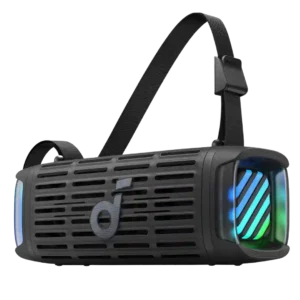
Design reactions were mixed: reviewers liked the unique rugged look and colors, but some called the grille polarizing or the body bomb-like.
P2
Product 2: JBL Flip 7 Portable Speaker
4.5
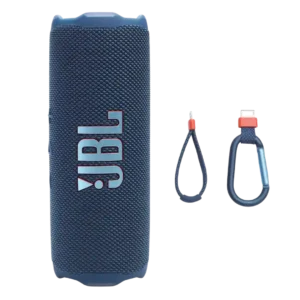
Design sentiment is mostly positive, with praise for rugged looks, compact styling, and color, though one reviewer said the aggressive casual design will not suit everyone.
Detail retrieval
P1
Product 1: Soundcore Boom 3i
4.1
Detail retrieval ranged from strong outdoor vocal/hi-hat detail to weaker orchestral separation or muffled default tuning.
P2
Product 2: JBL Flip 7 Portable Speaker
3.6
Detail retrieval varies by reviewer: several praise strong detail, while others find little nuance or limited improvement over Bluetooth.
Distortion at high volume
P1
Product 1: Soundcore Boom 3i
3.2
High-volume and water playback had limits: reviewers noted splashy bass in water and crispy clarity around higher volume levels.
P2
Product 2: JBL Flip 7 Portable Speaker
3.8
High-volume distortion is split: some reviewers heard little or no distortion, while others found harshness, crackly highs, or bass buckling at louder settings.
Drop resistance durability
P1
Product 1: Soundcore Boom 3i
4.6
Durability earned broad praise thanks to tough plastics, drop resistance, rubberized protection, and a build reviewers felt did not need babying.
P2
Product 2: JBL Flip 7 Portable Speaker
4.8
Drop durability and ruggedness are strongly supported, with reviewers saying the speaker feels robust and survived or inspired confidence during rough use.
Dust resistance rating
P1
Product 1: Soundcore Boom 3i
4.9
Dust resistance is positively tied to the rugged IP68 build, with reviewers describing it as dustproof or fully dustproof.
P2
Product 2: JBL Flip 7 Portable Speaker
5.0
Dust resistance earns positive evidence from IP68 and real-use comments that the fabric and sealed body handle dust and dirt well.
Dynamic headroom
P1
Product 1: Soundcore Boom 3i
4.3
Dynamic performance was above average for size, with praise for keeping bass at higher volume but some lost nuance at loud settings.
P2
Product 2: JBL Flip 7 Portable Speaker
5.0
Dynamic headroom is praised by sound-focused reviews, especially for punch, rhythmic expression, and scale for the size.
EQ customization
P1
Product 1: Soundcore Boom 3i
4.6
EQ customization was a standout, with reviewers repeatedly praising the 9-band/custom EQ as effective, easy, and important for unlocking better sound.
P2
Product 2: JBL Flip 7 Portable Speaker
4.3
EQ customization is a major strength; reviewers consistently praise the seven-band EQ as useful, impactful, and more flexible than previous Flip models.
Everyday usability
P1
Product 1: Soundcore Boom 3i
4.6
Everyday usability was strong because reviewers used it beyond outdoor trips, including cars, rooms, camping, and general daily use.
P2
Product 2: JBL Flip 7 Portable Speaker
4.4
Everyday usability is a strength: reviewers describe it as easy to place, easy to start, and pleasant to use across home, travel, and outdoor settings.
Frequency response balance
P1
Product 1: Soundcore Boom 3i
3.9
Sound balance is generally fun and bass-forward, but reviewers split between praising strong bass and noting dark, harsh, muffled, or bass-heavy tuning.
P2
Product 2: JBL Flip 7 Portable Speaker
4.3
Frequency balance receives broad praise for punch, bass, clarity, and balanced sound, but some reviewers found recessed mids, harsh treble, or midrange-heavy tuning.
Handle or strap quality
P1
Product 1: Soundcore Boom 3i
4.4
The strap and carry hardware were mostly useful and convenient, though one reviewer warned that loose strap clamps could slide off.
P2
Product 2: JBL Flip 7 Portable Speaker
4.5
The new PushLock loop/carabiner system is widely praised as useful, secure, and easier for bags, wrists, or outdoor clipping.
Inter-speaker connectivity
P1
Product 1: Soundcore Boom 3i
4.5
Inter-speaker connectivity was useful for stereo pairing or louder playback, and reviewers liked the fuller, more open result from paired units.
P2
Product 2: JBL Flip 7 Portable Speaker
4.2
Inter-speaker connectivity is useful and often easy with Auracast, though reviewers note limited receive behavior, exact-model stereo requirements, or less mature operation than older PartyBoost.
Latency with TV (lip sync)
P1
Product 1: Soundcore Boom 3i
4.4
Latency feedback was mostly positive for casual video use, but one reviewer still found enough lag to make mobile gaming a weak fit.
P2
Product 2: JBL Flip 7 Portable Speaker
2.6
Latency is a recurring caveat for Bluetooth video or gaming; USB-C can help, but reviewers still warned about lip-sync lag or missing low-latency modes.
Lighting effects
P1
Product 1: Soundcore Boom 3i
4.2
Lighting effects were often framed as fun, customizable, and visually distinctive, but some reviewers preferred leaving them off.
P2Product 2: JBL Flip 7 Portable Speaker
No score yetLoudness / maximum volume
P1
Product 1: Soundcore Boom 3i
4.6
Reviewers repeatedly found the Boom 3i loud for its size, with enough output for outdoor use, small gatherings, apartments, rooms, and backyard-style situations.
P2
Product 2: JBL Flip 7 Portable Speaker
4.8
Loudness is one of the strongest points; reviewers repeatedly call it very loud or louder than predecessors for its compact size.
Low-volume performance
P1
Product 1: Soundcore Boom 3i
4.6
Low-volume performance was praised in camping use, where the speaker stayed clear and audible at minimum volume.
P2
Product 2: JBL Flip 7 Portable Speaker
4.0
Low-volume performance is mixed: one reviewer found low-level separation weak, while others praised bass presence and no-distortion behavior even at low volume.
Multi-speaker pairing reliability
P1
Product 1: Soundcore Boom 3i
4.4
Multi-speaker pairing is viewed as useful, with praise for direct pairing controls and TWS/PartyCast as convenient extras.
P2
Product 2: JBL Flip 7 Portable Speaker
4.8
Stereo or group pairing through the app is mostly smooth when supported, but stereo mode requires matching Flip 7 units.
Multipoint connectivity
P1
Product 1: Soundcore Boom 3i
4.5
Multipoint was treated as a practical social feature because two devices can stay connected so more than one person can control music.
P2
Product 2: JBL Flip 7 Portable Speaker
4.2
Multipoint is mostly praised as fast or seamless, though one travel review found simultaneous device playback sometimes paused instead of switching smoothly.
On-device controls
P1
Product 1: Soundcore Boom 3i
4.9
On-device controls were praised as complete and reliable, including direct buttons and touch controls that worked perfectly.
P2
Product 2: JBL Flip 7 Portable Speaker
4.3
On-device controls are viewed positively, with easy-to-use playback controls and added track-skip behavior noted.
Power bank function
P1
Product 1: Soundcore Boom 3i
1.9
The lack of power-bank/reverse-charging support was a downside for outdoor use, especially camping or phone top-ups.
P2
Product 2: JBL Flip 7 Portable Speaker
2.0
Power-bank function is a weakness because reviewers note the Flip 7 cannot charge a phone and one explicitly wanted that for emergencies.
Price / value for money
P1
Product 1: Soundcore Boom 3i
4.9
Price/value comments were very positive when discounts were considered, with reviewers calling the deal or proposition appealing.
P2
Product 2: JBL Flip 7 Portable Speaker
4.2
Price/value sentiment is mostly positive at its launch or sale price, though a few reviewers framed the Flip 7 as a minor or more premium-priced upgrade.
Setup simplicity
P1
Product 1: Soundcore Boom 3i
4.6
Setup was described as simple, including straightforward Bluetooth pairing and less-complicated-than-expected strap assembly.
P2
Product 2: JBL Flip 7 Portable Speaker
5.0
Setup and pairing are repeatedly described as simple, easy, or usable by almost anyone.
Smart features
P1
Product 1: Soundcore Boom 3i
4.5
Smart extras such as Buzz Clean, emergency alarm, voice amplifier, white noise, and app controls were repeatedly praised as useful outdoor features.
P2
Product 2: JBL Flip 7 Portable Speaker
4.5
Smart-feature sentiment is positive around Auracast, lossless wired audio, EQ, and app-enabled features, with compatibility caveats covered separately.
Status indicators
P1
Product 1: Soundcore Boom 3i
3.9
Status indicators were adequate rather than exceptional, with reviewers noting rough battery estimates and useful small button LEDs.
P2
Product 2: JBL Flip 7 Portable Speaker
4.5
Status indicators receive positive evidence from a reviewer who found the visible battery percentage especially helpful in the app and on-device indicator.
Stereo imaging accuracy
P1
Product 1: Soundcore Boom 3i
2.4
The mono presentation limits stereo accuracy, with one reviewer saying dynamics and separation suffer because of the mono design.
P2
Product 2: JBL Flip 7 Portable Speaker
2.0
Stereo imaging is limited by the mono design; reviewers repeatedly note little soundstage unless another Flip 7 is added.
USB-C charging
P1
Product 1: Soundcore Boom 3i
4.4
USB-C charging was practical and convenient, especially because reviewers could use a phone charger, though it is charging-only.
P2
Product 2: JBL Flip 7 Portable Speaker
2.3
USB-C charging is convenient, but reviewers criticize the missing cable and lack of quick-charge or included accessories.
Value for money
P1
Product 1: Soundcore Boom 3i
4.6
Value for money was a major strength, especially where reviewers compared feature count, ruggedness, and sound against the price.
P2
Product 2: JBL Flip 7 Portable Speaker
4.5
Overall value for money is strongly positive across reviews, with repeated no-brainer and good-buy language despite some cheaper competitors.
Voice clarity
P1
Product 1: Soundcore Boom 3i
4.6
Vocal clarity was usually praised, especially with BassUp or EQ adjusted, and reviewers said vocals remained audible and well-defined.
P2
Product 2: JBL Flip 7 Portable Speaker
4.4
Voice clarity is generally positive, with several reviewers calling vocals clear or communicative, though one found vocals distant once bass entered.
Water resistance rating
P1
Product 1: Soundcore Boom 3i
4.9
Water resistance is one of the strongest points, with reviewers praising waterproofing, saltwater protection, and survival after pool, river, or sea exposure.
P2
Product 2: JBL Flip 7 Portable Speaker
4.9
Water and dust durability is a major strength, with repeated praise for IP68 readiness around pools, beaches, rain, sand, and travel.
Weight convenience
P1
Product 1: Soundcore Boom 3i
4.6
Reviewers liked the small, light body and found it easy to carry, conceal, pack, or use as a travel companion.
P2
Product 2: JBL Flip 7 Portable Speaker
4.3
The Flip 7 is consistently treated as portable and compact, although one reviewer noted it has more heft than expected.
Wired input
P1
Product 1: Soundcore Boom 3i
2.0
The lack of wired input was a clear drawback for reviewers who wanted aux or analog playback in addition to Bluetooth.
P2
Product 2: JBL Flip 7 Portable Speaker
3.9
USB-C wired audio is a valued addition and often easy to activate, but reviewers disagree on how much sonic improvement it delivers and one could not get it working.