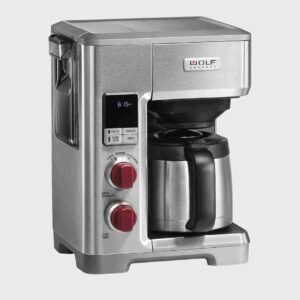
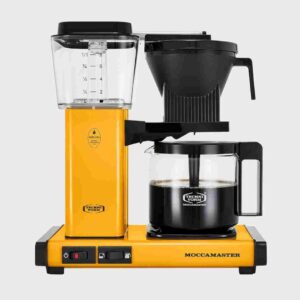
WOLF GOURMET Programmable Coffee Maker System 10 Cup
Where It Has the Edge
- Automation and sensors is 4.5 vs 4.1. The standout automation is AccuBrew: a built-in scale that guides how much ground coffee to add based on...
Reviews mention practical included extras like a reservoir water filter system (often with a few replacement filter pods) and removable components for rinsing. It is not a big accessory bundle, but the included filtration pieces meaningfully support day-to-day use.
Accessories are basic but useful: several reviews note a included coffee scoop and sometimes starter filter papers, plus clear reservoir markings and brew guidance in manuals. There is no built-in storage system for accessories, and the overall bundle is minimal rather than deluxe.
Claims about fast brew times, consistent dosing via AccuBrew, and a hot, well-extracted cup are generally supported in testing-style reviews, with repeated references to roughly 6.5 to 7-minute full-pot brews and strong flavor consistency. The more subjective premium-value positioning is where reviewers push back most.
Marketing claims about brewing at SCA-style temperatures and finishing a full pot in roughly 4 to 6 minutes are broadly supported by many hands-on reviews and measurements, though at least one test criticizes uneven water distribution and larger-than-expected temperature swings between brews.
There is no app, no connectivity, and no smart control. Multiple reviewers frame this as a deliberate simplicity choice, but it is a clear limitation for anyone expecting modern connected features.
Setup is typically described as simple: unbox, wash parts, and soak/install the reservoir water filter before brewing. The main setup friction is learning the AccuBrew workflow and button logic, which some reviewers say requires a quick read of the manual.
Setup is typically described as quick and straightforward, with light assembly like placing the outlet arm/spray arm, basket, lids, and carafe. Users report little to no learning curve beyond getting used to how parts slide and seat.
The standout automation is AccuBrew: a built-in scale that guides how much ground coffee to add based on cups and strength. Reviews also cite programmable start, brew-age timers, filter-change reminders, cleaning prompts, and at least one mention of a low-water safeguard.
Automation is minimal but practical: two-switch operation, auto drip-stop when the carafe is removed, a hotplate with automatic shutoff, and temperature/flow behavior that adjusts based on the half/full selection. There is no programmable timer or recipe automation.
Reviews repeatedly highlight a copper boiling element for brewing and a separate hotplate heating system for holding temperature. This is not an espresso-style dual boiler setup, but the dedicated heating design is frequently credited for fast heat-up and stable brewing.
Across reviews, brewing quality is the main strength: consistently hot drip coffee with rich flavor, even extraction, and strong repeatability from batch to batch. Multiple sources attribute the consistency to even water distribution and the scale-guided dosing process.
Most reviewers describe the cup as smooth, balanced, and close to pour-over when paired with good coffee and an appropriate grind, with strong repeatability day to day. A minority critique centers on spray head water distribution that can concentrate flow and reduce extraction uniformity.
Build is repeatedly characterized as premium and heavy-duty, with lots of stainless steel and solid-feeling mechanisms. Several reviewers imply long-term durability expectations, reinforced by the unusually long warranty for this category.
Build quality is widely praised for long-term durability and a sturdy overall chassis, with multiple accounts of years of daily use. The main recurring knock is that some plastic components, including parts of the basket and carafe handle, can feel thin or cheap relative to the premium price.
Cable convenience is not a highlight; at least one review mentions a relatively short power cord (around 3 feet) and no notable cord storage features, so placement may depend on outlet proximity.
It is positioned as a 10-cup brewer with a roughly 1.5 L reservoir/carafe capacity, suitable for households and entertaining. A common nuance is that coffee-maker cup sizes are smaller than mug servings, so the smaller-cup settings may not stretch as far as buyers expect.
Capacity is commonly cited as 10 cups or about 40 ounces (around 1.25 liters), which suits households and batch brewing. Some reviewers note it is still too much for true single-cup needs and can feel smaller than competing large-capacity brewers.
The insulated carafe/server is praised for keeping coffee hot for hours without a hot plate, helping preserve flavor. The downside is handling: multiple reviews describe a finicky pour that can dribble or require a steep tilt, and at least one mentions a heavier feel and lid-related pouring quirks.
Carafe handling gets mixed feedback: many report clean pouring and appreciate drip-stop functionality, while others mention a flimsy handle, sloppy pour at certain angles, or a lid that can flip when finishing a pour. The glass carafe and hot parts can get very hot to the touch.
It is widely described as large and counter-dominating, but the boxy, straight-edged design can tuck next to other appliances. Multiple reviews like the front-access reservoir and front-loading basket/drawer approach, which helps usability under cabinets.
The aesthetic is a major selling point: iconic design and many color options, often described as countertop-worthy. Footprint feedback is mixed; some find it compact enough, while others note it needs counter space and headroom due to the top-fill reservoir.
Recurring complaints center on the bulky footprint, the learning curve for AccuBrew, and carafe pouring behavior. Some reviews also mention small UX irritations like limited strength-step usefulness and audible beeps you cannot easily disable.
Most cited design drawbacks are the fixed (non-removable) reservoir, hand-wash-only parts, limited settings, and the inherent downsides of a hotplate if coffee sits too long. A repeated performance-specific concern is uneven spray distribution creating localized extraction.
At least one review calls out heavy use of plastic in the packaging, suggesting room for improvement in sustainability-focused presentation. Other reviews do not provide enough detail to form a broader consensus.
Reviews consistently reference standard #4 cone paper filters for brewing and a separate reservoir water filter for improving taste. The filtration approach is viewed as a plus for cup quality, but it adds recurring consumable costs and periodic replacement steps.
Most reviews describe using standard #4 cone paper filters, which makes cleanup easy; a few mention brand-specific or proprietary filters, creating planning friction if you cannot grab them locally. Compatible permanent filters are referenced as an optional way to reduce consumables.
Several reviews explicitly note there is no built-in grinder or hopper, so you will need pre-ground coffee or a separate grinder to take full advantage of the precision dosing.
There is no built-in grinder or dosing system. Multiple reviewers emphasize that grind quality and grind size matter a lot, meaning you will get the best results only if you already have or buy a capable grinder.
Power and heating performance are portrayed as strong, with at least one review citing 1500 W and multiple mentions of very hot brew temperatures and quick recovery for fast batches.
The copper heating element is frequently credited for rapid heat-up and maintaining ideal brewing temperatures, enabling fast brew cycles and a consistently hot cup. Several sources explicitly frame this heating performance as the core technical advantage.
There is no dedicated iced coffee or cold brew mode. Reviewers who want variety in brew styles call this out as a missing feature versus more feature-forward competitors.
It is a drip-coffee system only; one review explicitly notes the absence of a steam outlet or milk frothing capability, so it is not built for lattes or cappuccinos without separate equipment.
Most reviewers find day-to-day use pleasant once the dosing workflow clicks: the display is helpful, the machine is relatively quiet, and results are repeatable. The experience is dragged down mainly by size, price, and carafe pour quirks.
Overall experience is commonly described as dead simple, quiet, and reliable, with a pleasing and repeatable workflow. The main user-experience downsides are the lack of programmability and the need for hands-on filling/cleaning due to a fixed tank and hand-wash parts.
One review references strong marketplace ratings and broad positive sentiment, especially around flavor and consistency. The most common negatives cited in reviews are high price and the space it demands.
The product is portrayed as an iconic, hype-backed brewer with a strong enthusiast following, often positioned as a design statement as much as a tool. Several reviews reference widespread recognition and long-standing popularity among specialty-coffee fans.
The half/full pot selector is repeatedly praised as more than a volume toggle, helping extraction by adjusting flow and holding temperature for smaller batches. This feature is frequently cited as what sets the Select variant apart for households that do not always brew a full pot.
Multiple reviews point out that the brewer is not SCA certified, even though performance is often compared to other high-end brewers that target similar temperature and extraction standards.
Multiple sources reference Specialty Coffee Association certification and, in some cases, additional European standards or broader design-world recognition. These credentials are often used to justify the premium positioning and expectations around temperature and brew-time targets.
Speed is a clear positive: several reviews cite a full 10-cup brew in roughly 6.5 to 7 minutes, plus quick smaller-batch performance. Reviewers also describe the brew cycle as calm and relatively quiet for a high-output drip machine.
Speed is a consistent highlight: many tests land around six minutes for a full batch, with partial batches completing notably faster. A few reviews mention longer ranges depending on volume, but the overall pattern is quick time-to-cup for a batch brewer.
Value is the most polarizing theme. Many reviews call it expensive for a drip maker and suggest similarly good cups can be had for less, while others justify the price with the integrated scale, premium materials, and warranty; discounts materially improve perceived value.
Price is the biggest sticking point. Enthusiasts and long-term owners often call it an investment justified by durability and results, while at least one critical lab-style review argues the brewing performance does not match the premium cost compared with cheaper competitors.
A long warranty (often cited as 5 years) stands out and is treated as a confidence signal for durability in this price tier. Reviews do not provide much direct customer-support interaction detail beyond the warranty mention.
Warranty support is consistently positioned as strong, typically cited as five years, with replacement parts availability frequently mentioned. Some reviews also reference repairability as a long-term value lever beyond the standard warranty window.
Maintenance is described as structured rather than difficult: removable reservoir and basket, periodic water-filter changes (often cited around 30 cycles), and prompted cleaning/descaling routines (often cited around 300 brews). Some parts are described as hand-wash-first, with at least one mention of dishwasher-safe components like the basket.
Maintenance is described as manageable but not hands-off: regular rinsing/hand-washing of parts, periodic descaling (often framed as every ~3 months or ~100 cycles), and extra attention for hard-water environments. The fixed reservoir is a recurring convenience downside.