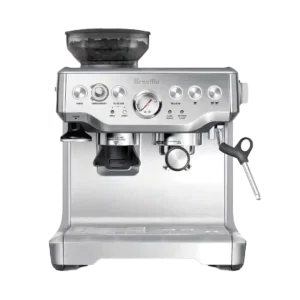
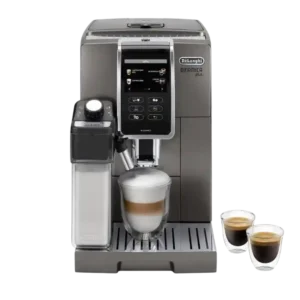
Breville Barista Express Espresso Machine
Where It Has the Edge
No clear scored advantage over the other product.
No clear scored advantage over the other product.
Reviews like the included portafilter, baskets, tamper, razor/leveling tool, milk pitcher, and cleaning tools, but many still budget for common upgrades like a better tamper, a scale, a bottomless portafilter, or a knock box.
Several reviews note a generous included kit (water filter, scoop, test strip, brush, descaler/water spout, and milk container), reducing the need for immediate add-on purchases.
Most reviewers feel the machine largely performs as advertised for its class, though marketing numbers like 15-bar pump pressure are often framed as less important than dialing in grind, dose, and tamp for good results.
No built-in app, Wi-Fi, or smart control is described; operation is manual via buttons, dials, and the pressure gauge.
Coffee Link connectivity enables drink tweaking and remote starts, but it’s commonly described as Bluetooth-based (not Wi-Fi) and is sometimes called slow, buggy, or laggy.
Out-of-box setup is generally straightforward, but getting great espresso takes a short learning period of dialing in grind size, dose, and tamp pressure.
Setup is generally minimal and guided via the touchscreen (and sometimes the app), with a few complaints about initial rinse/setup being loud or wasteful but still easy to follow.
It offers programmable shot buttons and simple, repeatable controls, but it is not a one-touch superautomatic and relies on hands-on technique.
Automation is a major strength: one-touch drinks, Smart-One-Touch favorites, and user profiles (often 3). Customization is broad enough for most users, though some call it limited versus pricier machines.
The single-boiler/thermocoil-style design heats quickly but requires switching between brewing and steaming, so you cannot pull a shot and steam milk at the same time.
Boiler configuration is described inconsistently in the reviews (some call it dual, others list a single boiler). In practice, reviewers still report quick heat-up and smooth pacing, but model-specific verification matters if boiler type is a priority.
Once dialed in, reviewers describe solid repeatability from shot to shot, with the pressure gauge and clear workflow helping consistency; early results can vary until you learn the machine.
Once grind and aroma are set, most reviewers report repeatable shots and dependable results across drinks; several call it unusually consistent for a super-automatic.
Build quality is commonly described as sturdy for the price, though a minority mention wear, leaks, or service needs after heavy use or over long ownership.
Many describe a solid, premium feel with stainless accents, but multiple reviews also call out the amount of exterior plastic; overall it’s viewed as sturdy for the price tier.
Water tank and bean hopper capacity are described as adequate for daily use, but frequent drinks can mean refilling water and emptying the drip tray more often.
Capacity is usually cited as a ~1.8L water tank and ~300g hopper with a practical grounds bin and drip tray; good for households, though heavy users will still refill/empty regularly.
This is a beans-and-grounds workflow rather than a capsule system; reviewers frequently cite pod machines like Nespresso as the convenience alternative.
Cup warming and general cup clearance are seen as practical, while the drip tray is a common pain point because it can fill quickly and collects water and stray grounds.
Reviewers like the front-access layout, large drip tray, and easy clip-on milk carafe; the adjustable dispenser helps accommodate taller cups and common glassware.
The stainless-steel look and overall footprint fit most home counters, though it is wider and heavier than compact starter machines and benefits from dedicated space.
The machine earns points for a sleek touchscreen and relatively manageable footprint for bean-to-cup; it’s still counter-dominant, but front access (tank/drip tray) improves ergonomics.
Recurring negatives include a weak pot mode, limited profiles, Bluetooth app lag/bugs, and occasional milk-carafe mess or start-up noise; none are dealbreakers for espresso-first buyers, but they show up repeatedly.
At least one review criticizes the packaging for heavy plastic/polystyrene rather than paper-forward materials, making sustainability a weak spot.
Espresso quality is a highlight once settings are tuned, with many describing rich flavor and crema; the main limiter is technique (grind, dose, tamp) rather than raw machine capability.
Reviewers consistently praise syrupy, crema-forward espresso and adjustable strength/temperature, though some note you still need a little experimentation to dial it in.
The included water filter is seen as helpful for taste and scale management, but it requires periodic replacement and does not eliminate the need for descaling.
The included water filter is frequently recommended for taste and scale control; some users skip it, but reviewers warn that can hurt flavor and increase maintenance.
The integrated grinder is a major value add and can produce strong results, but stepped adjustment, retention/clumping, and a bit of mess are recurring critiques as users become more advanced.
The conical burr grinder (often cited as 13 settings) is praised for being quiet and capable of grinding fine enough for richer espresso, with easy strength control via the aroma/dose settings.
The included tamper and leveling/razor tool help beginners get a repeatable puck, but several reviewers still upgrade their tamping and dosing tools for better feel and consistency.
Warm-up for espresso is generally quick and stable enough for home use; steam output is capable but not as forceful or fast as higher-end prosumer machines.
The TrueBrew Over Ice feature is repeatedly praised for better-than-average iced coffee; reviewers also clarify it is not true cold brew and it will not make cold foam.
Used-puck knock-out is typical for a semi-auto setup; cleanup is manageable with a knock box and quick rinse, but it is not a mess-free system.
Used grounds/pucks are typically described as tidy and easy to empty thanks to removable bins and accessible components.
The steam wand can make good microfoam and supports latte art with practice, though steaming can be slower or less powerful than higher-end equipment.
LatteCrema automation produces thick, silky foam for cappuccinos and lattes; some note it falls short of true microfoam for flat whites and can be a bit messy to detach/clean.
Owners describe the experience as rewarding and fun if you like hands-on coffee, with a learning curve that pays off once you establish a consistent routine.
Day-to-day use is widely described as simple and satisfying thanks to the touchscreen and presets; the biggest friction points are app reliability (for some) and the need to experiment with settings for best taste.
Reviews repeatedly call it a long-running best seller and a default recommendation for learning real espresso at home.
Multiple reviewers call the pot-of-coffee/drip-style function weak or outright terrible; it’s best treated as an occasional option, not a drip-coffee replacement.
Pump behavior is generally described as consistent for home use, and the pressure gauge helps dialing in toward typical espresso targets, but puck prep still strongly influences results.
A few reviewers highlight that it can reach espresso-range pressure and even choke with an overly fine grind, suggesting strong, stable pumping for this category.
The machine is cited more for reputation and community support than formal certifications, and it is frequently recommended by reviewers and coffee hobbyists.
Hidden tool storage in the drip tray is appreciated for keeping small accessories together, though it is easy to overlook during day-to-day use.
When shipping is discussed, experiences are mostly retailer-dependent; buyers emphasize purchasing from reputable or authorized sellers for smoother returns and service handling.
Time-to-first-shot is described as quick, and drink-making is fast once your workflow is set; switching over to steam and back adds time compared with dual-boiler setups.
Common notes include quick warm-up around 30–40 seconds and milk drinks in roughly 1–2 minutes, making it a fast daily driver.
Value is a consistent theme because it combines grinder plus espresso capability in one unit; price feels justified if you will actually use the manual workflow and keep up with maintenance.
Across reviews it’s positioned as expensive but strong value in its class, especially if you use milk drinks and iced options regularly.
Warranty is commonly cited as one year, and customer support feedback is mixed, ranging from smooth service to delays or repair inconvenience depending on the case.
Backflushing, steam-wand cleaning, and periodic descaling are recurring expectations; reviewers who stay on top of maintenance report better reliability and better-tasting drinks.
Maintenance is guided with rinse/clean prompts, removable brew group access, and a LatteCrema clean cycle; descaling is still required but described as straightforward, especially with a filter installed.