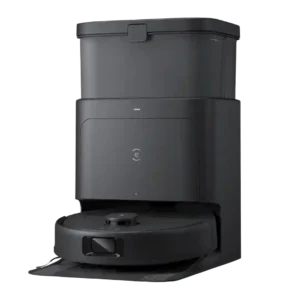
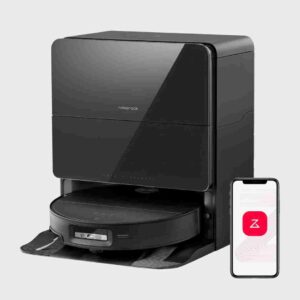
The reviews mention an optional cleaner stick and note Ecovacs removed the hidden cleaning tool from older docks, so accessory support is useful but less complete than some prior models.
AdaptiLift is one of the defining features: it can raise the chassis to clear thresholds and help traverse thicker rugs, and some reviews describe adaptive lifting at different points for awkward obstacles. It also ties into improved reach and reduced stuck events.
Multiple reviewers call the robot and dock stylish, with black and white color options and a station design that looks more refined than older boxy Ecovacs docks.
Fit and finish are often called sleek and premium, and the dock design is frequently described as unusually low and tidy for a full-feature base station. Some note fingerprint-prone surfaces, but overall aesthetics score high.
The app offers room control, suction and mop tuning, obstacle sensitivity, mapping edits and automation options, though base-station physical controls were reduced versus older models.
Smart features are a centerpiece, including advanced scheduling, room-by-room automation, object recognition, and configurable mop/vac sequences. Several reviews also mention helpful app intelligence like stuck-spot logging and smart-plan cleaning adjustments.
Mop lifting lets the N30 transition across carpets and rugs without soaking them, making mixed-floor cleaning more practical.
Rug handling is generally confident, including the ability to lift the mop or avoid wet contact by changing mop workflows. A few reviewers still recommend tuning carpet/rug settings to prevent dampness in homes with many area rugs.
Setup is consistently described as easy, with quick base assembly, straightforward app pairing and fast initial mapping.
Setup is repeatedly described as straightforward: charge, connect in-app, and run a quick mapping pass. Dock assembly and filling tanks are treated as simple, with most friction coming later from fine-tuning no-go zones for tricky furniture.
Battery life is adequate but not a strength; one reviewer saw steep drain at max power, while dock-based charging keeps autonomous operation convenient.
Battery life is generally viewed as sufficient for a flagship robot, with one lab-style test landing around two hours and other reviews reporting smooth recharge-and-resume behavior. Actual runtime depends on suction level, mopping intensity, and home size.
The onboard bin and dust bag are accessible and functional, but the 2.6 L dock bag is smaller than some rivals and may need more frequent changes in busy homes.
Dust collection is dock-based with bag use mentioned in several reviews, emphasizing cleaner emptying and longer intervals between disposal. The bag-and-bin approach is positioned as low-mess and hands-off.
The design is described as robust and well-finished, with no reviewer raising major build-quality concerns.
High-pile carpet performance is better than average for a hybrid robot, aided by AdaptiLift to keep the robot moving and cleaning. Some reviews still note slower run times on carpet compared with the quickest competitors.
Low-pile carpet pickup is typically strong and reliable, with good traction and coverage. It performs best when paired with appropriate power levels and when mop detaching or lifting is used to keep carpets dry.
On medium-pile carpet, reviews generally indicate strong pickup paired with stable navigation. Performance is helped by high suction and adaptive behaviors, though some testing suggests cleaning runs can take longer than a few competitors.
Reviewers place it above many similarly priced rivals for cleaning tech and value, though navigation trails the best Roborock and Dreame competition.
Comparisons are frequent: Saros 10 is often positioned as stronger at vacuuming and scrubbing pressure than some rivals, while competitors can beat it on obstacle avoidance or mopping style (for example, roller-mop or dual-spinning designs). Saros 10R is repeatedly framed as the better avoider, while Saros 10 can leave floors a bit cleaner in certain dried-mess scenarios.
The app is clear and flexible, but some users may miss more convenient top-mounted dock controls and fully button-based operation.
The UI experience is widely praised through the Roborock app, which centralizes maps, settings, and cleaning plans in a clear way. Reviewers also mention useful visualizations like obstacle markers and stuck-location suggestions.
The extendable mop arm noticeably improves corner reach and solves a common weak spot of robot mops.
Corner performance is improved by extending tools and side mopping coverage, and multiple reviews specifically mention better reach into corners than older designs. It is not perfect in every layout, but generally performs well along tight edges.
A light or illumination feature is mentioned as helpful for spotting dust in darker corners, improving perceived coverage in low-lit rooms. It is a nice-to-have rather than a core cleaning driver.
The robot reliably returns to the dock for emptying, mop washing and drying, adding the hands-off experience buyers expect from an Omni dock.
Dock reliability and automation are consistently highlighted: auto-emptying, heated pad washing, warm-air drying, detergent dosing, and base self-cleaning reduce manual maintenance. The dock is often described as both capable and unusually space-conscious for the feature set.
It handles light dried stains well and can clear tougher dried messes like ketchup with extra passes.
For tougher marks, results are mixed but often strong when settings are maximized: some reviews credit stain-focused behaviors and added pressure for better scrubbing. At least one stress test found it can smear sticky spills, so performance depends heavily on mess type.
Day-to-day use is simple once mapped, though cable clutter, tight spaces and the need for app familiarity keep it from being fully effortless.
Edge cleaning is a standout strength thanks to the extending mop that reaches along walls and baseboards more thoroughly than many rivals.
Edge work is frequently called out as a strength, driven by an extending side-brush approach and side mopping coverage along walls. Owners who care about baseboards and perimeter dust tend to be satisfied.
The robot generally tracks edges effectively when extending the mop, though room-layout complexity can still slow it down.
Auto-emptying and dock maintenance reduce manual mess handling, though bag size limits how long some heavy-use households can go between changes.
A sealed bagged dock and washable filter support decent dust containment and air cleanliness for a mainstream robot vacuum.
The cleaning head setup combines a main brush, side brush and dual rotating mop pads, with newer anti-tangle shaping that improves overall floor-contact behavior.
Reviewers say floors look noticeably cleaner and even sparkling after mopping, especially on everyday dirt and light dried residue.
The brush path does a good job funneling hair inward, so reviewers reported very few hair-channel cleanup annoyances.
Carpet hair pickup is generally strong, especially for pet hair, and improves further when paired with higher suction levels. It can still be limited by debris type and run time compared with specialized deep-clean passes.
Dog hair and general fur pickup are consistently strong on everyday floors, especially with the anti-tangle brush system.
Hair pickup on hard floors is a consistent strength, especially in pet homes. Reviewers highlight fewer hair clumps left behind and less manual post-cleaning.
The anti-tangle brush design is one of the product’s clearest wins, with reviewers specifically praising its resistance to wrapped hair.
Tangle resistance is one of the most praised elements, with the split-brush design frequently credited for channeling hair into the suction path and reducing wrap at the ends. A few users still mention occasional tangles with long hair plus certain carpet fabrics, but overall performance is above average.
Fine dust pickup on hard floors is strong, with reviewers repeatedly describing solid single-pass dirt removal.
Fine dust pickup on hard floors is consistently described as excellent, helped by strong suction and efficient pathing. Homes with visible dust and pet dander report noticeably cleaner floors.
It performs well on larger debris like crumbs and rice, usually clearing them in one or two passes.
Large debris intake on hard floors is generally strong, with reviewers citing confident pickup of everyday crumbs and heavier pet-hair clumps. Performance holds up well in mixed runs when the robot is not over-wet from mopping.
The dock uses hot water mop washing and warm-air drying, which improves post-clean maintenance and pad readiness.
The extending mop arm and upgraded anti-tangle system are viewed as meaningful innovations rather than marketing fluff.
Innovation is mainly tied to the retracting navigation module plus an adaptive lifting chassis and upgraded sonic mopping. Reviews frame these as practical innovations that expand where the robot can go and how hands-off the cleaning loop can be.
Everyday debris such as crumbs, rice and pet messes are handled confidently for a robot in this price tier.
At around 10.4 cm tall, the robot is reasonably slim and can reach under some furniture, though it is not ultra-low-profile.
Low-profile design is a headline feature, with multiple reviews citing an ultra-slim height enabled by the retracting navigation module. This improves access under beds and cabinets and is one of the clearest differentiators versus bulkier flagships.
The dock automation keeps upkeep low overall, but owners still need to replace bags, manage water tanks and occasionally clear problem areas.
It moves well in open areas, but tight corners and chair- or cable-heavy spots can slow it down or cause trouble.
Mapping is fast and editable, but pathing and room segmentation are not always optimal compared with class leaders.
Mapping and pathing are widely praised as fast and accurate, with efficient room coverage and solid navigation logic. However, at least one timed test found slower completion on some carpet routines compared with specific rivals, even when pickup was strong.
The mop lift works as intended, allowing safer carpet transitions during mixed cleaning runs.
Carpet protection is a strength: the mop can lift over carpet, and several reviews note workflows that detach or leave the mop bracket at the dock for dry vacuuming. This helps prevent damp pad drag and improves mixed-floor routines.
Mopping is one of the N30 Pro Omni’s biggest strengths, with very good everyday scrubbing and edge reach.
Mopping performance is the most polarized area: many reviews praise everyday cleaning, configurable water levels, and better results on dried messes when settings are maxed. However, at least one lab-style scrubbing test found it underwhelming versus roller or dual-spinning systems, with smearing on sticky spills.
Standard modes are reasonably quiet, but max suction is clearly loud and one of the main tradeoffs.
Noise is generally rated as controlled for a flagship robot, with at least one review noting extremely quiet operation in mop-only mode. Dock cycles can still be noticeable, but in-room cleaning noise is usually described as manageable.
Obstacle handling is serviceable rather than best-in-class; it avoids major collisions but still struggles with cables and cramped layouts.
Obstacle avoidance is competent but not uniformly best-in-class. Some reviews praise strong recognition and real-world avoidance, while others report patchy performance, occasional bumping or pushing items, and weaker results on cluttered carpets compared with top rivals.
Heated mop drying helps prevent damp-pad smells, a useful long-term hygiene benefit.
One reviewer specifically missed the hidden cleaning tools found on an older Ecovacs dock, so onboard storage is a step back here.
Running costs look moderate rather than minimal because the dock uses consumables and an optional cleaner stick is sold separately.
Vacuuming, mopping, auto-emptying and pad washing make this a highly convenient cleaner for everyday upkeep.
The overall tone is strongly positive: reviewers see it as an easy recommendation with a few navigation and noise caveats.
Pet households are a strong fit thanks to hair pickup, anti-tangle behavior and solid day-to-day floor maintenance.
Pet-focused performance is a highlight: multiple reviews mention strong pet-hair pickup and an anti-tangle brush design that reduces hair wrapping, making it well-suited to homes with shedding pets.
Reviewers repeatedly frame it as high-end functionality at a more approachable price than flagship competitors.
Value is the main friction point: the Saros 10 is firmly priced as a premium flagship. Several reviews say the cost makes sense only if you will use the hands-off dock and low-profile reach, while others point to cheaper rivals with stronger mopping or avoidance.
Privacy-related notes center on the camera and remote-view features, including an audible announcement when the camera is active. Reviewers generally present this as a thoughtful safeguard rather than a full privacy control suite.
Measured runtime in at least one timed test was about 118 minutes, with runtime varying widely by power level and mopping intensity. Recharge-and-resume helps cover larger homes over multiple passes.
The dock’s wash, dry and auto-empty cycle meaningfully reduces manual maintenance and keeps the robot ready for the next run.
Self-cleaning behavior is a major part of the ownership story: the dock can wash mop pads with heated water, dry them with warm air, and clean the wash base. Most reviews treat this as a big win, though one stress test noted pad washing can struggle with very sticky residues.
Software features are framed as a long-term strength, including over-the-air updates that can improve AI behaviors and navigation features over time. Reviewers also highlight advanced scheduling and smart-plan automation.
The dock supports standard water-based mopping and can use an optional cleaner stick that mixes solution into fresh water.
The dock-based detergent and solution system is a common highlight, with reviews mentioning automatic detergent dosing and a dedicated reservoir. It reduces manual mixing and helps keep mopping more consistent across runs.
The dock is more compact than some full-service stations, but it is still a sizable appliance that may feel bulky in smaller homes.
Residue control is mixed: light maintenance mopping can look clean and streak-free, but at least one stress test found smearing and sticky transfer on tougher spills. Results improve with proper water settings and avoiding combo runs on messy debris.
It is fine in open rooms but can get hung up on tight corners, chair bases and loose cables.
It avoids getting trapped better than many robots thanks to low-profile navigation and chassis adjustments, but it is not immune. Multiple reviewers mention occasional hang-ups under certain couches or cluttered areas, and recommend using app no-go zones where it repeats.
Suction is a clear strength, with 10,000 Pa class power translating to very strong everyday pickup.
Vacuuming is repeatedly described as flagship-level, with very high suction specs and strong real-world pickup on pet hair, fine dust, and larger debris. A lab-style review called suction best-in-class, while others note it stays competitive across mixed flooring.
The robot can work in smaller homes, but tight layouts and the station’s footprint make it a better fit for moderately open floorplans.
Review sentiment suggests reliable everyday cleaning, but no review gives notable evidence of standout customer support.
Mop lifting helps it avoid wetting carpets and rugs during mixed runs, improving surface safety.
Its compact body and reach around chair legs help it clean some under-furniture areas better than bulkier robots.
Under-furniture reach is a standout advantage, repeatedly credited to the retractable navigation module and low chassis height. That said, some owners report it can still get caught under certain couches with tricky geometry, making no-go zones helpful.
For the feature set, reviewers generally see the N30 Pro Omni as delivering better value than many pricier alternatives.
Multiple cleaning modes, mixed vacuum and mop runs and app-based room targeting make it versatile across different households and surfaces.
The dock’s 3.5 L clean-water and 3 L dirty-water tanks are practical for routine mopping and help limit refill frequency.
Dock water management is a major convenience, with reviews citing dual tanks (clean and dirty) and automated washing workflows. Tank sizes vary by source, but the overall theme is fewer manual mop tasks.