The reviews mention an optional cleaner stick and note Ecovacs removed the hidden cleaning tool from older docks, so accessory support is useful but less complete than some prior models.
The box contents are comprehensive for an all-in-one robot: dock, ramp, mop pads, power cord, an extra dust bag, and printed guides, making it easy to get started without extra purchases.
This model does not include an adaptive lift chassis, which limits threshold climbing compared with the higher Edge model and some flagships. If your home has tall transitions, this is a notable constraint.
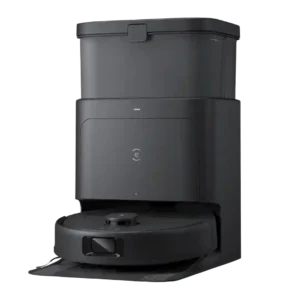
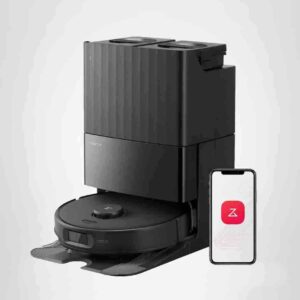
Multiple reviewers call the robot and dock stylish, with black and white color options and a station design that looks more refined than older boxy Ecovacs docks.
Design is generally viewed as modern and clean, though some reviewers prefer the more premium-looking alternatives (for example Curv or flagships). The dock can look a bit industrial, but the robot and station still fit well in most rooms.
The app offers room control, suction and mop tuning, obstacle sensitivity, mapping edits and automation options, though base-station physical controls were reduced versus older models.
Automation and smart features are a highlight: schedules, no-go/no-mop zones, multi-floor maps, granular suction and water control, assistant integrations, and dock control. Obstacle detection relies on structured-light style sensing rather than a camera on this model.
Mop lifting lets the N30 transition across carpets and rugs without soaking them, making mixed-floor cleaning more practical.
Mop pads lift when carpet/rugs are detected and many users report rugs staying dry during transitions. Very high-pile carpets may still get damp depending on settings, so vacuum-first routines can be helpful.
Setup is consistently described as easy, with quick base assembly, straightforward app pairing and fast initial mapping.
Setup is described as straightforward: attach the ramp, plug in the dock, charge, pair to Wi‑Fi, and fill the clean water tank. Most reviewers report quick, hassle-free first run and mapping.
Battery life is adequate but not a strength; one reviewer saw steep drain at max power, while dock-based charging keeps autonomous operation convenient.
Battery life is repeatedly called a strong point, with a large battery and long runtimes on lower suction settings. Higher suction drains faster, and some testing shows max-power coverage below average, but typical mixed use is expected to fall in between.
The onboard bin and dust bag are accessible and functional, but the 2.6 L dock bag is smaller than some rivals and may need more frequent changes in busy homes.
Uses a dock dust-bag system that empties cleanly and is easy to swap with minimal mess. Reported replacement cadence ranges from roughly 30–60 days to about 2–3 months depending on debris load.
The design is described as robust and well-finished, with no reviewer raising major build-quality concerns.
Carpet cleaning is generally rated strong for the tier, including an above-average deep-cleaning score in testing and good pickup on rugs. Performance is not positioned as flagship-level, but it is consistently described as effective.
The brush and dock system handle heavy hair and mixed debris without frequent clogs, and auto-emptying is reported to work without choking on hair. Occasional checks are still advisable, but clogging is not a common complaint.
Reviewers place it above many similarly priced rivals for cleaning tech and value, though navigation trails the best Roborock and Dreame competition.
Across comparisons, the S5A is framed as upper mid-tier: strong fundamentals and automation, but behind flagships in obstacle avoidance sophistication and premium extras. Many reviewers still consider it a sweet spot when priced well.
The app is clear and flexible, but some users may miss more convenient top-mounted dock controls and fully button-based operation.
The Roborock app and controls are repeatedly called intuitive and customizable, with clear UI for maps, routines, suction, and water levels. Live video-style viewing is not available on this model, but core control is polished.
The extendable mop arm noticeably improves corner reach and solves a common weak spot of robot mops.
Corner cleaning improves notably thanks to an extending side brush, leaving corners visibly cleaner than many robots. Some reviews still note a small amount of leftover debris in tight corners.
The dock dirt-detection and remopping concept can work well (for example, triggering a second pass after muddy paw prints). However, other testing reports it did not reliably detect certain dried stains, making the behavior inconsistent.
The robot reliably returns to the dock for emptying, mop washing and drying, adding the hands-off experience buyers expect from an Omni dock.
Docking and automation are consistently reliable in reviews: automatic dust emptying, water refilling, mop washing, and drying generally work as expected. The tradeoff is a larger dock footprint compared with simpler stations.
It handles light dried stains well and can clear tougher dried messes like ketchup with extra passes.
Handles common dried messes well, including muddy paw prints and dried coffee, often improving significantly on a second pass. Tougher stains like dried ketchup may require multiple passes and sometimes manual intervention.
Day-to-day use is simple once mapped, though cable clutter, tight spaces and the need for app familiarity keep it from being fully effortless.
Edge cleaning is a standout strength thanks to the extending mop that reaches along walls and baseboards more thoroughly than many rivals.
Edge and baseboard cleaning is a consistent strength, helped by an extending mop pad and flex arm side brush that can reach right up to walls. It is often described as better than most robot mops, though not always perfect in tight corners.
The robot generally tracks edges effectively when extending the mop, though room-layout complexity can still slow it down.
Edge-following is strong, with the robot staying close to walls and the mop pad reaching into baseboard lines. Reviewers often show it maintaining contact better than typical robot mops.
Auto-emptying and dock maintenance reduce manual mess handling, though bag size limits how long some heavy-use households can go between changes.
Auto-emptying to a sealed bag keeps dust handling clean and hands off, and swapping bags is reported to be quick with minimal mess. This is a major convenience advantage for frequent cleaning.
A sealed bagged dock and washable filter support decent dust containment and air cleanliness for a mainstream robot vacuum.
The cleaning head setup combines a main brush, side brush and dual rotating mop pads, with newer anti-tangle shaping that improves overall floor-contact behavior.
Reviewers say floors look noticeably cleaner and even sparkling after mopping, especially on everyday dirt and light dried residue.
Fresh liquid pickup is reported as effective when mopping up spills like a glass of water, with the spinning pads absorbing and clearing liquid without leaving notable residue.
The brush path does a good job funneling hair inward, so reviewers reported very few hair-channel cleanup annoyances.
When hair does collect, it tends to channel toward the center of the split brush, making it quick to remove by hand. This is described as manageable rather than a major snagging problem.
Carpet hair pickup is usually strong, especially on rugs, though a few tests still show small amounts of hair remaining after a pass. Overall performance is described as better than average for this tier.
Dog hair and general fur pickup are consistently strong on everyday floors, especially with the anti-tangle brush system.
Hair pickup on hard floors is a standout, including long and even slightly damp strands, with users reporting thorough collection and minimal cleanup afterward.
The anti-tangle brush design is one of the product’s clearest wins, with reviewers specifically praising its resistance to wrapped hair.
Hair-wrap resistance is one of the biggest strengths: the DuoDivide brush and redesigned side brush greatly reduce tangles. In extreme stress tests, some hair may channel to the center and require a quick manual pull, but it is easy to clear.
Fine dust pickup on hard floors is strong, with reviewers repeatedly describing solid single-pass dirt removal.
Hard-floor fine dust pickup is repeatedly described as strong, including successfully collecting very fine particles like powdery debris without leaving a visible film.
It performs well on larger debris like crumbs and rice, usually clearing them in one or two passes.
Handles larger debris well on hard floors, such as crumbs, rice, and oatmeal, often clearing scattered mess in a single run or a couple of passes.
This model is noted as lacking built-in LED or headlight illumination, which some reviewers say would help in dim rooms and for better obstacle detection.
The dock uses hot water mop washing and warm-air drying, which improves post-clean maintenance and pad readiness.
The dock uses heated processes (hot water mop washing and warm/hot air drying). Some testing questions whether advertised maximum water temperature is reached, but the heating still appears effective for pad cleaning and drying.
The extending mop arm and upgraded anti-tangle system are viewed as meaningful innovations rather than marketing fluff.
Everyday debris such as crumbs, rice and pet messes are handled confidently for a robot in this price tier.
At around 10.4 cm tall, the robot is reasonably slim and can reach under some furniture, though it is not ultra-low-profile.
The robot is relatively slim for a LiDAR-top model (around 4 inches / ~9.8 cm), helping it fit under more furniture than many competitors. It is still taller than ultra-thin flagships that remove the top LiDAR turret.
The dock automation keeps upkeep low overall, but owners still need to replace bags, manage water tanks and occasionally clear problem areas.
Maintenance is largely hands off thanks to the auto-empty and mop-wash dock, plus reduced hair tangling. Users still need to replace bags, rinse/clean the dock tray occasionally, and maintain filters and pads.
It moves well in open areas, but tight corners and chair- or cable-heavy spots can slow it down or cause trouble.
Mapping is fast and editable, but pathing and room segmentation are not always optimal compared with class leaders.
LiDAR-based navigation earns strong marks for fast, accurate mapping and efficient room coverage. Multi-floor support and reliable pathing are repeatedly highlighted as core strengths.
The mop lift works as intended, allowing safer carpet transitions during mixed cleaning runs.
The mop lifting system (about 10 mm) works well for most rugs and carpets and helps prevent wetting during transitions. Very plush/high-pile carpet can still be challenging without using vacuum-first settings.
Mopping is one of the N30 Pro Omni’s biggest strengths, with very good everyday scrubbing and edge reach.
Mopping performance is widely praised: dual spinning pads, adjustable water output, and frequent pad washing produce clean, refreshed hard floors. Sticky dried stains may take multiple passes, but everyday grime is handled very well.
Standard modes are reasonably quiet, but max suction is clearly loud and one of the main tradeoffs.
Generally quieter than many competitors; peak loudness is cited around 70 dB on higher suction, and real-home testing reports low disruption (pets barely reacting).
Obstacle handling is serviceable rather than best-in-class; it avoids major collisions but still struggles with cables and cramped layouts.
Obstacle avoidance is the most mixed area: some users see graceful navigation around common items, while multiple controlled tests show it can run over cables and miss smaller or low objects, especially on carpet. Camera-equipped models are consistently reported as better here.
Heated mop drying helps prevent damp-pad smells, a useful long-term hygiene benefit.
Hot-water washing plus hot/warm air drying helps keep mop pads fresh, and at least one real-home review explicitly reports no lingering smells after repeated runs.
One reviewer specifically missed the hidden cleaning tools found on an older Ecovacs dock, so onboard storage is a step back here.
Running costs look moderate rather than minimal because the dock uses consumables and an optional cleaner stick is sold separately.
Consumables are typical for an auto-empty robot: dust bags and periodic filter cleaning/replacement. Reported bag life of 30–60 days (or 2–3 months) helps keep ongoing costs manageable, but you may also buy cleaning solution since it is manually dosed.
Vacuuming, mopping, auto-emptying and pad washing make this a highly convenient cleaner for everyday upkeep.
The overall tone is strongly positive: reviewers see it as an easy recommendation with a few navigation and noise caveats.
Pet households are a strong fit thanks to hair pickup, anti-tangle behavior and solid day-to-day floor maintenance.
Well-suited to pet homes thanks to excellent hair pickup and anti-tangle brush design. It lacks camera-based pet recognition features found on higher models, but day-to-day pet hair cleanup is a standout.
Reviewers repeatedly frame it as high-end functionality at a more approachable price than flagship competitors.
Value is strongest when discounted, with multiple reviewers calling sale pricing an excellent deal versus higher models with cameras or chassis lift. At full price it sits in an upper mid-tier range and may feel expensive if you mainly want top obstacle avoidance.
The absence of a front-facing camera means no live video monitoring, which many see as a privacy benefit. The tradeoff is weaker camera-assisted obstacle recognition and fewer monitoring features compared with models that include an RGB camera.
Measured low-suction runtime and coverage are impressive in testing, with the robot covering roughly 3,947 sq ft before reaching 0% battery, which is above average. Measured max-suction runtime and coverage are weaker in testing, with roughly 513 sq ft covered before depletion, which is below average. Expect significantly better results on mixed or lower suction settings.
The dock’s wash, dry and auto-empty cycle meaningfully reduces manual maintenance and keeps the robot ready for the next run.
The dock automates mop washing, pad drying, water refills, and in some cases self-cleaning of the base tray. Reviews generally find these cycles effective and appreciate the reduced hands-on maintenance.
The dock supports standard water-based mopping and can use an optional cleaner stick that mixes solution into fresh water.
There is no auto solution or detergent dispensing tank, so cleaning solution must be added manually to the clean water tank. Multiple reviews call this a missed feature at this price.
The dock is more compact than some full-service stations, but it is still a sizable appliance that may feel bulky in smaller homes.
The dock is described as larger because it houses clean/dirty tanks and the auto-empty system, so it needs dedicated floor space. Some comparisons note it is narrower than certain flagship docks, but it is still a sizable station.
Mopping is typically reported as streak free on hard flooring, but heavy muddy messes can smear on an initial pass before pad washing and follow-up cleaning improves the result.
It is fine in open rooms but can get hung up on tight corners, chair bases and loose cables.
Most day-to-day runs are described as smooth with few stops, but the robot can still get caught by cables or a sock in some tests. Lack of chassis lift also limits its ability to self-recover on tall thresholds.
Suction is a clear strength, with 10,000 Pa class power translating to very strong everyday pickup.
Strong rated suction (up to 18,500 Pa) and consistently good real-world pickup, even when lab airflow/pressure measures slightly below average. Overall cleaning results on hard floors and rugs are described as above average for the price tier.
The robot can work in smaller homes, but tight layouts and the station’s footprint make it a better fit for moderately open floorplans.
The robot itself suits small spaces well thanks to efficient mapping, but the multifunction dock is relatively large. Homes with limited floor space near outlets may need to plan dock placement carefully.
Review sentiment suggests reliable everyday cleaning, but no review gives notable evidence of standout customer support.
Mop lifting helps it avoid wetting carpets and rugs during mixed runs, improving surface safety.
Its compact body and reach around chair legs help it clean some under-furniture areas better than bulkier robots.
Its relatively low height helps it reach under furniture and low cabinetry where many robots miss dust. At least one real-home test highlights under-cabinet cleaning as a major day-to-day benefit.
For the feature set, reviewers generally see the N30 Pro Omni as delivering better value than many pricier alternatives.
Multiple cleaning modes, mixed vacuum and mop runs and app-based room targeting make it versatile across different households and surfaces.
The dock’s 3.5 L clean-water and 3 L dirty-water tanks are practical for routine mopping and help limit refill frequency.
The clean/dirty water tank setup is a key convenience feature; reviewers cite large tanks (around 4 L clean and ~3.5 L dirty in one real-home test) and automatic onboard refills. This enables multiple full clean-and-mop sessions before needing attention.