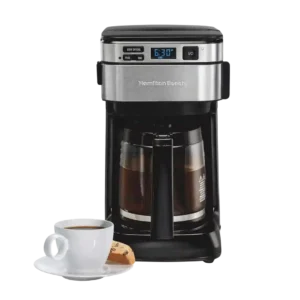
Hamilton Beach Front-Fill 12-Cup Coffee Maker, 46310
Where It Has the Edge
- Design, ergonomics and footprint is 4.5 vs 4.0. Ergonomics and footprint are a standout. The front-fill reservoir and front-access swing basket make it easy to use...
Accessories are minimal out of the box. Reviews note it does not include paper filters, and both the reusable basket filter and the compatible water filter are optional purchases.
Included extras commonly mentioned are a measuring scoop, a reusable metal filter, and a charcoal water filter kit. Some reviews imply we may still want to buy paper filters or replacement charcoal filters over time.
Marketing is mostly aligned with day-to-day use, but capacity labeling is a common gray area. Reviews point out that 12 cups refers to smaller cup sizes and that fill markings can feel inconsistent depending on how you measure.
The PerfectTemp and Bold positioning gets mixed support: some reviewers feel the Bold option improves strength, while others see little flavor change beyond a slower brew. Temperature-related testing in a few reviews reports brew temps below the classic 195-205 F target, which may not match perfectionist expectations.
Basic setup and brewing are straightforward, but setting the clock/program can be unintuitive. Some users also report having to fiddle to seat the front basket cleanly, which can slow routine use.
Setup is usually described as quick, with clear basic programming once we learn the buttons. The recurring caveat is that the interface has a learning curve at first, so the manual can matter for the initial setup.
Automation features are solid for a budget drip maker: programmable start, brew-strength modes (regular/bold) and small-batch mode, plus 2-hour auto shutoff and a clean reminder. The main downside is the lack of an audible completion beep and sometimes-finicky button workflow.
Programmability is a major strength: 24-hour auto-brew scheduling, adjustable auto-off (up to 4 hours), brew-strength options (Regular/Bold), a small-batch setting, and a toggle for the ready-tone. Several reviews also mention a Clean/descale indicator that prompts maintenance.
Brewing performance is consistently described as good, with hot output around the ~178–180F range in demos and an even brew bed in at least one hands-on check. A comparative test measured notably strong extraction versus other budget machines.
Many reviews describe the coffee as hot, aromatic, and reliably good, helped by showerhead-style water distribution and brew-strength controls. Test-driven reviews are more critical, citing slightly-low brew temperatures and occasional bitterness or uneven extraction, especially with darker roasts.
Build quality is mixed: the brewer body is mostly plastic and generally described as reliable, but multiple reviewers report the thin glass carafe cracking, making durability a notable weak point.
Build quality is generally seen as sturdy for the price, though several reviews note that the stainless appearance is paired with a mostly plastic body. The glass carafe is often described as solid, but some reviewers still flag breakability and fingerprint-prone finishes.
Cable management is a drawback. Reviews mention a short power cord and no cord storage, which can limit placement flexibility on the counter.
Capacity is advertised as 12 cups, but reviewers emphasize that this is based on smaller cup definitions (not typical large mugs). One test also suggests the water markings may read off versus measured ounces.
Reviews consistently highlight the oversized 14-cup capacity for households or offices, with a 1-4 cup mode for smaller batches. A few reviewers note that coffee-maker cups are about 5 oz, so the real-world number of mugs is lower than 14.
Carafe and handling are a split result. Pour performance is praised in a spill/dribble test and the drip-stop plunger helps reduce mess, but the thin glass carafe is repeatedly called fragile.
Carafe handling is mostly a plus: brew-pause/pause-and-serve reduces dripping when we pull the pot mid-brew, and several reviews praise the spout/knuckle-guard design and dishwasher-safe parts. Some users note pouring can be spill-prone depending on angle, and glass always carries break risk.
Ergonomics and footprint are a standout. The front-fill reservoir and front-access swing basket make it easy to use under cabinets, and multiple reviewers call out the compact, counter-friendly shape.
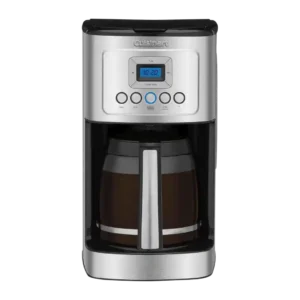
For a 14-cup machine, multiple reviewers call the footprint relatively compact and the stainless look attractive, with a clear LED display. At the same time, it can feel bulky or tall on the counter, and the control panel has lots of buttons.
Reported design flaws include a basket that can stick or be finicky to reinsert, clock/program controls that feel awkward to set, no finished-brew beep, and some steam/noise near the end of cycles. One demo also notes the water level window is only on one side.
Common complaints include an initially confusing interface, awkward water-tank refills for some kitchens, and the limitations of a glass carafe on a hot plate. A few reviews also call the Bold mode a minor difference or gimmick, and one lab-style review reports uneven spray coverage.
Filter setup uses standard 8–12 cup basket paper filters. A reusable basket filter is compatible but not included, and an optional water filter can be added in the reservoir slot.
The brewer is frequently praised for including a reusable Gold-Tone filter plus a charcoal water filter option, with compatibility for paper filters as well. Overall, filtration and basket design are treated as a value add versus bare-bones drip machines.
Heating performance is generally strong for the class: brew temperatures around ~178–180F are reported, and the warming plate can run very hot. Bold mode tends to increase brew time rather than dramatically increasing brew temperature.
At least one comparative test reports a heating draw around 1150 watts and places it among the hotter-running brewers in that lineup. Even so, measured brew temperatures in other reviews vary and can land below ideal specialty targets.
Overall experience is mostly positive thanks to easy front access, quiet operation, and good-tasting coffee. The biggest negatives are the fragile carafe and occasional annoyance with basket seating and time/program controls.
Overall sentiment is positive: reviewers like the combination of big capacity, scheduling, and practical features that make daily coffee easy. The main detractors are the busy control panel and the compromises of a glass carafe on a hot plate versus a thermal system.
Popularity is described as high in user commentary, with one reviewer noting it is commonly stocked and widely seen at major retailers.
Several sources describe this model as a best-seller and a common recommendation in roundups, suggesting broad adoption and easy availability. Its long run on the market is also used as a signal of popularity.
Pot functions cover the essentials: a warming plate to hold temperature, pause-and-serve via the drip-stop plunger, and automatic shutoff after about two hours.
The adjustable keep-warm/hot-plate settings are widely praised for holding temperature for hours, with multiple heat levels. The downside is inherent to hot plates: a few reviewers warn coffee can scorch or degrade if we leave it warming too long.
Certifications are not a major focus in most reviews. One source references SCA certification, while other test-based notes emphasize temperature ranges rather than formal certifications, so expectations on this point should be kept modest.
No summary yet.
Brew speed is generally described as quick enough for daily use, with measured full-pot brew times around the 7-8 minute range in testing. Some reviewers still call it slower than faster competitors, especially on the Bold cycle.
Value is frequently framed as strong, especially when purchased on sale. Reviewers feel the brewing results and convenience features justify the budget-to-midrange pricing despite some annoyances.
Across reviews, the typical street price (roughly the $90-$120 range) is framed as strong value given the capacity, programmability, and included filters. Most reviewers position it as a budget-friendly upgrade over basic drip brewers.
Multiple reviews call out the 3-year limited warranty as a standout at this price. One review notes that warranty service may require shipping the unit to Cuisinart.
Maintenance is guided by a clean notification that prompts descaling, with vinegar commonly suggested in reviews. One reviewer notes the reminder can be reset by unplugging, which is convenient but can encourage delaying proper descaling.
Maintenance is described as straightforward: a Clean/descale light, a self-clean cycle (typically vinegar/water), and removable parts that can go in the dishwasher. Reviews also mention periodic charcoal filter replacement and wiping steam/condensation around the basket area.