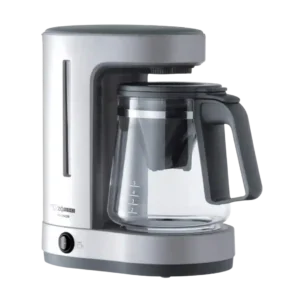
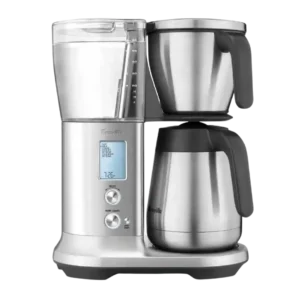
Zojirushi Zutto 5-Cup Drip Coffeemaker
Where It Has the Edge
- Design, ergonomics and footprint is 4.6 vs 4.1. Nearly every review highlights the compact footprint and minimalist design as a major advantage for dorms, small kitchens,...
Included items mentioned across reviews include a measuring scoop, instruction manual, and a charcoal/activated carbon water filter. Some reviewers also note registration or documentation inserts.
The included baskets, filters, scoop, and water-hardness tools add real versatility, but several reviewers disliked that the pour-over adapter is separate or not bundled on all versions.
Most reviewers felt the brewer broadly delivers on its premium positioning, especially around flexibility and batch quality, though some thought the long feature list overstates how useful every mode really is.
No app, Wi-Fi, or smart control features are mentioned; reviewers treat the Zutto as intentionally analog and simplified.
This is one of the brewer's clearest strengths. Reviewers repeatedly praised the smart control set, especially adjustable temperature, bloom, flow rate, presets, auto start, and intuitive LCD navigation.
Setup is straightforward: add water, a No. 2 cone filter, grounds, then flip the single switch. Several reviewers recommend running water-only cycles at first to reduce an initial plastic smell and following the manual’s folding and ratio guidance for best results.
Setup is not difficult, but it is longer and more involved than a basic drip machine because of initial cleaning, water-hardness setup, and learning the controls.
Automation is minimal by design: one on/off switch, no clock, no brew-finished beep, and no auto-off. It does offer a keep-warm behavior via the hot plate, but reviewers repeatedly frame it as a manual, no-frills brewer.
Automation is strong for this class. Auto start, water-hardness calibration, timers, reminders, small-batch adjustments, and preset brew logic make the machine feel unusually intelligent for a drip brewer.
Across outlets and hands-on videos, the Zutto is repeatedly described as making surprisingly good drip coffee for its size and price, with even wetting/extraction helped by the cone-in-carafe layout. A few notes suggest strength depends on dosing, so under-measuring grounds can taste watery.
Brewing performance is consistently excellent. Reviewers repeatedly praised stable brew temperatures, even extraction, and the ability to produce high-quality coffee across both preset and custom modes.
Build impressions are mixed: the machine feels light and is described as mostly plastic, which raises durability questions, but it also gets credit for stable feet and a tidy, compact build for small spaces.
Build quality is widely seen as premium, sturdy, and substantial. Multiple reviewers describe it as tank-like or espresso-machine-like, with only a few caveats around specific parts on certain versions.
Capacity is firmly small-batch: a 5-cup machine around 20–25 oz total, best for one to two drinkers. Reviewers consistently position it as a poor fit for larger households or people who want big carafes.
Its large 12-cup or roughly 60-ounce capacity is a major advantage, especially for families, entertaining, and small office use, while still remaining capable of smaller brews.
Carafe handling is generally easy once you learn the lid: multiple reviewers stress holding the lid/tab while pouring so it does not slip. The basket sitting inside the carafe can make used-grounds disposal a bit awkward and may drip slightly during cleanup.
The carafe system is generally well liked for secure pouring, thermal heat retention, and drip-lock behavior, though some reviews mention weight, leftover liquid, or weaker-than-expected heat retention versus top rivals.
Nearly every review highlights the compact footprint and minimalist design as a major advantage for dorms, small kitchens, and solo drinkers. The same compact, basket-in-carafe design is also the reason some users find cleanup and pouring technique slightly quirky.
The brewer looks premium and has a strong interface, but it is undeniably large and can feel bulky on tighter counters. Ergonomics are good overall, just not especially compact.
Common nitpicks include no pause-and-pour, no end-of-brew alert, and the need to manually switch off the warmer. A few users mention initial plastic odor, dense instructions, and the lid handling cautions as minor but real annoyances.
The most common flaws are the fixed water tank, large size, accessory gaps, some cleanup nuisance around the basket area, occasional noise, and a few interface or program quirks.
Even though this is a drip brewer rather than an espresso machine, beverage quality scores strongly. Most reviewers describe the coffee as flavorful, balanced, smooth, and often close to specialty pour-over quality when dialed in.
Filter setup uses No. 2 cone paper filters, and multiple reviews mention compatibility with reusable/permanent filters. The included charcoal water filter is discussed as a taste and odor helper and is said to need periodic replacement over time.
Filter flexibility is a real asset. Reviewers liked the included cone and flat-bottom options, reusable filter support, and the ability to match basket style to batch size, though cleaning the multi-part basket can be fussy.
Temperature performance is frequently praised, including measurements in the high 180s to low 190s F in video testing and reports of near-200 F brewing in older lab-style writeups. Multiple sources credit this heat retention for the strong flavor extraction.
Heating performance is one of the brewer's biggest advantages. Reviews consistently highlight precise temperature control, fast heat-up, and strong stability throughout the brew cycle.
Cold brew and over-ice functions are useful extras for many owners and work well for occasional specialty drinks, but a few reviewers considered them secondary or somewhat gimmicky compared with the main hot-brew strengths.
Overall, the user experience is framed as frustration-free for mornings: one switch, compact parts, and consistently good results when you follow dosing guidance. The tradeoffs that shape day-to-day satisfaction are the hot plate, the lack of programming/alerts, and a couple of handling quirks.
Overall user experience is very positive. Most reviewers found the machine rewarding to use day to day once set up, especially if they value flexibility, though it is not as effortless as a very simple brewer.
The brewer shows strong enthusiast credibility. Reviewers mention repeated recommendations, use by roasters at events, and standout status in broader best-of testing.
The hot-plate warming setup is the main functional compromise versus thermal carafes. Reviews warn that coffee can pick up overcooked or dull flavors if left sitting, and several recommend drinking it fairly soon and/or turning the unit off shortly after brewing.
As a pot brewer, it performs extremely well. Full-pot brewing, batch consistency, and multi-user convenience are recurring positives, and several reviewers specifically recommend it for households or office-style use.
The pump-driven flow control is consistently described as precise and stable, helping the machine manage bloom, flow rate, and extraction more accurately than simpler mechanical brewers.
Recognition is strong for such a small brewer: it is explicitly called a best-buy pick in comparative testing and is recommended in multiple buying guides. It is also noted as not being SCA certified, even though performance is often compared favorably to premium machines.
Recognition is excellent. The brewer is repeatedly cited as meeting or targeting SCA standards, and that certification-level performance is central to its reputation.
Brew times land in the normal drip window: about 5.5 minutes for 4 cups and roughly 6–7 minutes for a full 5-cup batch. It is not a speed demon, but most reviewers consider the timing reasonable for better flavor.
Speed is strong for a feature-rich brewer. Most reviewers found it fast enough for daily use and competitive with other premium batch brewers, even if some runs are not class-leading.
Value is a core theme: it is often cited around $70–$80 as a best-buy style pick that competes above its class on taste. A minority view is that it feels pricey for only 5 cups, and replacement parts like the glass carafe can be expensive.
Value is good for buyers who will use the flexibility, batch capacity, and precision, but the premium price makes less sense for casual drinkers who just want a simple pot of coffee.
Warranty and support are a weaker area than pure brewing performance. The standard warranty is shorter than some rivals, and a few reviews raise concerns about parts availability or customer-service confidence.
The removable water reservoir is a standout convenience for filling and cleaning, and several reviews mention scale/cleaning guidance (vinegar or citric acid) plus a charcoal filter to improve water taste. Some caution that you should avoid spilling water into the machine body when filling.
Water management is thoughtful overall, with hardness testing, descale reminders, and straightforward routine cleaning, but the fixed reservoir and some basket-cleaning chores reduce convenience.