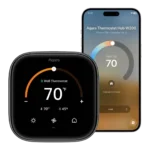
Aqara Hub W200 Feature Scores
Explore all 42 feature scores for Aqara Hub W200, organized into pros and cons.
Scores by Feature
Summary
42 reviewed features-
Very positive 4.5-5.015 (36%)
-
Positive 3.5-4.415 (36%)
-
Neutral 2.5-3.48 (19%)
-
Negative 1.5-2.44 (10%)
Pros
Sort
-
Smart-home ecosystem compatibility was one of the W200's clearest strengths across reviewers.
-
The mmWave occupancy sensor earned strong praise for detecting presence more accurately than basic motion sensing.
-
Value for money was a major strength because reviewers saw premium features at a lower or competitive price.
-
Apple Home and HomeKit support stood out as a major advantage, especially because of Apple-only thermostat features.
-
Matter support was praised both as a compatibility bridge and as part of the thermostat's hub role.
-
Energy-saving guidance was generally viewed as useful for saving money or energy without harming comfort.
-
Privacy controls were praised because Apple Adaptive Temperature processing stays local/on-device.
-
Installation was consistently described as easy, especially for swaps from an existing smart thermostat.
-
Adaptive recovery intelligence was a standout because Apple Adaptive Temperature anticipates returns and improves comfort.
-
Auto-adjustment and learning-style behavior were praised as smarter and more accurate than typical reactive thermostats.
-
Design and finish were generally praised as clean, compact, and attractive.
-
External Aqara sensors were viewed as meaningful companions for room-based control.
-
Presence-based automation was broadly useful, though one reviewer found the practical value room-dependent.
-
Room prioritization through Aqara sensors was seen as a useful way to heat or cool based on a preferred room.
-
Wi-Fi connectivity was described positively, with reviewers pointing to reliable dual-band support.
-
Comfort consistency was a high point, with a reviewer reporting a more comfortable home after switching.
-
Touchscreen feedback was mixed: one reviewer found temperature changes fiddly, while others called the screen intuitive or highly responsive.
-
Geofencing reliability was praised for consistently recognizing when the reviewer left home.
-
The display is bright and sharp, but glossy fingerprints and limited visual options keep impressions from being uniformly excellent.
-
Away mode worked well in review testing, with automatic temperature adjustments after leaving home.
-
Notifications were praised for consistently appearing when the reviewer left home.
-
Local automation behavior was viewed favorably because routines can still work during an internet outage.
-
The guided installation instructions were praised as clear and manageable for handy homeowners.
-
On-device controls were useful as a wall controller, though one reviewer struggled with gestures and menu access.
-
Alexa/Amazon support was described as solid for app and voice control, though Apple support received more enthusiasm.
-
General 24V conventional compatibility came across as suitable for common household systems.
-
Google support was described as solid for app and voice control, but not as differentiated as Apple Home integration.
-
Humidity support earned a positive note because the W200 can use an external humidity source.
-
Basic scheduling and modes were considered more than sufficient for everyday thermostat control.
-
Voice control was treated as convenient across major assistants.
Cons
Sort
-
Heat pump support drew the strongest compatibility criticism because compressor and auxiliary heat controls felt unclear or inadequate.
-
Energy reports lag behind competitors because the runtime presentation was judged too simple.
-
Reviewers noted the box is nearly complete, but the C-wire adapter is not included.
-
Multi-room balancing is a weakness because reviewers noted the W200 lacks simultaneous multi-sensor averaging.
-
Equipment/runtime diagnostics were considered less detailed than Ecobee-style reporting.
-
Coverage is broadly positioned, but one reviewer warned that heat-pump-specific control depth needs research before buying.
-
Manual override flexibility is limited by the absence of temperature set-limit controls.
-
Utility demand-response support is limited because provider availability was described as narrow.
-
Wall fit can be imperfect when replacing a larger thermostat because the smaller base may leave visible unpainted edges.
-
C-wire flexibility is limited because no-C-wire systems need an adapter rather than working cleanly out of the box.
-
The app was praised as robust overall, but heat-pump and auxiliary-heat wording created real confusion.
-
Filter reminders are present, but one reviewer disliked the minimum alert interval.