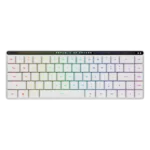
ASUS ROG Falchion RX Feature Scores
Explore all 48 feature scores for ASUS ROG Falchion RX, organized into pros and cons.
Scores by Feature
Summary
48 reviewed features-
Very positive 4.5-5.028 (58%)
-
Positive 3.5-4.412 (25%)
-
Neutral 2.5-3.47 (15%)
-
Negative 1.5-2.41 (2%)
Pros
Sort
-
Design is one of the strongest areas, with reviewers repeatedly calling the keyboard elegant, futuristic, clean, or premium-looking.
-
Switch feel is one of the keyboard’s strongest attributes, with reviewers describing the low-profile switches as smooth, refined, snappy, or surprisingly good.
-
Typing feel is broadly excellent, especially on red-switch units, though one reviewer found it less satisfying than traditional mechanical switches.
-
Build quality is broadly praised as solid, premium, and well put together despite the compact low-profile body.
-
RGB lighting quality is consistently praised for brightness, vividness, shine-through legends, and attractive integration with the white design.
-
Connectivity is repeatedly praised for wired, Bluetooth, and 2.4GHz options, with several reviewers calling switching or setup easy.
-
Battery life is a consistent strength, with reviewers reporting long multi-day use and calling endurance fantastic or impressive.
-
Noise level is a major strength for red-switch units, repeatedly described as very quiet or near-silent.
-
Compatibility is a strength because reviewers appreciated Mac support, Mac/PC switching, and usefulness across operating systems.
-
Media controls are widely praised as useful and space-efficient, though a few reviewers found the touch panel less useful or only moderately responsive.
-
Frame rigidity is a major strength; multiple reviewers report no deck flex, creaking, or a rock-solid base.
-
Portability is strongly supported by the compact size and cover, though some reviewers dislike how the cover or dongle storage works for travel.
-
Key stability is highly praised; reviewers repeatedly mention minimal wobble, secure keycaps, and uniform feel.
-
Gaming performance is praised by most reviewers for responsiveness and real-world play, with one reviewer seeing it more as a work keyboard.
-
Wireless performance is strong overall, with reviewers praising stable 2.4GHz behavior, while Bluetooth delay is mentioned as a minor limitation.
-
Keycaps are mostly praised for feel, coating, shine-through lighting, and stability, but ABS material and replacement concerns temper scores.
-
Sound dampening is strongly praised for reducing ping, rattle, echo, and case noise through silicone foam layers.
-
Key responsiveness is generally strong and fast, though a few reviewers mention sensitivity can cause accidental inputs during adjustment.
-
Ergonomics are mostly positive thanks to comfort, height options, and low fatigue, though one reviewer found the stock height very low.
-
Reliability is excellent in the available evidence, with reviewers reporting stable wireless use and no dropouts or missed keypresses.
-
Latency evidence is strongly positive, with reviewers reporting near-zero latency, no perceivable input delay, and strong low-latency wireless performance.
-
Stabilizer quality is praised, especially for limited spacebar rattle and lack of ticking.
-
Most reviewers praised the sound profile as quiet, pleasant, or refined, though one clicky-switch review found the sound annoying for long work sessions.
-
Customization is generally strong thanks to remapping, profiles, touch-panel options, and RGB controls, though software quality varies.
-
Value is mixed: many reviewers think the premium experience justifies the price, while others call the keyboard expensive or not especially affordable.
-
The compact design is praised for saving desk space and leaving more room for mouse movement or small-desk setups.
-
Gaming extras are viewed positively, including high rollover, Omni receiver sharing, and profile or macro features that gamers still use.
-
Size and form factor are useful but polarizing: reviewers like the compact 65%-in-60% footprint while noting cramped keys and adjustment time.
-
Macro customization is a strength, with reviewers praising on-the-fly macro recording and programmable macro support.
-
Typing comfort is very positive in the limited evidence, with reviewers describing long typing as joyful and non-cramping.
-
Volume control is generally useful and convenient through the touch panel, though one reviewer rated it only a decent interface.
-
Backlighting is judged bright enough for low-light use, with one reviewer especially praising its daytime brightness.
-
Profile management is positive, with reviewers noting five or six profiles and customization that can carry between devices.
-
Materials quality is positive, especially the metal top plate and premium feel, despite plastic being used elsewhere.
-
Evidence is limited but positive: the switches are described as wobble-free with near-zero debounce behavior.
-
Per-key lighting control is supported positively by fully configurable RGB that can assign colors and patterns per key.
-
Polling-rate evidence is limited but positive, with one reviewer calling the high-rate 2.4GHz mode suitable for gaming.
-
RGB customization is praised where tested, with a reviewer highlighting many lighting-effect options in Armoury Crate.
-
Layout feedback is mixed: reviewers like the compact function access, but missing dedicated function-row keys can be inconvenient.
-
Onboard memory receives positive but limited evidence, with one review noting storage for five profiles.
Cons
Sort
-
Hot-swappability is a limitation: several reviewers note the board is not hot-swappable, with only one reviewer downplaying the issue.
-
The bundled USB cable is the clear weak point, with one reviewer calling it overly stiff.
-
Software quality is the weakest repeated theme; Armoury Crate is called bloated, frustrating, difficult, or mixed despite offering useful controls.
-
Switch replacement flexibility is weak because reviewers suggest tinkerers may need another keyboard if they want to swap switches.
-
Wrist-rest evidence is negative because the keyboard lacks one and a reviewer wished the cover had been replaced by a slim wrist rest.
-
Legend visibility is mixed to weak because side or secondary legends do not receive as much light and can be hard to see in the dark.
-
Key spacing is one of the main compromises, with reviewers citing cramped keys, accidental presses, and a short right Shift learning curve.
-
Durability evidence is limited and mixed, focused on concern that ABS keycaps may wear over time.