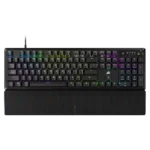
Corsair K70 Core Feature Scores
Explore all 48 feature scores for Corsair K70 Core, organized into pros and cons.
Scores by Feature
Summary
48 reviewed features-
Very positive 4.5-5.010 (21%)
-
Positive 3.5-4.422 (46%)
-
Neutral 2.5-3.411 (23%)
-
Negative 1.5-2.44 (8%)
-
Very negative below 1.51 (2%)
Pros
Sort
-
Typing feel is the strongest consensus win, with most reviewers praising smooth, quiet, satisfying typing despite a few reservations about sluggishness or stiffness.
-
Sound dampening was one of the most consistently praised attributes, with foam layers credited for lower ping, quieter typing, and better acoustics.
-
RGB customization was a major positive, with reviewers highlighting deep iCUE control, effects, per-zone options, and ecosystem integration.
-
Value for money was widely praised around the $100/£90 class, though a few reviewers felt feature cuts or market competition weakened the deal.
-
Gaming performance was consistently solid to excellent, with reviewers reporting responsive play and no major speed or registration issues in games.
-
Noise level was generally considered low for a mechanical board, with reviewers praising subdued, quiet, or less annoying operation.
-
Reviewers generally liked the pre-lubed linear switch feel, often calling it smooth or buttery, though a few criticized gumminess, sluggishness, stiffness, or reliability.
-
Customization options were broadly strong, covering key remaps, RGB, dial behavior, and iCUE controls, though dial programmability was limited.
-
Acoustics were a clear strength for most reviewers thanks to a deeper, quieter sound, though one negative review found the sound unpleasant.
-
RGB lighting quality was widely praised as bright, uniform, crisp, or attractive, though one reviewer noticed inconsistent shine-through on some keys.
-
Macro customization was praised, especially through iCUE, with reviewers noting useful shortcuts, remapping, and macro recording.
-
Typing comfort was strongly positive where discussed, with reviewers describing the board as comfortable or useful for long work sessions.
-
Frame rigidity was usually praised, with reviewers citing low flex, good rigidity, and torsional stiffness.
-
Gaming and general input responsiveness were mostly praised, with reviewers describing presses as snappy, responsive, or quick enough in actual play.
-
Most reviewers found the 1,000Hz polling rate sufficient or excellent for this class, even if it lacks higher-end AXON-style rates.
-
Onboard memory was mostly valued for portable profiles, though one review wanted stronger onboard behavior and another noted software-profile limitations.
-
Compatibility evidence was positive, with reviewers reporting Windows/Mac support and console testing without issues.
-
Per-key lighting control was praised where discussed, with reviewers noting individual key color control and granular lighting customization.
-
Stabilizers and the spacebar were mostly praised for reduced rattle and good tuning, though one reviewer still wanted more lube.
-
Build quality was generally solid, especially for the price, but opinions were pulled down by plastic construction and one strongly negative durability critique.
-
Key stability was viewed positively overall, with limited wobble noted across keycaps and stabilizer-supported keys.
-
Design aesthetics were mixed to positive, with praise for striking or sleek styling offset by comments that it was basic or even unattractive.
-
Volume control was generally useful through the dial, though some reviewers found the dial resistive or unreliable at fast scrolling.
-
Backlight brightness earned positive remarks, with reviewers calling the lighting impressively bright or noting strong shine.
-
Connectivity was judged positively when discussed, mainly because the wired connection avoided disconnects and wireless-interference concerns.
-
Software quality was mixed: iCUE was powerful and sometimes easy, but several reviewers called it convoluted, complicated, or difficult for newcomers.
-
Materials quality was mixed: reviewers liked the metal or aluminum elements but repeatedly noted budget plastic and less premium construction.
-
Ergonomics were mixed, with positive comments on height, palm support, and hand comfort but complaints about tall chassis positioning.
-
Legend visibility was mostly usable, but not perfect; one review noted uneven illumination while another found legends clear and easy to see.
-
One reviewer judged latency and speed solid overall, aided by the wired design and mainstream 1,000Hz behavior.
-
Wireless performance evidence came from the TKL Wireless review, which noted the wireless mode could exceed wired polling, though the gain was small.
-
Desk space opinions depended on layout: the TKL Wireless was efficient, while the full-size Core was called large and space-hungry.
Cons
Sort
-
Cable quality was the most repeated hardware complaint: reviewers disliked the fixed, rubber, non-braided, non-detachable cable.
-
Hot-swappable switch support was consistently negative because reviewers emphasized that the board is not hot-swappable.
-
Ease of switch replacement scored poorly because the negative review stressed difficult serviceability without hot-swap or easy disassembly.
-
Switch choice is limited: reviewers noted buyers effectively get Corsair Red linear switches, with no tactile or clicky options for different preferences.
-
Passthrough features scored low because a reviewer explicitly wanted a USB hub but noted it was absent.
-
Evidence is split: one review said actuation behaved as expected, while another reported severe switch chatter on multiple keys.
-
Profile management was a weakness in the cited reviews, mainly because software and onboard profiles could be awkward or disconnected.
-
Layout option criticism came from a reviewer who wanted a TKL version of the model they tested.
-
Durability evidence was mixed, with positive bend-test comments offset by concerns about the fixed cable and one review calling the keycaps non-durable.
-
Wrist rest quality was the most divided comfort issue: some found it supportive or comfortable, while many disliked the hard, rough texture.
-
Extra gaming features were adequate but not standout; reviewers liked useful basics but criticized limited or delayed advanced features.
-
Portability was mixed: the board is reasonably light, but full-size dimensions and the fixed cable limit easy travel.
-
Reliability evidence was split between positive long-term/no-issue impressions and one severe switch-chatter complaint.
-
The full-size form factor pleased some users but was also criticized for taking up desk space and not fitting every setup.
-
Keycap quality drew mixed reactions: some liked the ABS texture and feel, while others disliked slickness, shine risk, thinness, or durability concerns.
-
Media controls were mixed: reviewers liked the multifunction dial, but criticized registration issues, limited programmability, and lack of dedicated media keys.