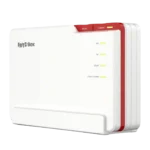
Fritz!Box 5690 Pro Feature Scores
Explore all 62 feature scores for Fritz!Box 5690 Pro, organized into pros and cons.
Scores by Feature
Summary
62 reviewed features-
Very positive 4.5-5.034 (55%)
-
Positive 3.5-4.414 (23%)
-
Neutral 2.5-3.46 (10%)
-
Negative 1.5-2.46 (10%)
-
Very negative below 1.52 (3%)
Pros
Sort
-
Integrated DECT, analogue-phone and VoIP functions are repeatedly treated as a major differentiator, especially for small businesses that want routing and telephony in one box.
-
Setup feedback is mixed by user type: basic installation can be fast and beginner-friendly, while advanced fibre, telephony and smart-home configuration demands more networking knowledge.
-
WireGuard and IPSec support performs very well in testing, combining strong throughput with manageable latency and straightforward common setup paths.
-
Coverage is a recurring strength: reviewers report useful signal through multiple walls, across large homes and at distances where existing setups weakened.
-
FRITZ!OS earns strong marks for depth, clarity and accessibility, although one reviewer finds the main dashboard text-heavy and more verbose than necessary.
-
The 6GHz band delivers the highest throughput and excellent nearby speeds, but range drops faster with distance and barriers than on 5GHz.
-
Long update support, fibre readiness and modern Wi-Fi give the router strong longevity, although missing XGS-PON and limited Ethernet speeds may matter to the most demanding users.
-
Reviewers repeatedly describe very fast real-world Wi-Fi, including dramatic gains over older routers and a noticeable step up when using Wi-Fi 7-capable clients.
-
Across tests, wireless performance is consistently strong, with especially good breadth of coverage and standout Wi-Fi 7 results even when peak close-range speed is not always class-leading.
-
Value depends heavily on use case: it looks expensive as a simple router, but reviewers find the price much easier to justify when its modem, telephony, mesh and smart-home roles replace separate hardware.
-
Build quality is consistently strong, with solid plastics, protected rear ports and sturdy physical controls despite the glossy finish.
-
Migration from another FRITZ!Box is a highlight, with settings transferring smoothly and with very little manual rework.
-
The integrated DSL and fibre options are repeatedly praised for letting users move from DSL to fibre without replacing the router again.
-
Monitoring tools are a strength, offering detailed traffic visibility while making it easier to identify high-usage devices and understand the network.
-
FRITZ!NAS makes attached storage easy to share, including newer link-based uploads and multiple access methods for home or small-office files.
-
MLO can deliver very high throughput and lower latency, but one test notes that the current two-band Wi-Fi 7 implementation limits theoretical peak speed and that many clients still cannot exploit it fully.
-
Parental controls are broad and increasingly easy to manage, with schedules, time tickets and per-device profiles; category-based filtering is the main missing piece.
-
Zigbee and DECT ULE make the router a capable smart-home hub that can replace extra bridges, but compatibility is not universal and missing Matter reduces cross-platform reach.
-
FRITZ!OS updates are viewed positively for regular fixes, integrated delivery and continuous development over the product’s life.
-
Wi-Fi 7 and VPN testing both point to low latency, with reviewers noting modest VPN overhead and noticeable improvements when newer wireless features are used.
-
Wi-Fi 7 is a central strength and delivers clear performance gains, though 2.4GHz remains on Wi-Fi 6 and some reviewers note that not every client can exploit the newest features.
-
The lower bands carry well through walls, but 6GHz still struggles with thick concrete; overall wall penetration is strong rather than physics-defying.
-
Most testing found stable, reliable connectivity and smooth streaming, although one client in one test did lose its connection.
-
5GHz performance is consistently strong, with reviewers finding excellent throughput and useful signal across larger homes and through brick walls.
-
The four extra gigabit LAN ports are genuinely useful for NAS boxes, adapters and other wired gear, even though their individual speeds are conservative.
-
The router is repeatedly framed as the center of a broader ecosystem, with mesh, smart-home, telephony and storage functions that can grow beyond basic routing.
-
One review explicitly cites the brand’s reliability as part of the reason this router is easy to recommend for serious home networking.
-
A dedicated WLAN button makes it easy to shut wireless access off quickly without opening the administration interface, a convenience one reviewer particularly liked.
-
One detailed home test found the router pulling ahead of rivals in distant rooms, making sustained speed away from the router a standout strength.
-
Reviewers describe the FRITZ! mesh ecosystem as powerful and easy to expand, with centralized management helping multiple nodes behave as one network.
-
Repeater integration has become easier, with streamlined onboarding and less repeated credential entry when adding mesh nodes.
-
AVM’s long software-support history is repeatedly treated as a major ownership advantage and a reason the router should remain viable for years.
-
The guided setup is clearly structured and walks users through the important connection and wireless settings step by step.
-
The full 2.4GHz, 5GHz and 6GHz arrangement is praised as a genuine premium implementation that improves capacity and gives newer devices more room to operate.
-
Newer firmware adds automatic fallback to a mobile dongle or another FRITZ!Box, which materially improves resilience when the primary connection fails.
-
Multi-room coverage is one of the strongest results, with performance holding up unusually well in bedrooms, dining rooms and other farther locations.
-
Despite the LAN-speed ceiling, actual NAS transfers were described as excellent and comparable with the reviewer’s existing system.
-
The 2.4GHz band is viewed as solid for IoT and older devices, but it is also the one band that does not receive full Wi-Fi 7 support.
-
The vertical orientation reduces desk footprint, but the router is still physically wide and substantial, so reactions depend on where it will be placed.
-
The single USB port is useful and fast enough for storage expansion, but reviewers repeatedly note that one port feels limited on a premium Pro model.
-
Firewall controls are considered robust enough for families and small businesses, with advanced customization available for more technical users.
-
Guest Wi-Fi is well regarded, including isolated guest access and controls suited to homes, visitors and small offices.
-
The Pro model’s 4×4 MIMO coverage across every band is presented as an advantage over the non-Pro version, particularly for buyers chasing stronger coverage and peak performance.
-
The front LEDs are clear and easy to interpret, giving at-a-glance confirmation of internet, wireless and telephony status.
-
Thermal results are mixed across tests: one measured a very cool fanless chassis, while another noticed meaningful heat under load.
-
Popular Zigbee products such as Philips Hue and IKEA devices generally work reliably, though some advanced functions can vary versus dedicated manufacturer hubs.
-
Near the router, results range from merely average for the class to fast and stable, so short-range speed is good but not the clearest reason to buy it.
-
The interface exposes a huge amount of control and can feel busy, but the simpler MyFRITZ! view gives less technical users a cleaner overview.
Cons
Sort
-
Matter is the clearest smart-home weakness: several reviewers note that promised support was still unavailable, and one considers that a dealbreaker for a modern controller.
-
Wired speed is the most repeated hardware complaint: four LAN ports are only gigabit and the faster port tops out at 2.5GbE, which limits high-end NAS and local transfers.
-
There is no built-in wall-mounting option, a repeated disappointment for users who prefer to keep networking hardware off desks or shelves.
-
Multiple reviewers wanted 10GbE on a router this capable, especially because faster competitors can avoid the local-network bottleneck.
-
The router cannot use its internet inputs in parallel, and one review specifically notes that this also prevents using both as a conventional fallback pair.
-
One reviewer flags the lack of XGS-PON as a genuine future-proofing gap for users expecting faster next-generation fibre service.
-
A reviewer specifically calls out the absence of 5GbE as part of the wired-connectivity shortfall that keeps the router from being the best overall.
-
An early software build had several annoying bugs and inactive Zigbee functionality, showing that launch-period firmware was not fully mature.
-
Multi-gig capability exists, but reviewers consistently wish there were more fast Ethernet ports rather than concentrating higher speed on only the SFP/WAN side.
-
Filtering supports specific sites, apps and usage profiles, but one reviewer criticizes the lack of category-based web filtering found on some competitors.
-
The router offers extensive configurable security tools, but one review notes the absence of active threat-protection features beyond auditing and configuration checks.
-
Power use is acceptable under heavy activity but less impressive at idle, where reviewers feel efficiency could be better.
-
The upright chassis is practical and understated to some reviewers, while others dislike the dated styling and glossy surface that attracts fingerprints and scratches.
-
Compatibility is strongest for European AON/GPON and DSL users; UK reviewers caution that direct fibre use may be limited by ISP practices, though Ethernet WAN provides a workaround.