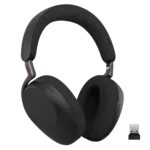
Jabra Evolve3 85 Feature Scores
Explore all 80 feature scores for Jabra Evolve3 85, organized into pros and cons.
Scores by Feature
Summary
80 reviewed features-
Very positive 4.5-5.040 (50%)
-
Positive 3.5-4.430 (38%)
-
Neutral 2.5-3.43 (4%)
-
Negative 1.5-2.47 (9%)
Pros
Sort
-
Fast charging is universally praised, and Qi charging is an unusually convenient bonus for desk use. A few minutes on power can add hours of runtime.
-
Despite being over-ear, the headset folds exceptionally flat and takes up very little bag space. Its slim profile is repeatedly singled out as a travel advantage.
-
Battery life is outstanding and one of the clearest strengths, routinely lasting several workdays and sometimes close to a week in mixed use.
-
Comfort is exceptionally consistent across long sessions, with multiple eight-hour or full-workday tests reporting little pressure or fatigue. The lightweight frame and roomy cups are central to that result.
-
Call quality is the standout feature: voices repeatedly come through clear, natural, and professional without a boom arm. Outdoor results are occasionally less perfect, but office performance is consistently exceptional.
-
The boomless, slim design is one of the product’s biggest successes, looking much more like premium everyday headphones than traditional office gear.
-
The six-mic boomless array is a major success, delivering clear professional speech without the visual bulk of a traditional microphone arm.
-
With no boom arm and a very slim silhouette, the headset blends into everyday use far better than conventional enterprise headsets.
-
At roughly 220 grams, the headset feels unusually light for an over-ear model and repeatedly disappears on the head during long workdays.
-
ClearVoice removes an impressive amount of office, café, street, fan, and household noise while keeping speech understandable. Only a small amount of background sound occasionally leaks through in tougher outdoor use.
-
Replaceable batteries and cushions are a major long-term ownership advantage, making the headset less disposable than most premium competitors.
-
Two-device switching is one of the strongest practical features, with laptop-and-phone handoffs repeatedly described as effortless or reliable. Adapter priority can affect media behavior in one setup.
-
Replaceable cushion components make wear parts easier to refresh and improve the headset’s long-term serviceability.
-
The ultra-slim folded shape, light weight, compact case, and optional analog connection make the headset especially easy to travel with.
-
Materials and construction feel unusually solid and premium for a business headset, with metal used in key structural areas and little sense of hollowness.
-
Most testers are highly positive about the work experience, especially calls, comfort, and battery life. Satisfaction drops when judged as a premium consumer headphone rather than a professional tool.
-
Wireless performance is usually quick, stable, and easy to connect across work devices. One test reported noticeable stutters in busy open locations, but that is the exception.
-
Earpads are easy to replace on several tested configurations, improving comfort maintenance and product longevity.
-
The strongest case is for professionals who spend much of the day on calls and value comfort, battery life, and voice isolation. Music-first buyers can find better ANC and audio value elsewhere.
-
The USB adapter generally provides reliable, low-friction PC connectivity and may improve call performance in some setups. One configuration may still require an extra USB adapter.
-
Voices are a major sonic strength, with clear, natural mids that suit calls and vocal-heavy music. A few listeners found the overall tuning slightly recessed or softened outside that core range.
-
Breathable fabric cushions are soft, airy, and comfortable for long calls. Some testers wanted thicker or plusher padding, but heat control is generally better than leatherette.
-
Physical controls are generally clicky, direct, and easy to learn. The main criticism is a fiddly power switch and some right-hand bias in the layout.
-
The compact case is unusually slim and easy to pack, with clever dongle storage in some versions. One tester thought its material felt less robust and disliked the lack of charger storage.
-
The over-ear fit usually provides strong passive isolation and helps the ANC, though one tester found the fabric cushions less isolating than expected.
-
The analog jack is a practical bonus for flights, entertainment systems, and wired listening, and several testers specifically appreciated having it.
-
Metal accents, clean finishing, and quality plastics give the headset a convincingly premium look and feel.
-
The all-angle call-status light is generally a handy way to signal “do not disturb” in shared spaces. One tester disliked the bright automatic red lights, but most found the cue practical.
-
Spatial processing is often useful for making calls feel more natural and adding media depth. One listener found the music upmixing too boomy, so its value depends on content.
-
Clamp is secure without excessive pressure, helping the headset stay put while remaining comfortable.
-
Bluetooth, multipoint, a pre-paired adapter, and wired options give the headset unusually broad flexibility across office and personal devices.
-
The cups pivot and rotate freely enough for fitting, folding, and resting the headset around the neck.
-
Breathable headband cushioning feels excellent and reduces pressure during long work sessions.
-
Fit and wireless behavior are both strong in the positive tests, with the headset staying put and connections remaining stable through real-world movement.
-
Recyclable packaging, recycled structural materials, and other sustainability choices are viewed positively alongside the repairable design.
-
A five-band custom EQ and presets provide useful tuning control, though the adjustment range is basic compared with the best consumer apps.
-
Separation is mostly good, keeping vocals and instruments intelligible even in busier tracks. It still falls short of the precision some premium music-focused headphones deliver.
-
ANC works well for offices and steady background noise, and some testers found it excellent. Others heard too much traffic, transport noise, or midrange sound for a headset at this price.
-
Music quality ranges from merely decent to excellent depending on the listener, but the broad pattern is work-first tuning rather than true flagship hi-fi. Voices and everyday listening fare better than demanding audiophile comparisons.
-
Adjustable sidetone is consistently useful for hearing your own voice and avoiding speaking too loudly during calls.
-
The adjustable headband is easy to dial in and works with the swiveling cups to produce a comfortable fit.
-
Metal hinge and mounting hardware create a solid, premium impression and support confidence in repeated folding.
-
Auto-pause is handy when it triggers and can work extremely well, but one test found music often continued after the headset was removed.
-
Bass is usually described as warm and usable, yet opinions split on impact: some hear strong, detailed low end while others find it light, vague, or lacking depth.
-
Setup is usually straightforward, especially with Fast Pair, the dongle, or the correct UC variant. Enterprise model choices and occasional app quirks can still create confusion.
-
Treble is generally clean and non-fatiguing, though several listeners wanted more brightness, sparkle, or extension. Stronger impressions praise crisp detail without harshness.
-
Hearing protection, sidetone, spatial processing, wind reduction, AI voice tools, and management features create a deep work-focused feature set. Some users still want more control over the AI microphone processing.
-
HearThrough is generally clear and useful, with several testers calling it natural. One listener found it too quiet and less natural than leading consumer implementations.
-
Hands-free assistant access works well for voice prompts and productivity tasks, with successful testing across AI assistants.
-
Residual noise depends heavily on environment: offices and steady machinery can become very quiet, while voices, traffic, and transport highs remain more noticeable for some users.
-
The headset can create a convincing, enveloping presentation for media, especially when spatial processing is used, though its core tuning remains work-focused.
-
The UC version works well for people moving across Teams, Meet, Zoom, and other work platforms instead of staying locked to one service.
-
The Jabra Plus experience is useful but uneven: some testers found it intuitive and feature-rich, while others called it slow, cumbersome, or too limited for consumer customization.
-
Wear sensing can be excellent and convenient, but reliability varies by unit or setup; one tester saw frequent misses while others found it seamless.
-
Wear detection ranges from best-in-class behavior to frustrating inconsistency, making this one of the less settled smart features.
-
Wind handling is mixed: call-side wind reduction can work very well, but one tester still heard substantial wind through the listening experience.
-
A Samsung/Android setup handled dual Bluetooth media output without the shared-audio restriction the tester encountered on iPad.
-
One heavy user described the headset as robust after regular use and a couple of drops, supporting confidence in day-to-day toughness.
-
One music-focused test described the presentation as true-to-life and full of character, with complex mixes staying composed.
-
A glasses wearer reported no discomfort during extended use, suggesting the fit handles eyewear well.
-
The tested bundle includes a travel case, Bluetooth adapter, charging cable, and wireless pad, creating a complete setup for hybrid work.
-
Detail varies by music and listener: some hear crisp fine information, while others find the presentation merely average and less precise than premium music headphones.
-
Finding support is inconsistent by implementation: some tests praise Apple/Google tracking or an in-app find function, while another app-focused test reported no Find My Headphones tool.
-
Dynamics are polarizing, ranging from wide and lively in one test to lacking energy and excitement in another.
-
Apple and Google device-finding support is a welcome cross-platform strength, but Apple’s restricted shared-audio ecosystem limits one specific use case.
-
The wear-sensing hardware can perform brilliantly, but at least one tester found it inconsistent enough to undermine auto-pause.
-
Wear sensing and call-status touches can make daily use smoother, but the consumer-style automation set is less complete than on some flagship headphones.
-
Automatic pause can be excellent when the sensing works, but one tester experienced frequent failures when removing the headset.
-
USB-C charging fits neatly into a modern desk setup, but one tester criticized the port for not supporting wired listening.
-
Breathable fabric reduces sweat compared with faux leather, though ears can still warm up after an hour or more in humid conditions.
Cons
Sort
-
Several testers specifically disliked the lack of aptX-class hi-res support, especially given the premium pricing.
-
LDAC is absent, and multiple testers called that omission disappointing for buyers expecting premium music features.
-
Price is the dominant weakness. Businesses and call-heavy professionals may justify the premium, but many reviewers think personal buyers can get stronger music or ANC performance for less.
-
LC3, AAC, and SBC fit the work-first mission, but the lack of higher-end music codecs is a repeated complaint at this price.
-
The feature set is broad, but launch completeness drew criticism for missing desktop software and limited control over microphone AI processing.
-
The soft-touch finish looks clean but picks up visible fingerprints easily.
-
One tester found the headset noticeably quieter than their regular over-ear headphones and needed a higher volume setting to reach the same loudness.
-
The lack of an IP or water-resistance rating surprised one tester given the headset’s otherwise broad everyday ambitions.
-
Preset EQs are not a major strength; some have subtle effects, and one tester found they could thin out music.
-
The stage is inconsistent across listeners: some hear a wide, dynamic presentation, while others find it enclosed or only average in width and depth.