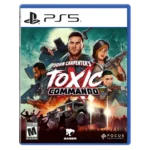
John Carpenter’s Toxic Commando Feature Scores
Explore all 88 feature scores for John Carpenter’s Toxic Commando, organized into pros and cons.
Scores by Feature
Summary
88 reviewed features-
Very positive 4.5-5.014 (16%)
-
Positive 3.5-4.432 (36%)
-
Neutral 2.5-3.421 (24%)
-
Negative 1.5-2.419 (22%)
-
Very negative below 1.52 (2%)
Pros
Sort
-
The dominant verdict is that the game is simply fun, especially when a squad is mowing through enormous hordes or improvising with vehicles, even if repetition limits how long that excitement lasts for some reviewers.
-
Gunplay is widely praised for punchy feedback, satisfying hits, and a strong first-person feel, although a minority describe it as merely serviceable or a little light.
-
Huge swarms, dismemberment, explosions, particles, and gore create the game's strongest visual spectacle, with set-piece defenses repeatedly earning praise.
-
Visual quality is generally attractive and clean enough to sell the apocalypse, with detailed hordes and effects, though some sources call the character models, palette, or overall fidelity less impressive.
-
Sound effects are a strong contributor to game feel: guns hit with punch, impacts read clearly, and positional audio often helps parse the chaos, despite a few audio glitches.
-
The campy 1980s horror atmosphere is one of the clearest strengths, combining sludge-covered locations, schlocky humor, synth music, and Carpenter-inspired framing into a distinctive mood.
-
The vehicle lineup adds real tactical variety through healing, turrets, EMPs, boosts, and other roles, making the choice of ride more meaningful than simple transportation.
-
Mud, sludge, ruined facilities, debris, and weapon wear give the environments convincing texture, even when the broader scenery and palette do not always stand out.
-
Mud deformation, winches, destructible obstacles, and vehicle interactions make the world unusually tactile for a horde shooter and create many of its most memorable emergent moments.
-
Co-op is the game at its best. Coordinating classes, vehicles, defenses, and huge hordes with friends repeatedly turns the straightforward shooting into memorable chaotic teamwork.
-
Vehicles are one of the signature ideas and are frequently great fun to drive, especially with mud and winches creating emergencies, though some reviewers find the off-road friction slow or frustrating.
-
The synth-heavy score is one of the most consistent presentation highlights and fits the Carpenter-inspired action well, though a minority find the music less distinctive than expected.
-
The semi-open structure is widely seen as a refreshing change from linear horde shooters, adding exploration and routing freedom, though critics argue it can make missions feel flabby or repetitive.
-
Performance ranges from impressively stable under huge hordes to rough on specific PCs or builds. Hardware, settings, and launch-period patches make this one of the more variable findings.
-
The familiar structure and straightforward mechanics make the game easy for shooter veterans to understand quickly, with several reviewers describing it as simple to jump into.
-
Special enemies keep fights readable and dangerous, but opinions split on originality; several reviewers call the roster effective yet familiar compared with other horde shooters.
-
Reviewers who focus on the broader mechanical package like how shooting, classes, vehicles, exploration, and horde defenses interlock into an easy-to-grasp action game.
-
Monetization earns positive marks at launch because progression is not locked behind premium systems and earnable rewards remain tied to play.
-
Open, vehicle-sized maps are a major point of differentiation and can make exploration feel freeing, but some reviewers think the larger spaces dilute pacing and memorable encounter design.
-
Value depends on the group: several reviewers call the roughly $40 launch price fair for the campaign and replay systems, while others see it as a tough ask when every friend needs a copy.
-
The explore-scavenge-drive-defend loop creates an addictive rhythm at first, especially with friends, but its repeated structure becomes easier to see after several missions.
-
Basic shooting controls are usually responsive, yet a few reviews call out awkward interaction inputs, missing movement conveniences, or online response problems.
-
Server impressions are mostly positive where directly discussed, with reviewers reporting stable netcode and little lag, although the mandatory online connection remains a separate concern.
-
Vehicles, mud physics, and semi-open maps give the formula a fresh wrinkle, but reviewers broadly agree the game evolves familiar horde-shooter ideas rather than reinventing the genre.
-
Most reviewers feel the synth score, camp, gore, and B-movie tone make good use of the Carpenter connection, while a minority think the writing and presentation do not fully earn the name.
-
Creepy special infected, huge swarms, and stressful objective setups can create genuine tension even though the overall tone remains more campy action than serious horror.
-
Heavy weapons and loot found around the maps are a highlight, giving exploration a satisfying payoff with railguns, grenade launchers, and other temporary power spikes.
-
The interface is generally praised for being clean, minimal, and easy to read, keeping loadouts and combat information understandable without clutter.
-
Frame-rate results depend heavily on hardware. Strong 30 FPS handheld targets and smooth high-end performance are reported, but the largest hordes can produce sharp dips on weaker systems.
-
Exploration is usually rewarding because detours can uncover parts, weapons, ammo, and progression items, though a few reviewers think repeated points of interest become tedious.
-
Gun aiming is usually described as precise and satisfying, with proper aim-down-sights and convincing recoil, though one console-focused review reported aiming problems when online responsiveness faltered.
-
The multiplayer design favors straightforward squad play over competitive complexity, and reviewers generally like how easy it is to coordinate roles and share the chaos.
-
Map markers and points of interest generally make objectives and resources easy to track, while route planning adds a useful tactical layer to larger stages.
-
The polished core shooting and horde technology impress several reviewers, but bot behavior, cutscene roughness, and occasional launch issues keep the overall finish from feeling uniformly refined.
-
The climactic Sludge God encounter is singled out as a fun, spectacle-heavy payoff rather than a mechanically deep boss showcase.
-
One PlayStation-focused review praises the DualSense adaptive-trigger and vibration treatment for adding useful tactile feedback to the shooting.
-
The HUD is praised for staying clear and readable, with useful indicators and markers that communicate threats and objectives without overwhelming the screen.
-
At launch, reviewers appreciate that there are no microtransactions and that cosmetics and progression rewards can be earned through play.
-
The four classes cover clear damage, healing, defense, and support roles and generally complement a squad well, though some reviewers find specific classes less engaging or their cooldowns and trees uneven.
-
Subtitles, resize options, aim assist, control remapping, and other useful settings help, but several reviewers note the absence of a dedicated accessibility suite or common extras such as colorblind modes.
-
Pacing is highly context-dependent: compact points of interest can keep the action flowing, while long missions, resource detours, mud, and repeated objectives can slow the experience considerably.
-
Matchmaking is described as refreshingly simple, with the option to keep customizing in the hub and fall back to bots if a queue takes too long.
-
The semi-open maps let squads wander off the critical path and explore without penalties, a freedom reviewers appreciate compared with more linear horde shooters.
-
Seamless cross-play is praised for making it easy to assemble a four-player squad across supported platforms.
-
One reviewer specifically enjoys the strange Sludge God lore and darker setup, even though the wider critical consensus treats the narrative as lightweight.
-
The small cast is viewed as more memorable than Saber's previous co-op roster, even though it remains compact and not especially deep.
Cons
Sort
-
The launch package is relatively lean, with a short campaign and few modes beyond it. Randomized details and progression add mileage, but several reviewers still want more maps or activities.
-
Always-online requirements are a repeated complaint, especially for solo play and pausing, although at least one review reports excellent netcode even across long-distance co-op sessions.
-
Camera comfort is a weak spot for some players: missing or limited FOV options and first-person vehicle movement can feel claustrophobic or even cause motion sickness.
-
Endgame depth is a recurring concern: after the campaign, most of the incentive comes from replaying familiar missions, raising difficulty, and continuing class or weapon progression.
-
Bots can handle basic combat and sometimes perform respectably, but the recurring complaint is that they struggle with objectives, driving, interactions, and harder difficulties, making solo play noticeably weaker.
-
Randomized locations and occasional objective twists help, yet the repeated pattern of traveling, collecting or activating something, then defending against a final horde is one of the most consistent criticisms.
-
Resource and currency design is a common friction point. Upgrade costs and multiple currencies can feel excessive, even though higher difficulties and exploration provide ways to accelerate earnings.
-
Grind is one of the most disputed areas. Some reviewers find weapon and class leveling well paced, while others say attachment costs and repeated campaign runs make experimentation needlessly laborious.
-
This is not family-friendly material: reviewers explicitly point to mature-rated gore, dismemberment, brutal violence, and strong language.
-
The story provides enough campy context to move the campaign along, but most reviewers consider it thin, forgettable, or poorly developed rather than a reason to play.
-
The commandos have recognizable personalities and banter, but most reviewers see them as lightly sketched rather than deeply developed characters.
-
Weapon cosmetics offer much more freedom than the characters themselves. Reviewers like granular gun styling, while character outfits and skins are repeatedly described as basic or poor value.
-
On-foot movement receives some criticism for lacking conveniences such as a slide or dodge and for feeling laborious across large maps, making vehicles feel almost mandatory.
-
Save-related friction comes from cloud-synced graphics settings on Steam and the lack of useful mid-mission save points in some long stages.
-
The game is squarely aimed at mature players: one reviewer emphasizes its relentless gore, brutal violence, and frequent strong language rather than broad age suitability.
-
Crash reports are inconsistent: some reviewers encountered frustrating mission-ending crashes, while others completed extensive sessions without a single crash.
-
Emotional depth is not a selling point; one reviewer explicitly warns not to expect an emotional rollercoaster from the thin, absurd narrative.
-
Loading can be a nuisance: reviewers mention longer-than-expected waits, including multiplayer loads that depend on the slowest machine in the group.
-
Launch-era glitches show up in several accounts, ranging from a fair share of quirks to bugs that noticeably hurt moments, while other reports describe the odd issue as minor.
-
There is no couch co-op, which limits the appeal for households that want to share the multiplayer experience on one system.
-
A reviewer found that a noticeable glitch briefly broke immersion, even though it was not severe enough to ruin the broader experience.
-
Split-screen is absent, so local players cannot share a console for the co-op campaign.
-
Steam cloud saves work, but one handheld review found that graphics settings also followed the save, forcing unwanted low-resolution settings onto a desktop PC.
-
Checkpoint impressions vary by mode and source: frequent checkpoints are appreciated where available, while reviewers criticize situations where long solo runs can be lost without a useful checkpoint.
-
Voice acting divides reviewers almost as much as the dialogue: some praise convincing or excellent performances, while others hear generic delivery that adds little personality.
-
Difficulty generally scales into a satisfying co-op challenge, with Hard earning praise from experienced shooter players, but solo runs can become disproportionately punishing when bots cannot keep up.
-
The commandos' appeal depends on tolerance for dumb, campy personalities: some reviewers find them charming, while others call them bland or too shallow to care about.
-
Attachments, weapon tiers, and prestige give guns substantial tuning depth, but high costs and some underwhelming stat boosts can make the upgrade chase feel more restrictive than empowering.
-
Replay value is sharply divided. Randomized spawns, classes, difficulties, and upgrade goals invite repeat runs, but unchanged maps and repeated mission structures make others lose interest after the campaign.
-
Writing is a major split: a few reviewers enjoy the knowingly campy script, while others call the dialogue and narrative writing shallow, grating, or outright awful.
-
Handheld play is surprisingly viable, particularly on Steam Deck and ROG Ally, but it requires lower settings, occasional tuning, and acceptance of frame-rate or battery compromises.
-
Side objectives can make scavenging useful and occasionally fun, but one review specifically wants more compelling side quests and meaningful optional goals.
-
The deliberately cheesy banter is divisive. Some reviewers enjoy its well-timed jokes and campy tone, while others find the quipping grating, generic, or outright awful.
-
Most weapons are useful and feel distinct, but a few reviewers argue high-capacity or explosive options fit horde combat much better than shotguns or sniper rifles.
-
Platform-specific impressions split: DualSense features add value on PlayStation, while one Xbox review says the always-online design does not cooperate well with Quick Resume.
-
The Carpenter-inspired setting and Sludge God concept can give the world a fun identity, but some reviewers find the actual mission locations too bland to sustain that promise.
-
Mission design can produce excellent set-piece defenses and a few clever objectives, but some reviewers criticize the broader structure as overlong, predictable, or poorly arranged.
-
The sludge-soaked eldritch look lands well for many reviewers, especially its creepy monsters and 1980s horror styling, although some find the dark palette bland or visually noisy.
-
Skill trees can meaningfully reshape class abilities and support different builds, but some reviewers find parts of the trees shallow, stat-heavy, or uninspired.
-
Moment-to-moment animation often sells the horde spectacle and weapon handling, but cutscenes and some character movement can look floaty, dated, or rough.
-
Class and weapon progression can be motivating and give builds ownership, but the same systems become a grind for players who want to switch classes or fully upgrade several guns.
-
The game wears its Left 4 Dead and World War Z influences openly. Vehicles and open maps give it some identity, but reviewers rarely consider the overall package truly original.