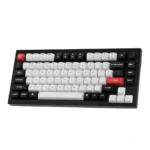
Keychron Q1 HE Feature Scores
Explore all 50 feature scores for Keychron Q1 HE, organized into pros and cons.
Scores by Feature
Summary
50 reviewed features-
Very positive 4.5-5.026 (52%)
-
Positive 3.5-4.415 (30%)
-
Neutral 2.5-3.45 (10%)
-
Negative 1.5-2.44 (8%)
Pros
Sort
-
Build quality is one of the strongest points, with reviewers repeatedly praising the solid metal body, premium feel, rigidity, and high-quality construction.
-
Switch feel is one of the most consistently praised attributes, with reviewers describing the magnetic switches as smooth, soft, quiet, premium, and satisfying.
-
Typing feel is one of the product's biggest strengths, with reviewers calling it excellent, satisfying, smooth, cloud-like, and premium.
-
Gaming performance is a major strength; most reviewers found the Q1 HE responsive and effective for competitive play, though one PCWorld review found it less compelling than gaming-focused rivals.
-
Customization is widely praised for actuation, keymaps, macros, layers, HE features, and browser-based controls, though one dissenting review argued its practical appeal is narrow.
-
Reviewers strongly liked the Q1 HE's clean, premium, understated look, with praise for both the colorways and professional styling.
-
Sound dampening is a standout, with reviewers repeatedly praising foam, gaskets, acoustic pads, and reduced ping or noise.
-
Compatibility is highly praised, especially for users moving between Windows and macOS, with several reviewers valuing the platform switch and included alternate keycaps.
-
Rapid trigger support is one of the strongest gaming features, with reviewers repeatedly saying it works well, feels solid, and improves fast inputs.
-
Keycaps received strong praise for PBT material, comfort, shape, durability, and overall feel, with only minor legend or profile caveats elsewhere.
-
Materials quality is strongly praised, especially the aluminum body, robust construction, PBT caps, and premium finishes, with only the copper variant's finish drawing a caveat.
-
Connectivity is broadly strong thanks to wired, Bluetooth, and 2.4GHz options, although one reviewer found the mode switch fiddly.
-
Responsiveness is rated very highly, with reviewers citing fast reaction, low actuation advantages, and little difference from top Hall Effect competitors.
-
Typing comfort is very strong, with reviewers praising long-session comfort, reduced fatigue, and comfortable typing feel.
-
The rotary knob is generally well liked for volume and mute control, with praise for feel, usefulness, and tactile operation.
-
Reviewers usually liked the Q1 HE's sound, describing it as nice, deep, thocky, semi-silent, or excellent, though a few said rivals sounded better or that it could be improved.
-
Software quality is mixed-positive: many praised Keychron Launcher as powerful, easy, and lightweight, while others reported messiness, confusing setup, or wired-only limitations.
-
Most reviewers found the Q1 HE quiet or quieter than typical mechanical boards, though PCWorld considered it noisy compared with quieter expectations.
-
Frame rigidity is unanimously praised in the scored evidence, with reviewers noting no flex, no shifting, and strong aluminum construction.
-
Value is split: many reviewers felt the premium price was justified by build and features, while others called it steep, overkill, or hard to justify in specific variants.
-
Latency evidence is very strong in wired and 2.4GHz modes, with reviewers finding wireless close to wired or solid in testing.
-
Wireless performance is mostly strong in 2.4GHz mode, with low latency and solid consistency, though setup or wake issues hurt a couple of reviews.
-
The 75% layout was praised for balancing compactness with usability and fitting smaller desks while keeping essential controls.
-
Lighting quality is mixed-positive: reviewers often found it bright, smooth, vivid, or attractive, but some said it looked muted or got lost under the keycaps.
-
The limited direct evidence is very positive, with reviewers saying actuation felt natural across adjustment points and that tracking was very accurate.
-
Macro and multi-command support is useful and powerful, but the interface or one-key-multiple-command design was confusing or imperfect for some reviewers.
-
Layout evidence is highly positive, especially among reviewers who preferred the Q1 HE's 75% layout over smaller gaming boards.
-
Durability evidence is mostly positive due to the sturdy metal construction, though one teardown-focused review warned against opening the board because a connector was easy to damage.
-
Gaming extras are generally strong, especially rapid trigger, snap/priority-style functions, and multi-action commands, though one review missed some pro-focused features.
-
Analog and gamepad-style input drew mixed reactions: several reviewers saw real potential or useful racing/gamepad possibilities, while others found gamepad functions quirky or unable to work natively as expected.
-
The only explicit spacing judgment is very positive, with one reviewer calling the key spacing just right.
-
The only direct evidence is very positive, with one reviewer finding minimal lateral movement or stem wobble.
-
Battery life is acceptable but not a standout; reviewers ranged from calling it weak or only a few days with RGB to saying it was enough for regular use.
-
Stabilizer feedback is mixed, ranging from noticeable rattle to great-feeling stabilizers.
-
The only direct hands-on switch-removal evidence was positive, with the reviewer finding the process easy.
-
The 1,000Hz polling rate is generally adequate and responsive, but one review penalized it for lacking 8,000Hz support.
-
The programmable knob was praised as useful for volume and more complex functions, especially for editing workflows.
-
The only scored evidence is positive, with one reviewer valuing that configurations can be stored on the keyboard.
-
The scored evidence praises the 75% form factor for staying compact while retaining essential productivity and gaming keys.
-
Legend feedback is mixed: one reviewer praised clear legends, while another found subtle typesetting and process issues.
-
Only one reviewer evaluated the cable directly, calling the included braided USB-C cable decent.
Cons
Sort
-
Switch options are the clearest repeated weakness, with reviewers consistently noting the narrow magnetic-only, linear-only ecosystem.
-
Portability is a weakness: reviewers repeatedly liked the layout but found the heavy metal body poor for travel or tournaments.
-
Profile management is a weak point in the scored evidence because PCWorld criticized the lack of automatic per-game profiles.
-
The only reliability score is negative, based on PCWorld's recurring wake-from-sleep problems in wireless mode.
-
Brightness feedback is mixed: one video found the LEDs pretty bright, while written reviews complained the Caps Lock indicator was hard to see and RGB looked tame.
-
Per-key lighting control is limited; one reviewer noted that effects exist, but individual key RGB customization was not available through the app.
-
RGB customization is mixed, with several reviewers liking presets or hue controls but others criticizing limited per-key and advanced lighting control.
-
Hot-swap support is useful but constrained because compatible switches are limited to specific magnetic options rather than standard MX-style choices.
-
Ergonomic feedback is mixed: typing angle and comfort often worked well, but many reviewers disliked the lack of adjustable feet or found the profile too tall.