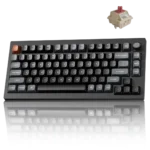
Keychron V1 Ultra 8K Feature Scores
Explore all 50 feature scores for Keychron V1 Ultra 8K, organized into pros and cons.
Scores by Feature
Summary
50 reviewed features-
Very positive 4.5-5.032 (64%)
-
Positive 3.5-4.47 (14%)
-
Neutral 2.5-3.48 (16%)
-
Negative 1.5-2.42 (4%)
-
Very negative below 1.51 (2%)
Pros
Sort
-
Battery endurance is the standout feature: the 600- to 660-hour claim was not fully exhausted, but testers saw very little drain. RGB and 8K wireless polling reduce runtime, yet even a skeptical estimate still amounted to months.
-
The Red switches are smoother and cleaner than earlier Keychron stock options, while Banana and Brown variants offer responsive tactile feedback. Heavier Banana switches remain comfortable for many users but are not universally ideal.
-
Inputs felt fast, clean, and dependable across competitive and casual games, with responsive switches and reliable multi-key registration. The board performs very well even when reviewers question the practical value of 8K polling.
-
Reviewers broadly consider it a highly capable, enjoyable keyboard with exceptional battery life and customization for the price. Enthusiasm is tempered mainly by case flex, tall ergonomics, and skepticism about 8K polling.
-
The gasket mount, foam, and stock switches usually produce a deep, rounded, or poppy sound that feels mature rather than harsh. The newer Silk switches are especially praised for sounding smoother and more premium.
-
Wired USB-C, 2.4GHz wireless, and Bluetooth cover nearly every setup, including multi-device use. Physical switching is easy, though Bluetooth runs at a much lower polling rate than 2.4GHz.
-
More than 20 effects, per-key control, and two independent Mix RGB zones provide unusually deep lighting customization.
-
The board packs premium-level battery life, tri-mode connectivity, hot-swap support, advanced RGB, and strong gaming performance into roughly $115. One reviewer still prefers the cheaper original V1, but the broader consensus calls this excellent value.
-
Reviewers experienced no meaningful input lag in games, whether using high polling rates or standard modes. Most also felt 1,000Hz would already be fast enough for ordinary users.
-
A gasket mount and several foam layers soften keypresses, suppress metallic ping, and create the rounded sound many reviewers liked.
-
Red, Brown, and Banana stock choices cover linear and tactile preferences, and broad MX-style hot-swap compatibility greatly expands the available alternatives.
-
Key remapping, firmware controls, lighting, polling, macros, and even downloadable case files make this unusually open to personalization. It works well both as a ready-made board and as a platform for future mods.
-
Hot-swap sockets accept broad three- and five-pin MX-style choices, so owners are not locked into the factory Red, Brown, or Banana switches.
-
Every key can be individually lit, while Mix RGB adds two independently controlled zones for more elaborate combinations.
-
The 2.4GHz receiver has a convenient onboard storage slot, described as neat, secure, and helpful for preventing loss.
-
The browser-based Keychron Launcher is widely praised as fast, clear, and feature-rich without background bloatware. It does require a compatible Chromium browser and a wired connection for changes.
-
The double-shot PBT caps are thick, durable, and premium-feeling. Their sculpted OSA shape is more divisive, especially for fast, prolonged writing.
-
N-key rollover worked cleanly across tested modes, with simultaneous presses registering together and no missed or dropped keystrokes reported.
-
The early tactile bump on the Banana switches makes them feel quicker and lighter than their force rating suggests, and gaming inputs were perceived as immediate.
-
Changes made in the launcher are stored on the keyboard, allowing remaps, lighting, and other settings to carry across devices and connection modes.
-
Most reviewers like the restrained black-and-gray, office-friendly look and its subtle accent keys. One enthusiast found the reused shell and poorly aligned rear labeling lazy.
-
Macros can be recorded and assigned through the web launcher alongside key remapping. One enthusiast noted that macro work is less straightforward under standard ZMK tools.
-
The dampened sound and non-clicky Brown switches are considered suitable for offices and shared spaces, with little risk of harsh clatter.
-
The 2.4GHz connection delivered responsive, hiccup-free gaming, while ZMK improves Bluetooth efficiency. Bluetooth favors battery life over speed, and 2.4GHz does not match the headline endurance claim.
-
Most reviewers enjoy the cushioned, tactile, and satisfying typing experience. The same tall OSA profile that anchors fingers during gaming can slow adaptation and reduce accuracy for marathon writing.
-
Windows and macOS support is smooth, with painless mode switching and a browser launcher that works well on both platforms.
-
The 75% footprint keeps arrows and a function row while removing the numpad, leaving noticeably more room on compact desks.
-
Switches can be pulled and replaced without soldering, making experimentation or future repairs straightforward.
-
The keys show very little wobble, including the larger stabilized keys.
-
The 75% layout is repeatedly called a practical sweet spot because it retains arrows, the function row, navigation keys, and a knob without full-size bulk.
-
The rotary knob is convenient for media use and can be remapped for scrolling, zooming, tab switching, brightness, and other actions.
-
The clickable aluminum knob makes volume adjustment quick and satisfying, and it can be remapped for other functions.
-
The compact 75% footprint is efficient and functional, but the keyboard is much taller than many boards and can feel bulky at the front edge.
-
The lighting is colorful, smooth, and clean between the keys, but solid non-shine-through caps substantially mute its visual impact.
-
Several reviewers found the screw-in stabilizers stable and rattle-free, but one enthusiast encountered poor factory lubrication and ticking that required a manual relube.
-
Multiple personalized profiles can be saved to internal memory for different devices or uses.
-
PBT keycaps, internal metal reinforcement, foam, and brass fittings are strong choices for the price. The all-ABS exterior is the notable compromise.
-
The plastic chassis makes the board lighter and easier to carry than a comparable metal model.
-
The lighting has strong intensity and saturated color, although the opaque keycaps prevent much of that brightness from reaching the legends.
Cons
Sort
-
The mechanical switches do not provide true Rapid Trigger, and the available Snap Tap implementation is considered weaker than a Hall Effect version.
-
The mechanical switches do not offer Hall Effect-style adjustable sensitivity. Reviewers who want switch-level actuation tuning for serious competition are steered toward magnetic alternatives.
-
The solid PBT keycaps do not have shine-through legends, so RGB illuminates around the keys rather than making the labels easier to see.
-
The internal plate provides a stable base for key presses, yet several reviewers could flex or twist the plastic shell easily. Rigidity is the most consistent construction complaint.
-
Adjustable feet and a cushioned plate help, but the tall front edge often pushes wrists backward. Several reviewers recommend adding a wrist rest for extended typing.
-
The 8,000Hz wired and 2.4GHz modes impress on paper and may matter to elite esports players. Most reviewers call the difference from 1,000Hz imperceptible, resource-heavy, or simply gimmicky.
-
Wireless inputs were stable in testing, but reviewers raised longer-term concerns about body flex and inconsistent factory stabilizer lubrication.
-
N-key rollover is useful and a mechanical version of Snap Tap is available, but the board lacks the adjustable actuation and stronger Rapid Trigger behavior found on Hall Effect models.
-
Thick PBT caps, internal foam, metal reinforcement, and screw-in stabilizers give the board solid fundamentals. The flexible ABS outer shell keeps it from feeling truly premium.
-
PBT keycaps, screw-in stabilizers, metal reinforcement, and brass fittings suggest good component longevity. Repeated concerns about chassis flex make the long-term durability of the outer body less reassuring.
-
Comfort depends heavily on posture and session length. Some reviewers typed without fatigue, while others found the tall chassis and sculpted caps uncomfortable or less accurate during long writing sessions.