MSI Roamii BE Pro Feature Scores
Explore all 63 feature scores for MSI Roamii BE Pro, organized into pros and cons.
Scores by Feature
Summary
63 reviewed features-
Very positive 4.5-5.038 (60%)
-
Positive 3.5-4.415 (24%)
-
Neutral 2.5-3.44 (6%)
-
Negative 1.5-2.45 (8%)
-
Very negative below 1.51 (2%)
Pros
Sort
-
Value was the strongest consensus: the system combines Wi-Fi 7, multi-gig ports, and broad features at a price below many competing mesh kits.
-
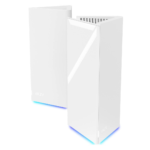
Most reviewers liked the clean triangular towers and subtle RGB lighting, though the bold size and shape may not suit every room.
-
Several reviewers achieved strong speeds throughout multi-room homes, but larger or more difficult properties may need another node.
-
The system is built for busy homes and newer Wi-Fi 7 clients, although weaker legacy-band throughput may constrain several simultaneous high-quality streams.
-
The placement tool is a strong concept and often helpful, but its heatmap can become confusing in multi-floor homes.
-
Several reviewers found setup quick and straightforward, but others encountered pairing, login, and platform-specific problems.
-
Parental controls are broad, free, and unusually capable, though app instability and limited filtering granularity can reduce their usefulness.
-
Included brackets, screws, and cable clearance make wall installation unusually convenient for a mesh kit.
-
The browser interface is stable, responsive, and unusually comprehensive, although a few app-only controls remain unavailable there.
-
Reviewers consistently praised the all-2.5GbE layout, which supports fast broadband, NAS devices, and wired clients without falling back to gigabit ports.
-
Reviewers saw full tri-band Wi-Fi 7 as strong future-proofing, especially for homes adding newer phones, laptops, and high-speed broadband.
-
Wired backhaul is a major strength, preserving wireless capacity and supporting demanding gaming, storage, and long-distance links.
-
Wireless backhaul was excellent in some tests and adequate for normal use, though one review found a steep secondary-node slowdown.
-
The 320MHz channel capability was viewed as a major Wi-Fi 7 advantage, providing substantial throughput headroom for compatible devices.
-
Reviewers associated the Wi-Fi 7 implementation with low latency and responsive performance for gaming, calls, and heavy traffic.
-
Switching between nodes was described as automatic and effectively unnoticeable during normal movement.
-
Security and parental-control features are available without recurring fees, a clear advantage over several rivals.
-
The router offers unusually broad VPN server support, including several popular protocols and client profile management.
-
The generous Ethernet selection on both nodes stood out, giving users room for multiple wired devices at both mesh locations.
-
Coverage results varied sharply by home: some reviewers achieved excellent whole-house performance, while others found the two-node kit weak at far range.
-
The free FortiSecu tools, network isolation, and built-in protections form a strong security package, with optional third-party traffic scanning as the main caveat.
-
Passive cooling and generous ventilation kept the nodes only slightly warm, with no fan noise reported.
-
Overall wireless results ranged from excellent multi-gigabit speeds to merely average throughput, with home layout and client type playing a major role.
-
The app is feature-rich and intuitive when stable, but crashes and login problems made it unreliable for at least one reviewer.
-
The app can promptly flag new devices and security concerns, adding useful awareness without constant monitoring.
-
RGB lighting is attractive and adjustable, but scheduling behavior was inconsistent across reviews and firmware versions.
-
USB 3.0 adds useful storage and NAS flexibility, though reviewers differed on how much practical value it offers.
-
The software provides practical per-device bandwidth limiting alongside more advanced traffic controls.
-
At close range, the system reached exceptional multi-gigabit wireless throughput in one test, though another lab found more ordinary results.
-
Several reviewers described the finished network as dependable and easy to forget about once running.
-
The two-node design was praised for reaching rooms that previously had little or no usable Wi-Fi.
-
The system is positioned well for smart homes with many connected devices and substantial simultaneous traffic.
-
Real-world game downloads held close to the reviewer’s full broadband rate even in a difficult room.
-
The built-in firewall offers extensive controls, including service blocking, rules, URL restrictions, and denial-of-service protection.
-
The hardware passed an extended stress test without instability and stayed reliable under sustained use.
-
Measured ping stayed low and steady across rooms, including a difficult back-office location.
-
Separate main, guest, child, and IoT networks provide useful isolation and purpose-based control.
-
In favorable homes, speeds remained consistently high throughout the property with no major dropouts.
-
No mandatory cloud account keeps default privacy risk low, while optional security scanning requires sharing traffic with a third party.
-
Detailed QoS settings let users prioritize specific devices and manage traffic with more control than many consumer mesh kits.
-
Adaptive roaming was praised for maintaining connections as users moved around the home.
-
The web interface presents advanced controls in a clear, well-organized structure that remains approachable.
-
One home test maintained excellent speed through a closed door, suggesting strong indoor penetration in favorable layouts.
-
The 2.5GbE ports delivered near-line-rate throughput, making the system well suited to fast broadband and local wired transfers.
-
Family and device access tools were viewed positively, with simple ways to control who can use the network.
-
The platform is designed to grow, but standalone node availability may limit practical expansion in some markets.
-
Coverage analysis and connected-device information make it easier to understand and manage the network.
-
Opinions were split: one reviewer found the towers lightweight and plasticky, while another considered the construction high quality.
-
Some homes saw excellent reach from two nodes, while other tests found far-range performance variable or poor.
-
Nearby Wi-Fi 7 speed can be exceptional, but other testing found mediocre throughput and weak scaling at distance, making overall speed highly environment-dependent.
-
App-led setup ranged from pleasantly simple to frustrating and crash-prone, so the experience appears sensitive to phone platform and firmware state.
-
Mid-range performance was generally strong for the price and well suited to typical medium-sized homes.
-
The 2.4GHz band delivered respectable nearby throughput and useful coverage, although it weakened at longer distances.
Cons
Sort
-
Automatic satellite discovery was unreliable in multiple tests, often forcing manual intervention or lengthy retries.
-
Pairing experiences ranged from a few manageable minutes to repeated failures and exceptionally long waits.
-
Garden and far-location results were weak overall, ranging from barely usable speeds to complete connection failure on some devices.
-
The browser interface was responsive, but the mobile app suffered frequent crashes in one test.
-
Wireless node-to-node performance can be fast, but one review measured a severe throughput drop when connecting through the secondary node.
-
A two-node kit suits small to mid-sized spaces, but limited availability of individual nodes makes larger deployments less straightforward.
-
Content controls cover broad categories and family use cases, but one reviewer wanted finer domain-level control.
-
The tall, wide towers may be difficult to place discreetly despite their clean styling.
-
Firmware updating was seamless in one test but disrupted app connectivity in another, producing a mixed setup experience.
-
USB storage can serve files through several protocols, but measured NAS speeds were disappointing compared with the 2.5GbE network.