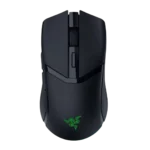
Razer Cobra HyperSpeed Feature Scores
Explore all 50 feature scores for Razer Cobra HyperSpeed, organized into pros and cons.
Scores by Feature
Summary
50 reviewed features-
Very positive 4.5-5.024 (48%)
-
Positive 3.5-4.423 (46%)
-
Neutral 2.5-3.42 (4%)
-
Negative 1.5-2.41 (2%)
Pros
Sort
-
Battery life was a major strength, repeatedly described as stellar, impressive, remarkable, or easily near the claimed endurance.
-
Reviewers consistently described tracking as precise, accurate, snappy, and reliable, with only budget-focused criticism questioning whether the sensor is truly better than competitors.
-
Build quality was consistently positive, described as solid, durable, excellent, premium, and buttoned up.
-
The optical scroll wheel was one of the strongest points, repeatedly praised for precise, tactile, responsive, and defined scrolling.
-
Wireless performance was reviewed positively, with strong notes on tri-mode versatility, responsiveness, and day-to-day reliability.
-
Button responsiveness was widely praised as snappy, tactile, quick, and satisfying across reviews.
-
Shape comfort was broadly praised, especially by users with smaller or adaptable grips, but some reviewers found the compact shape uncomfortable.
-
Switch feel was mostly positive thanks to crisp Gen-4 optical switches, but one reviewer felt the improvement was not dramatic.
-
Most reviewers liked the lighter 62 g weight, though a few still wanted it lighter for a small performance mouse.
-
The ergonomic design was praised for comfort, thumb support, and balanced handling.
-
Bluetooth support was valued for work and everyday use, especially switching between devices, though one reviewer called it merely serviceable.
-
Most reviewers found the Focus X 26K sensor strong enough for real gaming use, though several noted it is not Razer's top-tier sensor.
-
FPS suitability was generally good for shooters and gaming, but one reviewer said it would not be a top Fortnite recommendation.
-
Connection stability was strong, with reviewers noting quick recognition, no stuttering, and hassle-free receiver pairing.
-
Ecosystem integration was praised through Synapse, HyperFlux, and Razer receiver pairing, especially plug-and-play accessory behavior.
-
Fingertip grip comfort was mostly strong, though one reviewer preferred the original Viper Mini for fingertip use.
-
Premium feel was praised through the refined aesthetic, premium look, and premium user experience.
-
Software usability was broadly positive thanks to clear controls and deep settings, though Synapse could be finicky.
-
Claw grip comfort was generally positive where discussed, with reviewers saying the shape works across grip styles.
-
2.4GHz connectivity was praised as reliable and ideal for high-speed gaming.
-
Dock compatibility was useful and sometimes excellent, but reviewers repeatedly noted that the best dock or wireless charging experience costs extra.
-
Charging convenience was split: wireless charging accessories impressed reviewers, but the need to buy extras and slower charging drew criticism.
-
Glide smoothness was mostly positive, especially on pads, but one reviewer found the stock skates too controlled.
-
Side button feedback was polarized, with strong praise from some reviewers and a budget-feeling complaint from another.
-
Button customization was viewed positively, especially through Razer Synapse remapping and broad command assignment.
-
Programmable controls were praised for opening strong customization options and adapting to individual player needs.
-
Materials quality received praise for premium matte or plastic feel and a comfortable mild texture.
-
Value was mixed: reviewers liked the mid-range package and lower price than flagships, but several criticized optional add-ons and competing alternatives.
-
Grip texture was generally acceptable to strong, with praise for secure grip and only mild criticism of the smooth coating.
-
DPI range was viewed as sufficient for most gamers and competitive enough for premium use, despite one review noting rivals can reach higher DPI.
-
RGB opinions were mixed: some liked the tasteful underglow and accurate colors, while others found the lighting limited or dull.
-
Palm grip comfort was mixed, with broad grip support in some reviews but concerns that large-hand palm users may find it too small.
-
Weight balance was mixed, with some reviewers praising predictable or comfortable balance and another criticizing rear-heavy distribution.
-
Switch durability was judged positively where discussed, with reviewers framing the newer switches as a refinement over the prior generation.
-
Long-session comfort was praised directly for gaming sessions and everyday use.
-
Surface compatibility was excellent in the one direct test, where the mouse handled multiple surfaces equally well.
-
The default 1,000 Hz polling rate was generally considered good enough, but reviewers criticized the need for extra hardware to unlock higher polling.
-
Click latency received clear praise in testing, with the reviewer reporting barely any latency from click response.
-
Wireless latency was praised in the one direct test, with no interruptions reported beyond 10 feet.
-
Cross-platform compatibility was supported by positive switching between a MacBook and gaming PC.
-
Durability over time received positive support from the simple, robust build expected to handle daily use.
-
Macro support was praised through Synapse, with one reviewer noting easy custom macro setup across the buttons.
-
Motion consistency was praised for predictable twitch reactions during gaming.
-
Profile switching received positive mention as a way to tailor settings for different game genres.
-
Acceleration and speed were described as good, though not at the level of Razer's flagship models.
-
Primary click quality was split: one reviewer praised the tight clickfeel, while another complained the buttons sounded hollow and cheap.
-
Handedness options were limited by right-side button placement despite an ambidextrous-style shell.
Cons
Sort
-
Click noise was the most repeated complaint, with multiple reviewers calling the Gen-4 switches loud, hollow, pingy, or distracting.
-
Software stability was only criticized once, with Synapse described as finicky at times.
-
AI Prompt Master was divisive: one reviewer found it useful for productivity, while others saw it as unnecessary for gaming.