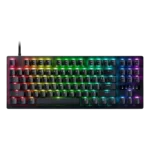
Razer Huntsman V3 TKL Feature Scores
Explore all 42 feature scores for Razer Huntsman V3 TKL, organized into pros and cons.
Scores by Feature
Summary
42 reviewed features-
Very positive 4.5-5.024 (57%)
-
Positive 3.5-4.413 (31%)
-
Neutral 2.5-3.45 (12%)
Pros
Sort
-
Customization is a standout: reviewers highlight actuation tuning, Rapid Trigger settings, onboard adjustments, software control, browser options, and deep analog behavior.
-
Responsiveness is consistently praised, from pressure-sensitive analog control to instantaneous-feeling keystrokes and crisp movement changes.
-
Latency is a major strength, with reviewers tying the 8KHz implementation to extremely low input delay and tight on-screen response.
-
Rapid Trigger is one of the best-reviewed features, praised for fast resets, movement control, and competitive FPS value.
-
Value is strong for the target buyer: reviewers like getting the core esports features, 8KHz polling, and analog customization below higher-end alternatives.
-
Analog support is one of the board's biggest strengths, with reviewers praising pressure-sensitive control, controller-style behavior, and precise optical switching. It is most useful for players who will actually tune those deeper inputs.
-
Gaming performance is the main reason to buy it: reviewers describe smooth, reactive, pro-level play with fast input handling and strong competitive control.
-
Build quality lands as a clear strength: reviewers describe the board as solid, sturdy, premium-feeling, and competitive-grade despite its compact size.
-
The doubleshot PBT keycaps are widely liked for texture, comfort, gaming traction, and resistance to shine. The only real split is whether their height and graining fit every typist.
-
Snap Tap and similar esports features are treated as genuinely powerful, even game-changing for competitive movement. The same strength can be situational because certain games may restrict them.
-
RGB lighting is consistently liked, from subtle color accents to a bright, polished look that reviewers call gorgeous.
-
The analog switches are repeatedly praised for precise, consistent actuation and highly adjustable reset behavior. The main caveat is that very sensitive settings can lead to accidental inputs until tuned.
-
Durability is praised in the stronger hands-on takes, with one reviewer calling out shock absorption and another saying it feels built like a tank.
-
Per-key RGB control is a clear plus, with both app and web control contributing to a highly customizable lighting setup.
-
The 8KHz polling rate is repeatedly framed as a serious speed upgrade, especially for competitive play where tiny input delays matter.
-
RGB customization is rich, with presets and per-key lighting giving users plenty of room to build a flashy or personalized look.
-
The board gets strong marks for its brushed-metal look, sleek minimalism, and functional esports styling. It is understated rather than flashy until the RGB is on.
-
Typing feel ranges from excellent to merely acceptable. The best reviews call it a dream or a great typing experience, while the critical review finds the keys somewhat harsh.
-
Most reviewers like the sound more than expected, especially where foam dampening gives the board a more controlled tone. One take still finds it clickier than thockier, so the sound is improved rather than silent.
-
The frame feels rigid and premium, with very little flex called out and sturdy construction reinforced by the board's compact build.
-
Software is powerful and mostly easy to use, with Synapse and browser-based tuning covering deep settings. A few bugs and occasional setting issues keep it from being flawless.
-
The legends are treated positively because the keycaps let lighting pass through cleanly and are described as resistant to fading.
-
Key assignment depth is strong, including multi-action inputs and dual-step behavior that let players map more than one action to a keypress.
-
Materials feel premium across the stronger reviews, especially the aluminum top plate and textured PBT caps.
-
The TKL form factor is praised for being compact and backpack-friendly without feeling flimsy.
-
The lighting comes through the keycaps cleanly and vividly, giving the board a bright look without reviewers calling it harsh.
-
Portability is better than a typical gaming keyboard thanks to the TKL size and detachable cable, making tournament or LAN travel feel practical.
-
Sound dampening is improved in the more positive takes, especially where foam creates a better typing sound. One review still finds the switches under-damped and a little harsh.
-
Switch feel depends on priorities: reviewers like the smooth analog response and strong gaming behavior, but one finds the feedback at the top of travel too vague.
-
The detachable USB-C cable is appreciated because it keeps the board easier to pack and avoids a forced wired design.
-
Gaming features are described as useful across many games, though Snap Tap may be restricted in some competitive titles.
-
The wired USB-C setup is generally fine, with praise for the detachable cable. One reviewer notes the recessed port is harder to reach, but also sees the secure fit as a fair tradeoff.
-
The compact TKL body is treated as easy to fit on a setup while still feeling solid, making it friendlier for tighter desks than a full-size board.
-
The WASD area and nearby keys are described as comfortably spaced for gaming, even by a reviewer who disliked the board more for typing.
-
Profiles are useful in Synapse, including game-oriented presets that can be selected with Fn shortcuts.
-
Noise impressions are mixed. One reviewer finds it quieter than many mechanical boards, while another says it is still audible enough to be questionable for a quiet office.
-
The lack of an included wrist rest is noted, but at least one reviewer says this version does not really miss the accessory.
Cons
Sort
-
Key stability is a weak point in one review, which reports noticeable wobble that makes presses feel less secure.
-
Keyboard passthrough for controller emulation is a sore spot in one review, where it occasionally failed until the board was replugged.
-
Typing comfort is the clearest tradeoff. Some reviewers enjoy the typing experience, but the most critical take says the high keycaps make finger movement and wrist position uncomfortable.
-
Media controls are a compromise. The board still has regular media keys, but reviewers note that the dial and dedicated multi-function controls from pricier variants are gone.
-
Comfort is more mixed: the feet help the angle, but the elevated, thick keycaps can make movement and wrist position awkward for typing.