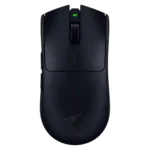
Razer Viper V3 HyperSpeed Feature Scores
Explore all 51 feature scores for Razer Viper V3 HyperSpeed, organized into pros and cons.
Scores by Feature
Summary
51 reviewed features-
Very positive 4.5-5.019 (37%)
-
Positive 3.5-4.422 (43%)
-
Neutral 2.5-3.48 (16%)
-
Negative 1.5-2.42 (4%)
Pros
Sort
-
The Focus Pro 30K sensor was one of the strongest consensus positives, described as accurate, reliable, snappy, and premium-grade.
-
Value for money was one of the strongest positives, with reviewers repeatedly calling the mouse affordable, budget-friendly, or outstanding for its specs.
-
Side buttons were one of the most consistent positives, with reviewers calling them easier to reach, premium, and among Razer's best.
-
Glide smoothness was consistently praised, with reviewers noting smooth motion, strong feet/skates, and effortless movement.
-
Grip texture/coating was strongly praised for grippiness, though reviewers often noted fingerprints, sweat marks, or preference for rubber sides.
-
FPS gaming suitability was strong overall, especially for competitive shooters, though weight and click speed were caveats for elite players.
-
Reviewers repeatedly praised tracking accuracy, with only a few preference-based caveats around the forward sensor placement.
-
Wireless performance was widely praised for cable-free use, reliability, and professional-level responsiveness.
-
Shape comfort was broadly praised for the redesigned hump and fuller support, though a few reviewers disliked it for their grip or game style.
-
The scroll wheel drew mostly positive notes for tactile steps, grip, and control, with a few reviewers calling it merely fine or muted.
-
Polling was generally viewed positively: 1,000Hz was enough for most, while 4K/8K support was valuable but battery-hungry or dongle-dependent.
-
Lift-off and landing customization earned strong praise where reviewed, especially asymmetric cut-off and granular height adjustment.
-
Palm grip comfort improved versus flatter Viper shapes and suited many reviewers, though not every hand size or palm style was ideal.
-
Left and right clicks were often praised for crispness and solidity, though a few units or grip positions felt mushy or merely average.
-
Battery life was generally praised as long, sometimes mindblowing, but higher polling rates and AA dependence created caveats.
-
Weight tuning received positive evidence from reviewers using AAA/lithium battery mods to cut substantial weight.
-
Connection stability was a strong positive, with reviewers reporting no lag, jitter, signal loss, or testing issues.
-
Claw grip comfort was usually positive, with the revised hump and shell fitting relaxed claw users well.
-
Button response was typically praised as snappy, responsive, satisfying, and reliable in play.
-
Surface compatibility was a strong positive where tested, including smooth tracking across desks, mats, wood, and glass.
-
Ergonomic design was generally praised for the revised hump, curves, and hand support, with some caveats around side support.
-
Switch feel split reviewers: many liked the crisp or snappy Gen-2 mechanical feel, while others found it mushy or less sharp than premium opticals.
-
Build quality was mostly solid, but several reviewers reported rattles, a lopsided base, or less-than-Pro feel.
-
Programmable controls were easy to reach and sufficient for most reviewers, reinforcing the mouse's simple FPS-first layout.
-
Materials and finish felt premium to many reviewers, though the coating could show marks or smudges.
-
Button customization through Synapse was seen as useful and accessible, including remapping and DPI-related controls.
-
Click latency evidence was mixed: reviewers found the clicks usable and often fast, but some noticed slower actuation than optical-switch competitors.
-
Skate durability/quality evidence was limited but positive, with reviewers saying the PTFE feet felt smooth, great, or long-lasting.
-
Ecosystem integration was positive but narrow, focused on HyperSpeed multi-device dongle sharing and saving USB ports.
-
Fingertip grip comfort was more mixed: some found it workable or comfortable, while others preferred smaller/lighter Viper-style shapes.
-
Premium feel was mixed: several reviewers said it felt high-end or more expensive than it was, while others said it lacked true Pro feel.
-
Motion consistency was praised where reviewed, especially consistent tracking and stable performance during play.
-
Wireless latency received limited but strong praise, especially around low-latency 2.4GHz use.
-
The 30K DPI ceiling was considered powerful for FPS use, though one reviewer viewed extreme DPI as more buzzword than necessity.
-
Long-session comfort was supported by praise for palm support and comfort over extended play, though it overlapped with shape and grip evidence.
-
Profile switching was praised when the reviewer could quickly see or cycle DPI/profile states, though evidence was limited.
-
2.4GHz connectivity was seen as simple and effective, with limited but positive opinionated evidence.
-
Portability evidence was limited but positive, mainly that the receiver can be stored safely in the mouse.
-
Click noise was mixed but generally acceptable: one reviewer found the click louder, while another said the mouse kept noise muted.
-
Switch durability evidence was mixed: rated lifecycle was considered respectable for the price, but one reviewer warned mechanical switches can develop double-clicks.
-
Software stability evidence was limited and mixed, with one reviewer saying Synapse improved but still had hiccups.
Cons
Sort
-
Charging and power convenience was a major tradeoff: reviewers disliked AA dependence and no wired fallback, though some liked quick battery swaps.
-
Handedness was a negative where discussed because the design is effectively right-handed and could be a problem for left-handed players.
-
Onboard memory was a recurring limitation because reviewers noted it stores only one profile or one preset slot.
-
Bluetooth support was weak because reviewers noted its absence, though at least one said it was unlikely to be a dealbreaker.
-
Durability over time evidence was limited and slightly negative, focused on click grinding after some use.
-
Weight was the most divisive physical trait: some liked the controlled mid-weight feel, while others found the AA-battery weight heavy or brick-like.
-
RGB opinions were mostly neutral: reviewers noted the no-RGB design as minimalist or acceptable, not a major functional loss.
-
Macro support was limited by the simple button layout, but HyperShift expanded options for reviewers who wanted extra commands.
-
Balance evidence was mixed, ranging from even and predictable to rear-heavy, unbalanced, or affected by battery inertia.
-
Software usability was mixed: Synapse enabled useful customization and was often straightforward, but battery readings and setup requirements frustrated some reviewers.