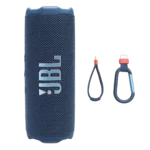
JBL Flip 7 Portable Speaker Feature Scores
Explore all 43 feature scores for JBL Flip 7 Portable Speaker, organized into pros and cons.
Scores by Feature
Summary
43 reviewed features-
Very positive 4.5-5.018 (42%)
-
Positive 3.5-4.417 (40%)
-
Neutral 2.5-3.43 (7%)
-
Negative 1.5-2.45 (12%)
Pros
Sort
-
Loudness is one of the strongest points; reviewers repeatedly call it very loud or louder than predecessors for its compact size.
-
Water and dust durability is a major strength, with repeated praise for IP68 readiness around pools, beaches, rain, sand, and travel.
-
The new PushLock loop/carabiner system is widely praised as useful, secure, and easier for bags, wrists, or outdoor clipping.
-
Overall value for money is strongly positive across reviews, with repeated no-brainer and good-buy language despite some cheaper competitors.
-
Frequency balance receives broad praise for punch, bass, clarity, and balanced sound, but some reviewers found recessed mids, harsh treble, or midrange-heavy tuning.
-
Design sentiment is mostly positive, with praise for rugged looks, compact styling, and color, though one reviewer said the aggressive casual design will not suit everyone.
-
Bluetooth stability is praised as stable, seamless, or hitch-free across several reviews.
-
Drop durability and ruggedness are strongly supported, with reviewers saying the speaker feels robust and survived or inspired confidence during rough use.
-
Voice clarity is generally positive, with several reviewers calling vocals clear or communicative, though one found vocals distant once bass entered.
-
EQ customization is a major strength; reviewers consistently praise the seven-band EQ as useful, impactful, and more flexible than previous Flip models.
-
Inter-speaker connectivity is useful and often easy with Auracast, though reviewers note limited receive behavior, exact-model stereo requirements, or less mature operation than older PartyBoost.
-
Cohesive presentation is praised by audio-focused reviews describing the Flip 7 as lively, uncluttered, confident, or more mature than older models.
-
Dynamic headroom is praised by sound-focused reviews, especially for punch, rhythmic expression, and scale for the size.
-
The Flip 7 is consistently treated as portable and compact, although one reviewer noted it has more heft than expected.
-
Battery life is mixed: many reviewers found 14 hours or vacation-long use good, while standardized or high-volume testing produced shorter results and Playtime Boost trades away bass.
-
Price/value sentiment is mostly positive at its launch or sale price, though a few reviewers framed the Flip 7 as a minor or more premium-priced upgrade.
-
Everyday usability is a strength: reviewers describe it as easy to place, easy to start, and pleasant to use across home, travel, and outdoor settings.
-
Multipoint is mostly praised as fast or seamless, though one travel review found simultaneous device playback sometimes paused instead of switching smoothly.
-
Setup and pairing are repeatedly described as simple, easy, or usable by almost anyone.
-
USB-C wired audio is a valued addition and often easy to activate, but reviewers disagree on how much sonic improvement it delivers and one could not get it working.
-
High-volume distortion is split: some reviewers heard little or no distortion, while others found harshness, crackly highs, or bass buckling at louder settings.
-
Stereo or group pairing through the app is mostly smooth when supported, but stereo mode requires matching Flip 7 units.
-
The companion app is generally viewed positively, with praise for stability, usefulness, and respect-worthy controls; PCMag found it bare bones but still usable.
-
On-device controls are viewed positively, with easy-to-use playback controls and added track-skip behavior noted.
-
Range evidence is positive: one reviewer reported a strong Bluetooth range and another stayed connected around 50 meters away.
-
On-unit buttons are praised as tactile or responsive where reviewers discussed them.
-
Detail retrieval varies by reviewer: several praise strong detail, while others find little nuance or limited improvement over Bluetooth.
-
Low-volume performance is mixed: one reviewer found low-level separation weak, while others praised bass presence and no-distortion behavior even at low volume.
-
Reviewers who discussed construction praised the Flip 7 as solid, sturdy, and capable of handling real portable use.
-
Dust resistance earns positive evidence from IP68 and real-use comments that the fabric and sealed body handle dust and dirt well.
-
Google Fast Pair earned a positive setup note because pairing with a Pixel phone was described as very simple.
-
Audio format support is a plus because USB-C can enable higher-resolution or lossless listening, though reviewers caution that the small mono speaker limits the payoff.
-
Smart-feature sentiment is positive around Auracast, lossless wired audio, EQ, and app-enabled features, with compatibility caveats covered separately.
-
Status indicators receive positive evidence from a reviewer who found the visible battery percentage especially helpful in the app and on-device indicator.
-
Energy-related evidence centers on USB-C not draining the source device and Playtime Boost extending battery while reducing sound quality.
Cons
Sort
-
Backwards compatibility is a clear weakness because reviewers repeatedly call out that Flip 7 cannot pair with older JBL PartyBoost speakers.
-
Stereo imaging is limited by the mono design; reviewers repeatedly note little soundstage unless another Flip 7 is added.
-
Low-bass/subwoofer capability is limited: reviewers note there is no subwoofer and the smallest low notes or low-end punch are not fully reproduced.
-
USB-C charging is convenient, but reviewers criticize the missing cable and lack of quick-charge or included accessories.
-
Latency is a recurring caveat for Bluetooth video or gaming; USB-C can help, but reviewers still warned about lip-sync lag or missing low-latency modes.
-
Power-bank function is a weakness because reviewers note the Flip 7 cannot charge a phone and one explicitly wanted that for emergencies.
-
Charging time is a mild weakness because reviewers cite a 2.5-hour full recharge and no quick-charge support.
-
Codec support is mixed to weak: some sources criticize SBC-only support, while others note AAC/SBC is adequate for the product context.