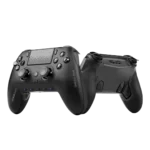
Scuf Omega PS5 Controller Feature Scores
Explore all 62 feature scores for Scuf Omega PS5 Controller, organized into pros and cons.
Scores by Feature
Summary
62 reviewed features-
Very positive 4.5-5.024 (39%)
-
Positive 3.5-4.420 (32%)
-
Neutral 2.5-3.413 (21%)
-
Negative 1.5-2.44 (6%)
-
Very negative below 1.51 (2%)
Pros
Sort
-
Competitive suitability is the Omega’s strongest identity. Reviewers repeatedly recommend it for shooters, Fortnite, Warzone, fighting games, and players chasing faster inputs.
-
Many owners simply describe the Omega as a controller they love or would buy again. A few positive notes are broad rather than feature-specific, but the overall sentiment from those short reviews is enthusiastic.
-
The grip texture gets frequent praise for feeling secure, rubbery, and less slippery than standard controllers. It helps the lightweight body feel controlled during faster play.
-
Face-button response is widely praised as quick, precise, and more immediate than standard membrane buttons. Even a returned unit received credit for responsive front buttons.
-
Battery life is one of the strongest advantages over DualSense-style controllers. Reviewers reported multi-day use, double-digit hours, and far less need to reach for a cable.
-
The trigger stops are one of the Omega’s best-loved features because they let players switch between full travel and instant clicks. Reviewers like that they no longer have to choose one trigger style at purchase.
-
Reviewers treat the TMR sticks as a serious upgrade, describing them as precise, durable, and built to avoid drift. The technology is a core reason several competitive players prefer the Omega.
-
Stick drift resistance is one of the most consistently praised traits. Reviewers repeatedly point to TMR technology as the reason they worry less about long-term drift.
-
Customization depth is one of the Omega’s defining strengths, spanning faceplates, sticks, buttons, profiles, paddles, triggers, and software settings. The depth is best on PC.
-
Trigger response is very strong, with reviewers repeatedly describing instant, mouse-like actuation. The short-click mode is especially appreciated for shooters.
-
The companion app is usually praised for making setup and customization easier, with fast real-time changes. A small number of users had trouble connecting or updating through it.
-
Stick precision is a major selling point, especially for aiming in shooters. TMR sticks are repeatedly described as accurate, smooth, and more confidence-inspiring than older Hall-effect implementations.
-
The Smoke design and magnetic faceplate often make the Omega feel premium at first glance. Complaints mostly come from buyers who expected a denser, more luxurious feel for the money.
-
FPS performance is consistently strong. Reviewers praise fast triggers, accurate sticks, anti-drift technology, and rear controls for shooters like Warzone, Fortnite, Battlefield, and Call of Duty.
-
Polling-rate comments are very positive for PC, where 1,000Hz support is repeatedly called out. Reviewers note that the advantage is less meaningful on PS5.
-
Reviewers generally liked the ergonomic shape, especially the way it sits in the hand during longer sessions. The strongest praise comes from competitive-focused users who value the controller’s secure, natural hold.
-
Comfort is one of the Omega’s clearer strengths, with several reviewers saying it feels great in hand and works well for longer play. A minority found the shape or fit too small or not universal.
-
Rear paddles are often considered genuinely useful for keeping thumbs on the sticks in shooters and competitive games. Their value is strongest once the user has adapted to the layout.
-
The clicky mechanical buttons are a highlight for many reviewers, who find them tactile and fast. A few users dislike the same clickiness or found one stick-click input less consistent.
-
Input response is a standout theme, from instant buttons to fast trigger behavior. Shooter and fighting-game players describe it as a major reason the controller feels competitive.
-
The Omega feels noticeably light, which competitive players often welcomed. Some reviewers saw that lightness as a tradeoff because it also makes the controller feel less substantial or less immersive.
-
D-pad feel comes across as crisp, clicky, and easy to customize. The removable magnetic design also made swapping or inspecting the D-pad feel approachable.
-
Wireless stability is mostly positive in expert testing, with several reviewers reporting smooth dongle use. A few customer reviews mention drops or random disconnects, so trust is not unanimous.
-
Macro support is useful for PC players who want push-to-talk, recording, or keyboard-style shortcuts. Fortnite-focused feedback notes that missing scroll-wheel mapping keeps it from being perfect.
-
Software customization is deep enough for stick curves, dead zones, lighting, profiles, and button maps. Reviewers generally found it practical rather than overwhelming.
-
USB-C is useful for wired play, charging, and the cable-lock accessory. Reviewers liked the tournament-style lock because it helps prevent accidental unplugging.
-
Programmable buttons give the Omega much of its pro-controller appeal. The limitation is that PlayStation mode does not unlock every G-key the way PC mode does.
-
Accessories are mostly a plus, especially the hard case, braided USB-C cable, spare sticks, blanks, and dongle. One customer complaint says the replacement joystick kit arrived incomplete.
-
Paddle feel ranges from firm and easy to use to too hard to press, depending on grip and hand shape. The inner and outer paddle arrangement works well for some players and poorly for others.
-
Consistency is generally positive when the controller works as intended, with some owners reporting no issues or no mid-game disconnects. The main exceptions are firmware and dongle complaints.
-
Button remapping is extensive, especially on PC and through the app. PS5 users still get useful remapping, though not the full freedom of PC mode.
-
Durability optimism centers on TMR sticks, shorter triggers, and lessons from earlier Scuf designs. Long-term proof is still limited, so the confidence is promising rather than settled.
-
The D-pad is praised for reducing misinputs and helping with fighting-game inputs. Reviewers who like clicky controls see it as a meaningful upgrade over softer stock pads.
-
Software support is better than older iCue-dependent setups for some users, but the lack of a desktop app bothers PC players. The mobile app helps, yet it does not satisfy every workflow.
-
Onboard profiles are useful for switching between games and keeping settings on the controller. PC-focused reviewers especially liked saving macros or configurations without background software.
-
Charging speed receives a positive long-term note, with one reviewer saying a short charge restored a large chunk of battery. It is not as widely discussed as battery life itself.
-
Fighting-game feedback is positive, especially around clicky inputs and a responsive D-pad. The Omega appeals to players who want precise, fast command entry.
-
Wireless latency is praised around the 2.4GHz connection and competitive use. The strongest comments come from reviewers who value low-latency play on PS5 or PC.
-
Wired performance is treated as reliable and low-latency, with the USB-C lock adding confidence for tournament-style play. One buyer disliked needing USB on PS5 when ports were already occupied.
-
Mobile compatibility is mentioned as part of the Omega’s broader flexibility. Reviewers mainly frame it as a useful extra rather than a central reason to buy.
-
Repairability gets a modest positive note because the battery can be removed after disassembly. This is a useful detail, but not a major theme across reviews.
-
Material impressions range from excellent to flimsy. Spanish-language and expert reviews praise the materials, but a critical expert found individual removable parts cheap when handled separately.
-
Racing use is a tradeoff: full trigger travel helps, but the lack of rumble and haptics removes terrain and grip feedback. It can work, but it is not the ideal immersive racing pad.
-
Size works well for some players because the controller is small and easy to grip. Others found the smaller fit part of why the back controls did not land comfortably.
Cons
Sort
-
Haptics are the biggest immersion sacrifice. Reviewers focused on God of War, Spider-Man, racing, and other DualSense-friendly games say the Omega feels flatter without them.
-
Adaptive triggers are absent, and reviewers who value DualSense immersion call that a drawback. Competitive players are more willing to accept the omission in exchange for faster instant triggers.
-
The lack of vibration is an intentional competitive tradeoff, but not everyone likes it. Shooter players often do not mind, while racing and story-game players miss the extra feel.
-
Charging dock support is poor for users expecting Sony-style dock convenience. One reviewer said it physically will not fit or connect to the official dock.
-
The dongle enables the Omega’s fast wireless play, but one customer reported random disconnects while using it. The feature looks strong in expert hands and less certain in all customer setups.
-
Touchpad usefulness depends heavily on platform. It works well enough on PS5 in some reviews, but PC behavior drew complaints because it does not always act like a PlayStation touchpad.
-
Firmware support is mixed in customer feedback. Updating helped one owner’s connection, while another struggled for hours to update or connect through the app.
-
Back and side button placement is polarizing. Some reviewers love where the paddles fall, while others complain about accidental presses, hard actuation, or hand placement that does not match the controls.
-
Build quality is divisive: some reviewers call the controller sturdy and high-end, while others say removable parts or the shell feel cheaper than the price suggests. This is one of the clearest split opinions.
-
Setup is mixed: pairing and app-guided configuration can be simple, but hidden switches under the faceplate annoy users who move between PS5, PC, wired, and wireless modes.
-
Connection reliability is mixed. Some long-term impressions reported no mid-game drops, while others had disconnects over dongle use that made the controller harder to trust.
-
Microphone-related feedback is mostly about controls and limitations. Reviewers liked headset mute and volume controls, while one customer noted the controller itself lacks a microphone.
-
The extra controls and aggressive competitive layout can take time to learn. Once adapted, reviewers often found the controller faster and more efficient.
-
Casual suitability is more limited. Some reviewers say it is fine for everyday play, but others call it overkill or less enjoyable for relaxed story-driven games.
-
PlayStation use is generally strong once connected, but some users dislike relying on USB or the dongle instead of fully native behavior. It is a PS5-focused controller with a few platform caveats.
-
RGB lighting is tasteful but limited. Reviewers liked the subtle look, while PS5 users get less customization than PC users.
-
Value depends on whether the buyer wants competitive features badly enough. Enthusiasts see the price as justifiable or sale-worthy, while skeptics say too many compromises remain for the cost.
-
PC compatibility draws mixed reactions. Some reviewers say it works great or better than the DualSense Edge, while others dislike Xbox-style recognition, missing touchpad behavior, or poor PC support.