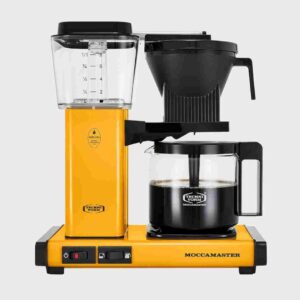
Review: Technivorm Moccamaster KBGV Coffee Maker
Updated: 2 months ago
4.0
Based on methodology below
156
Insights analyzed
24
Grouped by key features
14
From expert reviews
Scores below reflect consolidated expert coverage across these features.
Bottom Line
Choose the Moccamaster KBGV if you want fast, SCA-style drip coffee with long-haul durability. Skip it if you need programmability or the best value per dollar; you are paying for design and premium build.
Best for
Coffee enthusiasts who want consistently hot, balanced drip coffee fast and prefer a durable, repairable machine over lots of settings.
Not for
Anyone on a tight budget or who wants a programmable timer, app control, single-cup flexibility, or advanced recipe customization.
Verdict
Across reviews, the Moccamaster KBGV Select consistently delivers hot, smooth, pour-over-like drip coffee in roughly 4 to 6 minutes, backed by a copper heating system and a simple half/full switch that helps smaller batches taste better. Owners and testers praise the long-term durability, repairability, and strong warranty support. The tradeoff is that convenience features are intentionally sparse: no app, no timer, and a fixed reservoir, plus a few plasticky parts and occasional criticism of uneven spray distribution. For coffee-first buyers who want repeatable results with minimal fuss, it remains a standout.
Pros
-
4.9based on 5 reviewsRecognition and certifications: 4.9, based on 5 reviewsMultiple sources reference Specialty Coffee Association certification and, in some cases, additional European standards or broader design-world recognition. These credentials are often used to justify the premium positioning and expectations around temperature and brew-time targets.
-
4.8based on 7 reviewsHeating-element power: 4.8, based on 7 reviewsThe copper heating element is frequently credited for rapid heat-up and maintaining ideal brewing temperatures, enabling fast brew cycles and a consistently hot cup. Several sources explicitly frame this heating performance as the core technical advantage.
-
4.8based on 8 reviewsWarranty and Customer support: 4.8, based on 8 reviewsWarranty support is consistently positioned as strong, typically cited as five years, with replacement parts availability frequently mentioned. Some reviews also reference repairability as a long-term value lever beyond the standard warranty window.
-
4.8based on 3 reviewsPopularity: 4.8, based on 3 reviewsThe product is portrayed as an iconic, hype-backed brewer with a strong enthusiast following, often positioned as a design statement as much as a tool. Several reviews reference widespread recognition and long-standing popularity among specialty-coffee fans.
-
4.7based on 9 reviewsSpeed and time-to-cup: 4.7, based on 9 reviewsSpeed is a consistent highlight: many tests land around six minutes for a full batch, with partial batches completing notably faster. A few reviews mention longer ranges depending on volume, but the overall pattern is quick time-to-cup for a batch brewer.
-
4.6based on 1 reviewBoiler type (single vs dual): 4.6, based on 1 reviewReviews repeatedly highlight a copper boiling element for brewing and a separate hotplate heating system for holding temperature. This is not an espresso-style dual boiler setup, but the dedicated heating design is frequently credited for fast heat-up and stable brewing.
-
4.6based on 14 reviewsBrewing performance and consistency: 4.6, based on 14 reviewsMost reviewers describe the cup as smooth, balanced, and close to pour-over when paired with good coffee and an appropriate grind, with strong repeatability day to day. A minority critique centers on spray head water distribution that can concentrate flow and reduce extraction uniformity.
-
4.6based on 11 reviewsPot function: 4.6, based on 11 reviewsThe half/full pot selector is repeatedly praised as more than a volume toggle, helping extraction by adjusting flow and holding temperature for smaller batches. This feature is frequently cited as what sets the Select variant apart for households that do not always brew a full pot.
-
4.4based on 9 reviewsDesign, ergonomics and footprint: 4.4, based on 9 reviewsThe aesthetic is a major selling point: iconic design and many color options, often described as countertop-worthy. Footprint feedback is mixed; some find it compact enough, while others note it needs counter space and headroom due to the top-fill reservoir.
-
4.4based on 4 reviewsCapacity: 4.4, based on 4 reviewsCapacity is commonly cited as 10 cups or about 40 ounces (around 1.25 liters), which suits households and batch brewing. Some reviewers note it is still too much for true single-cup needs and can feel smaller than competing large-capacity brewers.
-
4.3based on 10 reviewsBuild quality and durability: 4.3, based on 10 reviewsBuild quality is widely praised for long-term durability and a sturdy overall chassis, with multiple accounts of years of daily use. The main recurring knock is that some plastic components, including parts of the basket and carafe handle, can feel thin or cheap relative to the premium price.
-
4.3based on 6 reviewsOverall user experience: 4.3, based on 6 reviewsOverall experience is commonly described as dead simple, quiet, and reliable, with a pleasing and repeatable workflow. The main user-experience downsides are the lack of programmability and the need for hands-on filling/cleaning due to a fixed tank and hand-wash parts.
-
4.2based on 4 reviewsAccuracy of marketing claims: 4.2, based on 4 reviewsMarketing claims about brewing at SCA-style temperatures and finishing a full pot in roughly 4 to 6 minutes are broadly supported by many hands-on reviews and measurements, though at least one test criticizes uneven water distribution and larger-than-expected temperature swings between brews.
-
4.2based on 6 reviewsFilter: 4.2, based on 6 reviewsMost reviews describe using standard #4 cone paper filters, which makes cleanup easy; a few mention brand-specific or proprietary filters, creating planning friction if you cannot grab them locally. Compatible permanent filters are referenced as an optional way to reduce consumables.
-
4.1based on 3 reviewsAccessories: 4.1, based on 3 reviewsAccessories are basic but useful: several reviews note a included coffee scoop and sometimes starter filter papers, plus clear reservoir markings and brew guidance in manuals. There is no built-in storage system for accessories, and the overall bundle is minimal rather than deluxe.
-
4.1based on 12 reviewsAutomation and sensors: 4.1, based on 12 reviewsAutomation is minimal but practical: two-switch operation, auto drip-stop when the carafe is removed, a hotplate with automatic shutoff, and temperature/flow behavior that adjusts based on the half/full selection. There is no programmable timer or recipe automation.
-
4.1based on 3 reviewsAssembly and Setup: 4.1, based on 3 reviewsSetup is typically described as quick and straightforward, with light assembly like placing the outlet arm/spray arm, basket, lids, and carafe. Users report little to no learning curve beyond getting used to how parts slide and seat.
-
4.0based on 7 reviewsWater system, maintenance and descaling: 4.0, based on 7 reviewsMaintenance is described as manageable but not hands-off: regular rinsing/hand-washing of parts, periodic descaling (often framed as every ~3 months or ~100 cycles), and extra attention for hard-water environments. The fixed reservoir is a recurring convenience downside.
-
3.9based on 12 reviewsValue and Price: 3.9, based on 12 reviewsPrice is the biggest sticking point. Enthusiasts and long-term owners often call it an investment justified by durability and results, while at least one critical lab-style review argues the brewing performance does not match the premium cost compared with cheaper competitors.
-
3.8based on 6 reviewsCup, tray and carafe handling: 3.8, based on 6 reviewsCarafe handling gets mixed feedback: many report clean pouring and appreciate drip-stop functionality, while others mention a flimsy handle, sloppy pour at certain angles, or a lid that can flip when finishing a pour. The glass carafe and hot parts can get very hot to the touch.
-
3.6based on 7 reviewsDesign flaws: 3.6, based on 7 reviewsMost cited design drawbacks are the fixed (non-removable) reservoir, hand-wash-only parts, limited settings, and the inherent downsides of a hotplate if coffee sits too long. A repeated performance-specific concern is uneven spray distribution creating localized extraction.
Cons
-
2.0based on 1 reviewGrinder, hopper and dosing system: 2.0, based on 1 reviewThere is no built-in grinder or dosing system. Multiple reviewers emphasize that grind quality and grind size matter a lot, meaning you will get the best results only if you already have or buy a capable grinder.
-
1.0based on 6 reviewsApp, connectivity and smart control: 1.0, based on 6 reviewsThere is no app, no connectivity, and no smart control. Multiple reviewers frame this as a deliberate simplicity choice, but it is a clear limitation for anyone expecting modern connected features.
-
1.0based on 2 reviewsIced / cold-brew function quality: 1.0, based on 2 reviewsThere is no dedicated iced coffee or cold brew mode. Reviewers who want variety in brew styles call this out as a missing feature versus more feature-forward competitors.
FAQ
Does the KBGV Select make coffee fast?
Most tests and users report a full carafe in about six minutes, with smaller batches finishing faster. That speed is a big part of why it feels closer to a weekday-friendly pour-over alternative.
Is the water tank removable?
No, the reservoir is fixed. Many users find filling easy enough, but it is less convenient if you prefer carrying a tank to the sink for filling or cleaning.
Does it have a timer or smart features?
No. It is intentionally simple with basic switches and no app, no delay brew, and no programmable schedule.
What is the half pot switch actually for?
It is designed to improve extraction on smaller batches by adjusting flow and hotplate behavior for lower volumes. Reviewers generally find it helpful when brewing less than a full pot.
How much maintenance does it need?
Routine cleanup is straightforward with paper filters, but parts are typically hand-wash only. Descaling is commonly recommended about every three months or around 100 brew cycles, depending on water hardness.
Reviews we analyzed
Video Reviews


Article Reviews
Food and wine
Tech Gear Lab
Best Coffee Machines
#1
4.4
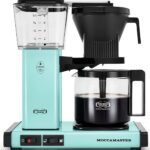
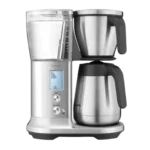
Choose it if you want a large, highly customizable batch brewer that can make excellent coffee consistently. Skip it if you mostly brew...
Pros: Popularity, Recognition and certifications, App, connectivity and smart control, Heating-element power, Build quality and durability, Brewing performance and consistency, Capacity
Cons: Design flaws, Warranty and Customer support
#2
4.4
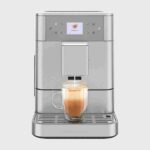
Choose the KF6 if you want excellent espresso and notably quiet operation from a super-automatic. Skip it if you want dense cappuccino foam...
Pros: Recognition and certifications, Grinder, hopper and dosing system, Water system, maintenance and descaling, Assembly and Setup, Automation and sensors, Build quality and durability,...
Cons: Accuracy of marketing claims
#3
4.3
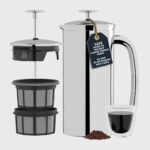
Choose the Espro P7 for a premium, insulated French press that noticeably cuts grit; Skip if you want a bargain brewer or expect...
Pros: Recognition & certifications, Popularity, Build quality & durability, Cup, tray & carafe handling, Filter, Brewing performance & consistency, Overall user experience
Cons: None
#4
4.3
Choose the Oracle Jet if you want fast, guided espresso that feels almost hands-off. Skip if you need true brew-and-steam-at-once dual-boiler performance or...
Pros: Speed & time-to-cup, Heating-element power, Automation & sensors, Assembly & Setup, Espresso & beverage quality, Guided tamper convenience, Overall user experience
Cons: Value & Price