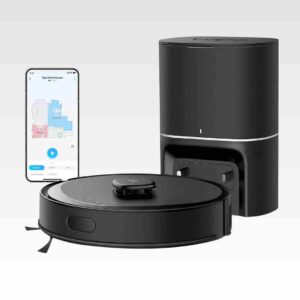

Accessories vary by package: some reviewers got spare bags/mop parts, while others reported few or no extra consumables.
Design feedback is mixed: many like the clean white look, while others find it basic or worry the glossy finish shows marks/scratches.
Automation features like scheduling, room/zone control, and voice assistants are commonly mentioned; the set is strong for the price, though some find the Alexa/assistant flow unintuitive.
The Roborock app is widely praised for deep customization, schedules, and map edits; a few mention missing/quirky workflows (e.g., open-plan room splitting).
It can traverse area rugs, but reviewers warn about mop mode on rugs (and the lack of mop lifting), so using avoid/zone settings is often recommended.
Mixed-floor homes benefit from mop-lift + carpet detection, letting it clean rugs without soaking them in many cases.
No summary yet.
Setup is repeatedly described as quick: minimal assembly, straightforward app onboarding, and fast initial mapping.
Battery life is typically described as sufficient for smaller to mid-size homes, with tested runtimes around the 90–100 minute range in some reviews and dependable dock returns.
Battery life is commonly cited around 180 minutes, with reliable recharge-and-resume behavior and good efficiency.
The self-empty system reduces how often you handle the onboard bin; reviewers generally like the hands-off emptying, though capacity and upkeep still matter over time.
Bagged auto-emptying and onboard bin capacity are viewed as convenient, with reports of weeks-long bag life in typical use.
Build quality is described as decent and functional for a budget robot rather than premium; most feedback suggests it feels solid enough if you maintain brushes and filters.
Build quality impressions vary: some find it solid, while others say materials feel less premium than Roborock’s flagship lines.
Deep/high-pile carpet cleaning is strong for a single-roller bot, but some reviewers say dual-roller flagships still clean thicker carpets better.
On low-pile carpet it generally handles everyday debris well, but hair pickup on carpet is a recurring limitation and can reduce cleaning efficiency.
Low-pile rugs are handled very well in both tests and everyday cleaning.
Carpet performance is generally strong, though at least one test reported weaker results on medium-pile compared with low-pile or top competitors.
Compared with other budget hybrids, it is often framed as better feature value (LiDAR plus auto-empty), while premium models still win on deep-clean power and advanced avoidance.
Comparative testing often places it near the top for overall vacuum+mop combos, with tradeoffs mainly versus pricier flagships.
The app provides solid control for maps and cleaning options, but several reviews mention a learning curve, an unintuitive layout, or voice-assistant controls that are not as polished.
The app controls are generally clear and feature-rich; the built-in voice assistant is seen as helpful by some but limited/overly sensitive by others.
Corner performance is decent for a round robot but not perfect; reviews suggest it can miss tight corners and may need occasional manual touch-ups.
Corners remain a common limitation (round body + geometry), even though edge cleaning is strong.
Crevice pickup is generally above average, with some tests showing it can pull debris from fairly deep cracks.
Dirty-water/dirt sensing is cited as useful for triggering extra mop washing when pads are especially dirty.
The self-empty dock is a major selling point and is generally reported to work reliably, emptying quickly after runs; minor complaints tend to focus on noise rather than failures.
The dock is a core strength (auto-empty + hot-water mop washing + drying), but it still requires water-tank service and occasional tray/plate cleaning.
Noise around the dock is mostly about the auto-empty burst and occasional whine; reviewers note it is not silent, but the loud part is brief.
Dried-on stain results are strong (coffee/grape/sauce), sometimes ranking near the top; the most stubborn spots may need extra passes.
Setup is widely described as straightforward, and day-to-day operation is easy once the app is learned; most users see it as a simple maintenance helper.
Overall usability is high once configured, but convenience drops if you regularly need to pre-tidy cords or de-tangle long hair.
Edge cleaning is generally good enough for routine upkeep along walls and baseboards, but not as precise as robots with dedicated edge hardware.
Edge/baseboard mopping is a standout due to the extending mop, with repeated mentions of near wall-to-wall coverage.
Emptying is mostly seen as convenient and cleaner than manual bin dumps; the main drawbacks mentioned are noise during emptying and the need to maintain the base and disposal method.
Auto-emptying is described as clean and convenient; you still need to replace bags and manage dirty water.
Filtration gets few direct complaints; the consensus is adequate dust containment for routine cleaning, with performance depending on regular filter upkeep.
HEPA-style filtration and sealed dust handling are mentioned as effective, with no major dust-containment complaints.
Mopping leaves a thin layer that dries quickly, and the dock’s pad drying helps reduce lingering dampness.
Long-hair wrap on the side brush is a recurring complaint and can be time-consuming to clean.
Carpet hair pickup is strong overall, though occasional clumps/fluff can still need a quick touch-up.
Hard-floor hair pickup is frequently praised, including for pet hair.
Hair tangling is a repeated theme: some users report wrap around brushes and more frequent cleaning, especially in homes with pets or long hair.
Main-brush tangling is usually well controlled, but long hair can still wrap the side brush and needs periodic clearing.
Multiple reviews call out weaker fine-debris pickup (sand, fine dust) versus larger crumbs, sometimes needing extra passes or targeted spot cleaning.
Hard-floor fine debris pickup is consistently excellent in tests and daily use.
Large debris pickup is a consistent strong point, with reviewers praising how well it handles crumbs and bigger particles during everyday runs.
Large-debris pickup on hard floors is a strength, though tight inside corners can still be a weak spot.
Headlights/LEDs are noted as helpful in low light, supporting more consistent cleaning in darker rooms.
Its low-profile design helps it fit under many common furnishings, though very low-clearance furniture can still block access.
A relatively low body for a LiDAR robot helps it reach under more furniture, though the sensor turret still limits very low clearances.
Maintenance is typical for robot vacs: brushes and filters need routine cleaning, and hair-prone homes will do more upkeep; auto-emptying reduces bin-handling but not brush care.
Automation reduces upkeep, but reviewers still mention periodic brush hair removal and cleaning the wash tray/plate.
LiDAR-based mapping and navigation are frequently described as systematic and efficient; some reviews note minor map-editing quirks, but overall pathing is a strength.
Maps are detailed and coverage is efficient, but some tests note slower overall run times and occasional quirks segmenting open floor plans.
Mop lift height (often cited around 10 mm) is repeatedly praised for keeping carpets/rugs drier during mixed runs.
Mopping is characterized as light-duty: it can handle light spills and routine wipe-downs, but scrubbing power is limited and the lack of mop lifting is a key constraint on carpets.
Mopping is widely rated excellent for daily maintenance and coverage; a few compare it as slightly less ‘deep scrub’ than top sonic/vibrating systems.
Most reviewers find it reasonably quiet during normal cleaning, though some mention a noticeable whine; the auto-empty cycle is louder but short.
Often described as quiet for its performance (some measurements/estimates around low‑50 dB), though max power is still noticeable.
Obstacle avoidance is regularly described as basic for the category; it may bump objects or get tripped up by cords and small clutter, so floor prep improves results.
Obstacle avoidance is mixed: some report cable/small-item misses, while others (especially post-update) see meaningful improvement.
Ongoing costs mainly come from dust bags and wear items; some reviewers explicitly flag bag replacement as a recurring expense.
Packaging is praised as well organized in at least one review, making unboxing/setup smoother.
Owners with pets like the convenience for day-to-day shedding, but multiple reviews call pet hair a weak spot, often requiring extra runs and more brush cleaning.
Pet hair pickup is a frequent highlight, and some reviews mention pet-focused modes/behaviors and monitoring features.
Value is a consistent highlight: reviewers call it affordable for a LiDAR robot with a self-empty dock, accepting some performance limits as the tradeoff.
Value depends heavily on sale price: several call it feature-packed for the money, but many still label it expensive at MSRP.
The camera enables remote viewing/video calls; at least one reviewer flags camera-equipped robots as a privacy dealbreaker and suggests choosing camera-free if concerned.
Default-mode runtime is commonly described as adequate for routine sessions, with some reviews citing around 98 minutes in testing and consistent auto-dock behavior. Boost or turbo modes can improve pickup but shorten runtime; reviewers treat it as a situational option rather than the default for whole-home cleans.
Automatic mop washing/drying is strong, but some reviewers note the wash plate/board gets dirty and needs manual cleaning; periodic pad washing helps.
Software and app support is mentioned as part of the ecosystem; reviews focus more on current features than long-term update promises, with no widespread update complaints noted.
A documented firmware update improved obstacle avoidance in testing, suggesting active software tuning and support.
Multiple reviews call out limited/no detergent dosing (or not being able to use solution), a notable gap versus some rivals.
The dock is tall/space-hungry and needs a dedicated spot, even if it’s slimmer than some competitors’ stations.
Streaking is generally low, with settings/features that help keep finish even; deep-scrub expectations may still require tuning.
Stuck events tend to come from cords, thin legs, or small clutter; reviewers recommend pre-tidying to avoid hang-ups, with general mobility otherwise acceptable.
Reviews often report few rescues, with good threshold handling and less tendency to get stranded or stuck.
Reviews describe strong everyday suction for crumbs and larger debris, especially at this price, but note weaker performance on fine particles and heavy pet hair compared with pricier bots.
Strong 7,000‑Pa-class suction in reviews, with solid pickup across surfaces; a few note flagships can still edge it on deepest crevices or thick carpet.
Reliability commentary is mixed but generally positive for the price; a few reviews flag typical budget-robot quirks, so expectations should be set accordingly.
Reliability notes are mostly positive (stable operation/connectivity), though obstacle/cable situations can still cause interruptions if floors aren’t prepped.
The body height lets it reach under some furniture, but clearance still matters; it does best where there is moderate under-furniture space rather than ultra-low gaps.
Under-furniture/toe-kick reach is highlighted as better than average in hands-on use.
Across reviews it stands out as a practical 2-in-1 with a self-empty dock, making it versatile for routine vacuuming plus light mopping rather than specialty deep cleaning.
The water tank and water delivery are described as basic but usable for light mopping; expect maintenance and refills, especially for larger areas.
Large dock tanks reduce refill frequency in some homes, but dirty-water emptying can be frequent if you mop often.