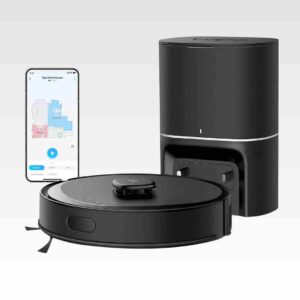
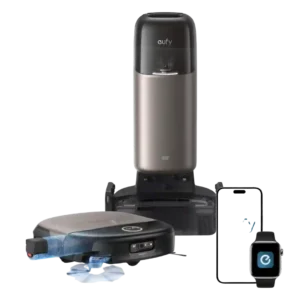
Included accessories are documented in unboxing/setup coverage, including cleaning solution, fragrance modules, and an extra vacuum bag.
Adaptive chassis lift is clearly supported by specifications and hands-on discussion, including automatic chassis lift, wheel-height adjustment, and lift behavior on carpets or transitions.
Design is repeatedly praised as sleek, premium, modern, and visually distinctive, with several reviewers calling out the translucent top, ring light, and slim or home-friendly styling.
Automation features like scheduling, room/zone control, and voice assistants are commonly mentioned; the set is strong for the price, though some find the Alexa/assistant flow unintuitive.
Smart features are a major part of the product, with CleanMind AI, floor-type detection, 3D mapping, app controls, and automation praised, though app disconnects and limited smart-home controls were also reported.
It can traverse area rugs, but reviewers warn about mop mode on rugs (and the lack of mop lifting), so using avoid/zone settings is often recommended.
Area-rug handling is generally strong, with evidence around avoiding tassels, preventing rug bunching, planning paths around rug edges, and adapting to different rug types.
No summary yet.
Setup is consistently described as straightforward or easy, with coverage mentioning simple setup steps, easy app-driven setup, and a base station that is mostly assembled.
Bag-level visibility is a weakness in the critical app review, which notes no real-time access to dust bag levels.
Battery life is typically described as sufficient for smaller to mid-size homes, with tested runtimes around the 90–100 minute range in some reviews and dependable dock returns.
Battery and charging evidence is mixed but concrete: one hands-on review measured a roughly 4.8-hour recharge time and noted that battery life varies significantly by suction level.
The self-empty system reduces how often you handle the onboard bin; reviewers generally like the hands-off emptying, though capacity and upkeep still matter over time.
Bin handling is supported by a hands-on note that overfilling the bin may require more than one empty cycle, so capacity and emptying behavior are good but not unlimited.
Build quality is described as decent and functional for a budget robot rather than premium; most feedback suggests it feels solid enough if you maintain brushes and filters.
Build quality appears strong in the available reviews, with comments describing strong build quality, a well-made feel, and solid overall construction.
High-pile carpet coverage is mixed. Several sources praise lift and thick-rug capability, but detailed testing found carpet performance underwhelming compared with expectations and some competitors.
On low-pile carpet it generally handles everyday debris well, but hair pickup on carpet is a recurring limitation and can reduce cleaning efficiency.
Low-pile carpet evidence is limited but favorable, with one review summary calling short-pile carpet performance very good.
Medium-pile evidence is limited but positive, with one test summary calling medium-pile results solid.
Child-lock support appears in dock/control discussion, where child lock limits touchscreen usefulness and one app walkthrough lists a child-lock option.
Clogging prevention is a major claimed and observed advantage. Reviews describe filters staying cleaner, low clogging rates, and cyclonic separation preventing performance drop.
Compared with other budget hybrids, it is often framed as better feature value (LiDAR plus auto-empty), while premium models still win on deep-clean power and advanced avoidance.
Comparison evidence is extensive. Reviewers compare the S2 against the S1 Pro, E25/E28, and competing flagships, finding meaningful upgrades in some areas but weaker value or carpet performance in others.
The app provides solid control for maps and cleaning options, but several reviews mention a learning curve, an unintuitive layout, or voice-assistant controls that are not as polished.
Controls are generally positive. Reviewers cite a clean, easy app, touch controls or displays, full app functionality, and 3D map controls, though one detailed test found smart-home integration limited.
Corner performance is decent for a round robot but not perfect; reviews suggest it can miss tight corners and may need occasional manual touch-ups.
Corner cleaning is improved but not perfect. Reviews praise extending brushes and corner reach, while some still want longer deployment or more aggressive behavior.
Crevice and groove pickup is mixed. One reviewer says it can get into cracks in wood or tile, while another found grout-line grime only partly removed.
Cyclone performance is one of the strongest technical themes. Reviews discuss multi-cyclone separation, in-robot cyclone technology, and stable airflow that helps keep filters from clogging.
Dirty-water or dirt-sensing support is limited to sources describing intelligent dirt detection that can trigger an additional cleaning cycle if used water is very dirty.
The self-empty dock is a major selling point and is generally reported to work reliably, emptying quickly after runs; minor complaints tend to focus on noise rather than failures.
Docking and auto-empty reliability are strongly supported. The station is described as handling emptying, washing, drying, refilling, maintenance cycles, dirty water, and debris with little intervention.
Noise around the dock is mostly about the auto-empty burst and occasional whine; reviewers note it is not silent, but the loud part is brief.
Dried-on stain evidence is mostly positive but not uniform. Reviews cite dried-on residue, sauce, and overnight spill tests, though one first-look source had not yet verified whether higher mop force made it better.
Setup is widely described as straightforward, and day-to-day operation is easy once the app is learned; most users see it as a simple maintenance helper.
Ease of use is supported by a reviewer calling the robot super easy to use in the context of common robot-vacuum challenges.
Edge cleaning is generally good enough for routine upkeep along walls and baseboards, but not as precise as robots with dedicated edge hardware.
Edge and baseboard performance is mixed. Many sources praise the extending mop or side brush, while detailed tests report visible gaps or inconsistent edge behavior near walls, cabinets, and baseboards.
Edge-following accuracy is a weakness in the critical hands-on testing, with reviewers noting the robot rides off walls and that edge behavior cannot be adjusted in the app.
Emptying is mostly seen as convenient and cleaner than manual bin dumps; the main drawbacks mentioned are noise during emptying and the need to maintain the base and disposal method.
Emptying and mess control are positive overall, with hands-on reviewers saying the self-emptying dock handled thick hair without clogs and the stronger dock cleared the robot bin thoroughly.
Filter or accessory tracking is supported by app evidence showing accessory wear tracking, though it is not described as a direct filter sensor.
Filtration gets few direct complaints; the consensus is adequate dust containment for routine cleaning, with performance depending on regular filter upkeep.
Filtration is a standout area in the hands-on coverage. Reviewers describe clean-looking filters after use, cyclonic filtration keeping the dustbin filter clear, and fine particles being separated before air returns to the room.
Floorhead design centers on the DuoSpiral brush and a main brush gap intended to manage hair and improve cleaning behavior.
Floor shine evidence is limited but positive, with one hands-on review saying floors looked clean and shiny after mopping.
Fresh liquid pickup evidence comes from first-look coverage explaining that the roller mop design is especially good for processing liquid spills.
Hair-removal channel evidence points to the center-gap brush design, which channels hair into the dustbin and reduces stuck strands.
Carpet hair pickup is strong in the evidence, with reviews calling pet-hair carpet performance very strong and long-hair/pet homes a good fit.
Hard-floor hair pickup is supported by reviewers describing hair, dust, and debris handled well and fine dust or loose hair picked up during hard-floor style tests.
Hair tangling is a repeated theme: some users report wrap around brushes and more frequent cleaning, especially in homes with pets or long hair.
Hair-wrap resistance is one of the most consistent strengths. Nearly all hands-on sources praise the DuoSpiral or gap-based brush for preventing tangles and reducing manual hair removal.
Multiple reviews call out weaker fine-debris pickup (sand, fine dust) versus larger crumbs, sometimes needing extra passes or targeted spot cleaning.
Hard-floor fine-dust pickup is strong in the available evidence, including hard-floor praise and tests involving dust or fine particles on hard surfaces.
Large debris pickup is a consistent strong point, with reviewers praising how well it handles crumbs and bigger particles during everyday runs.
Large hard-floor debris pickup is supported by cereal, candy, peanuts, sprinkles, and other medium debris tests, where the S2 generally picked debris up well.
Lighting support is narrow but present: one walkthrough notes a light for dark areas and tight spaces.
Heating evidence centers on dock functions such as hot-water mop washing, hot-air drying, and 60°C water for cleaning the mop roller.
Innovation is supported by unique-fragrance coverage, CES recognition, in-robot cyclone discussion, and reviewers calling the system advanced or distinctive.
Kid-friendliness is supported by one reviewer emphasizing pets or kids crawling around in the context of electrolyzed-water cleaning and chemical-free sanitation claims.
Large-debris handling is supported by tests with heavier or medium-sized debris, with reviewers saying the robot pulled everything in cleanly or picked up everyday debris quickly.
Its low-profile design helps it fit under many common furnishings, though very low-clearance furniture can still block access.
Low-profile evidence is limited to one review saying the robot fits under most furniture.
Maintenance is typical for robot vacs: brushes and filters need routine cleaning, and hair-prone homes will do more upkeep; auto-emptying reduces bin-handling but not brush care.
Maintenance is a key strength. Reviewers cite minimal maintenance, months before real attention, easier upkeep, cleaner filters, and less need to intervene.
Maneuverability is supported by room-transition and movement evidence: reviews describe moving between rooms without help and smooth motor behavior with no jerking.
LiDAR-based mapping and navigation are frequently described as systematic and efficient; some reviews note minor map-editing quirks, but overall pathing is a strength.
Mapping and path efficiency are well covered through 3D mapping, room routing, furniture identification, and app maps, with several reviewers saying the robot builds detailed maps quickly or accurately.
Mop lifting is strongly supported by multiple reviews, including automatic mop lift, carpet-wetness prevention, and 28 mm lift claims.
Mopping is characterized as light-duty: it can handle light spills and routine wipe-downs, but scrubbing power is limited and the lack of mop lifting is a key constraint on carpets.
Mopping performance is the S2’s strongest repeated theme. Reviews praise clean hard floors, active self-washing, pressure, stain handling, and no residue, though edge coverage and extreme stains remain caveats.
Most reviewers find it reasonably quiet during normal cleaning, though some mention a noticeable whine; the auto-empty cycle is louder but short.
Noise was a noted tradeoff. One reviewer called it louder than recent flagship bots, while another measured about 65.5 dB on quiet and 81 dB on max; a later benchmark also flagged the 81 dB peak as above average.
Obstacle avoidance is regularly described as basic for the category; it may bump objects or get tripped up by cords and small clutter, so floor prep improves results.
Obstacle avoidance is broadly capable but imperfect. Some reviewers report zero collisions or strong object avoidance, while detailed testing found a 71% obstacle score and minor bumps with everyday clutter.
Odor control is polarizing. Some reviewers liked the fragrance or odor-reduction approach, while the most critical hands-on review said the deodorizer did not make a noticeable difference during or after cleaning.
Ownership-cost evidence is limited to fragrance refills: one reviewer liked the modules up close but said refills were not worth personally recommending because the scent was not noticeable during cleaning.
Cleaning convenience is strong in the evidence, with reviewers citing long hands-off runtime and set-it-and-forget-it use.
Longevity claims center on sustained performance: reviewers describe peak-performance maintenance for up to 365 days and consistent cleaning results over extended use.
Overall opinion is generally favorable but not unanimous. Some reviewers call it one of the best or near-perfect, while a detailed tester describes it as strong but specialized.
Packaging evidence is narrow but positive, with one unboxing noting a large, easy-to-read quick-start card and documentation.
Owners with pets like the convenience for day-to-day shedding, but multiple reviews call pet hair a weak spot, often requiring extra runs and more brush cleaning.
Pet relevance is supported by a reviewer with dogs, who discussed odor control, hair challenges, and household pet mess concerns while describing the S2 as useful in that setting.
Value is a consistent highlight: reviewers call it affordable for a LiDAR robot with a self-empty dock, accepting some performance limits as the tradeoff.
Price is a caution point. The S2 is repeatedly tied to a high flagship price, with reviewers noting $1,599.99 or €1,599 and one saying the price was higher than expected.
Privacy control support is indirect but relevant: one reviewer noted the S2 does not have video monitoring mode, framing that as good news for privacy-minded users.
Default-mode runtime is commonly described as adequate for routine sessions, with some reviews citing around 98 minutes in testing and consistent auto-dock behavior. Boost or turbo modes can improve pickup but shorten runtime; reviewers treat it as a situational option rather than the default for whole-home cleans.
Runtime is mixed. Some coverage highlights long runtimes, but one detailed test found coverage varies widely by suction setting and drops sharply on max suction.
Sanitizing performance is widely mentioned through electrolyzed or ozone water claims, with multiple sources citing 99.99% sterilization or bacteria reduction; one source noted Eufy had not provided much specificity.
Self-cleaning is a core strength. Reviews describe mop self-cleaning, hot-water station washing, a mop that looks brand new, and station-based cleaning after each run.
Software and app support is mentioned as part of the ecosystem; reviews focus more on current features than long-term update promises, with no widespread update complaints noted.
Software support is evidenced by hands-on reviewers describing frequent firmware updates and improvements, including fixes for issues observed during pre-production use.
The liquid system includes clean and dirty water handling, cleaning solution, and a cleaning cartridge, with reviews describing water tanks and solution use in the dock.
The dock footprint is generally favorable, with coverage noting a relatively small footprint and a narrow base station that can fit in more places.
Residue and streaking results are positive in supported tests, with no visible streaking and surfaces left clean without visible residue.
Stuck events tend to come from cords, thin legs, or small clutter; reviewers recommend pre-tidying to avoid hang-ups, with general mobility otherwise acceptable.
Stuck resistance is supported by threshold and carpet-lift evidence, with reviewers saying it can avoid getting stuck where other vacuums do and can clear obstacles or thresholds.
Reviews describe strong everyday suction for crumbs and larger debris, especially at this price, but note weaker performance on fine particles and heavy pet hair compared with pricier bots.
Reviews consistently point to very strong suction and airflow, including 30,000 Pa claims, 100 air-watt discussion, and reports of strong pickup across debris types. Support was broad, though some carpet tests show that suction alone did not guarantee class-leading deep carpet cleaning.
Heavy-duty suitability is supported by one extended-use review estimating over 20,000 square feet cleaned and more than 40 hours of runtime.
Small-space suitability is supported by a reviewer saying the robot fits under most furniture.
Reliability commentary is mixed but generally positive for the price; a few reviews flag typical budget-robot quirks, so expectations should be set accordingly.
Reliability signals are mixed. One source discussed a pre-order recall or hardware issue, another flagged a conservative warranty, while a hands-on reviewer praised ongoing firmware updates to fix issues.
The body height lets it reach under some furniture, but clearance still matters; it does best where there is moderate under-furniture space rather than ultra-low gaps.
Under-furniture pickup is supported by one hands-on review saying the robot got into tight spaces under cabinets and under a bed.
Value-for-money is mixed; one detailed comparison said a less expensive Eufy model offers better value despite the S2’s flagship strengths.
Across reviews it stands out as a practical 2-in-1 with a self-empty dock, making it versatile for routine vacuuming plus light mopping rather than specialty deep cleaning.
Versatility is supported by evidence across hard floors, carpets, pet hair, rooms, and zones, including app-based cleaning by room or specific zone.
The water tank and water delivery are described as basic but usable for light mopping; expect maintenance and refills, especially for larger areas.
Water handling is a core part of the dock system. Reviews mention clean and dirty water tanks, water refilling, larger reservoirs, and back-side dirty water storage.