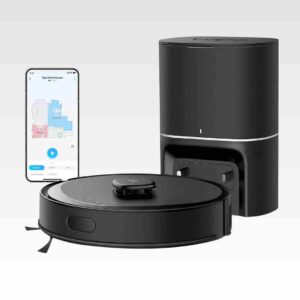
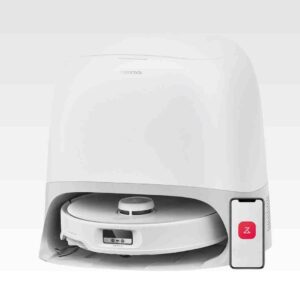
The adaptive chassis lift/threshold capability is a standout differentiator, helping it clear taller transitions than many robots. A few reviewers suggest real-world limits can be below marketing claims, but it’s still viewed as meaningfully better than average.
Its curved, modern dock and polished styling are frequently described as more living-room-friendly than boxier competitors. Overall sentiment on design is strongly positive.
Automation features like scheduling, room/zone control, and voice assistants are commonly mentioned; the set is strong for the price, though some find the Alexa/assistant flow unintuitive.
The app is consistently described as feature-rich, with strong automation options (room-by-room settings, scheduling, empty frequency, remop triggers, etc.). Overall sentiment is that the software is powerful without being overly hard to use.
It can traverse area rugs, but reviewers warn about mop mode on rugs (and the lack of mop lifting), so using avoid/zone settings is often recommended.
For mixed flooring, mop lifting and carpet detection are praised for keeping rugs dry while maintaining cleaning coverage; reviewers generally see it as well-suited to homes with area rugs.
No summary yet.
Setup is described as straightforward: the dock is largely ready out of the box, pairing/mapping is quick, and most complexity comes from exploring app settings rather than assembly.
Battery life is typically described as sufficient for smaller to mid-size homes, with tested runtimes around the 90–100 minute range in some reviews and dependable dock returns.
Battery life and efficiency are rated highly (including strong coverage per charge), making it a good fit for larger homes or multi-room schedules.
The self-empty system reduces how often you handle the onboard bin; reviewers generally like the hands-off emptying, though capacity and upkeep still matter over time.
Reviews commonly mention a disposable dust bag in the dock plus an onboard bin; overall feedback is that it reduces dust mess and feels appropriately sized for typical households.
Build quality is described as decent and functional for a budget robot rather than premium; most feedback suggests it feels solid enough if you maintain brushes and filters.
On low-pile carpet it generally handles everyday debris well, but hair pickup on carpet is a recurring limitation and can reduce cleaning efficiency.
Carpet deep-clean performance is rated very strong in testing, placing it near the top tier among vacuum+mop hybrids.
Compared with other budget hybrids, it is often framed as better feature value (LiDAR plus auto-empty), while premium models still win on deep-clean power and advanced avoidance.
The app provides solid control for maps and cleaning options, but several reviews mention a learning curve, an unintuitive layout, or voice-assistant controls that are not as polished.
Controls are generally praised: reviewers cite an intuitive app, useful remote-control features (e.g., pin-and-go), and broad customization. Some note competitor apps can feel more confusing, making Roborock’s UI a relative bright spot.
Corner performance is decent for a round robot but not perfect; reviews suggest it can miss tight corners and may need occasional manual touch-ups.
Corner cleaning gets frequent praise thanks to an extending side brush, improving reach into tight corners. One stress test notes the side brush can scatter debris in extreme scenarios, but overall corner performance is viewed as above average.
Crevice/groove pickup is noted as a relative weak spot: one review calls it average compared to the robot’s otherwise high-performing hard-floor and carpet results.
A dirty-water / dirt-detection sensor is credited with enabling remop/extra wash behavior, helping prevent spreading grime and improving hands-off cleaning.
The self-empty dock is a major selling point and is generally reported to work reliably, emptying quickly after runs; minor complaints tend to focus on noise rather than failures.
Docking and auto-empty reliability are repeatedly praised: the robot returns consistently, empties well, and handles mop washing/drying and refills with little fuss.
Noise around the dock is mostly about the auto-empty burst and occasional whine; reviewers note it is not silent, but the loud part is brief.
Dock emptying noise is described as relatively quiet for the category, including one report around ~67 dB.
In at least one standardized test, dried-on stain performance is described as more mid-pack than class-leading—good, but not the standout reason to buy.
Setup is widely described as straightforward, and day-to-day operation is easy once the app is learned; most users see it as a simple maintenance helper.
Day-to-day ownership is described as low-effort because the dock automates most chores; typical hands-on tasks are water refills/empties and occasional cleaning of the dock tray/consumables.
Edge cleaning is generally good enough for routine upkeep along walls and baseboards, but not as precise as robots with dedicated edge hardware.
Edge coverage is repeatedly highlighted: an extending mop pad and sweep arm help it clean closer to walls and baseboards than many rivals. Reviewers still wish for true baseboard scrubbing, but edge pickup is considered a strength.
Emptying is mostly seen as convenient and cleaner than manual bin dumps; the main drawbacks mentioned are noise during emptying and the need to maintain the base and disposal method.
The bagged emptying system is viewed as clean and convenient, with quiet emptying noted in at least one review and helpful indicators when water tanks need attention.
Filtration gets few direct complaints; the consensus is adequate dust containment for routine cleaning, with performance depending on regular filter upkeep.
For carpet hair, reviews and pet-hair testing place it among the better performers, though some results suggest two passes may still be needed for the most thorough pickup.
Hard-floor hair pickup is described as excellent in pet-focused testing, with near-perfect results reported.
Hair tangling is a repeated theme: some users report wrap around brushes and more frequent cleaning, especially in homes with pets or long hair.
Hair‑wrap resistance is a major highlight: the split/DuoDivide-style roller design earns perfect or near-perfect tangle-test results in multiple discussions. One reviewer still noted minor hair accumulation in certain joints, but overall sentiment remains very strong.
Multiple reviews call out weaker fine-debris pickup (sand, fine dust) versus larger crumbs, sometimes needing extra passes or targeted spot cleaning.
Testing-focused reviews describe excellent fine-dust pickup on hard floors, with strong results across small particulate debris.
Large debris pickup is a consistent strong point, with reviewers praising how well it handles crumbs and bigger particles during everyday runs.
Large-debris intake is repeatedly described as excellent in testing, handling bigger particles without major issues.
Hot-water mop washing and heated/warm-air drying are consistently praised for hygiene and for keeping mop pads from staying damp between runs.
Its low-profile design helps it fit under many common furnishings, though very low-clearance furniture can still block access.
Maintenance is typical for robot vacs: brushes and filters need routine cleaning, and hair-prone homes will do more upkeep; auto-emptying reduces bin-handling but not brush care.
Maintenance is often framed as low thanks to automation, but owners still need to refill clean water, empty dirty water, replace bags/consumables, and occasionally clean the dock tray and brushes.
LiDAR-based mapping and navigation are frequently described as systematic and efficient; some reviews note minor map-editing quirks, but overall pathing is a strength.
Lidar mapping and route planning are described as fast and efficient, with organized straight-line coverage and solid room handling/multi-level mapping.
Mop lifting is frequently cited as effective (often framed around a ~17mm lift), enabling it to vacuum carpets/rugs without soaking them.
Mopping is characterized as light-duty: it can handle light spills and routine wipe-downs, but scrubbing power is limited and the lack of mop lifting is a key constraint on carpets.
Mopping is broadly praised—dual spinning pads with adjustable wetness tackle everyday grime and paw prints well, and the extending mop pad improves edge coverage. A few reviewers still give the edge to the best-in-class moppers for heavy stains, but Curv is considered an excellent all‑around performer.
Most reviewers find it reasonably quiet during normal cleaning, though some mention a noticeable whine; the auto-empty cycle is louder but short.
Obstacle avoidance is regularly described as basic for the category; it may bump objects or get tripped up by cords and small clutter, so floor prep improves results.
Obstacle avoidance is usually described as good for larger items and many everyday obstacles, but several reviewers call out missed small cables/cords. In cable-heavy rooms, it may snag or stop, so floor prep or no-go zones are recommended.
Across the reviews, Qrevo Curv lands as a top-tier vacuum+mop with strong cleaning results, a highly automated dock, and smart navigation. Praise centers on edge/corner reach and pet-hair handling, while the most common knocks are premium pricing and imperfect cable avoidance.
Owners with pets like the convenience for day-to-day shedding, but multiple reviews call pet hair a weak spot, often requiring extra runs and more brush cleaning.
Multiple reviews frame it as a great choice for pet owners thanks to strong hair pickup, anti-tangle brush design, and camera/app features (where enabled) for monitoring. Pet homes with lots of cords still need some floor prep.
Value is a consistent highlight: reviewers call it affordable for a LiDAR robot with a self-empty dock, accepting some performance limits as the tradeoff.
The price is repeatedly called premium (often framed around a ~$1,600 MSRP), and several reviewers recommend waiting for discounts. When on sale, value is described as far more compelling; a few reviewers question whether camera/chassis-lift extras are worth the upcharge versus cheaper variants or rivals.
Camera-based features (obstacle recognition, remote viewing/voice) bring privacy considerations. Reviews note the camera can be disabled/off by default, and a camera-free variant exists for buyers who prioritize privacy.
Default-mode runtime is commonly described as adequate for routine sessions, with some reviews citing around 98 minutes in testing and consistent auto-dock behavior. Boost or turbo modes can improve pickup but shorten runtime; reviewers treat it as a situational option rather than the default for whole-home cleans.
The dock’s self-cleaning base/tray features reduce manual scrubbing, though reviewers still expect periodic cleaning to keep things fresh.
Software and app support is mentioned as part of the ecosystem; reviews focus more on current features than long-term update promises, with no widespread update complaints noted.
Most reviewers say detergent dosing is manual (add solution to the clean-water tank rather than a dedicated auto-dosing reservoir), while one review lists a detergent capacity/mixing capability. Net takeaway: plan for at least some manual solution handling.
Stuck events tend to come from cords, thin legs, or small clutter; reviewers recommend pre-tidying to avoid hang-ups, with general mobility otherwise acceptable.
Adaptive lift helps it clear thresholds and some obstacles, but cable snags and occasional attempts to 'climb' awkward objects can still interrupt runs in some homes.
Reviews describe strong everyday suction for crumbs and larger debris, especially at this price, but note weaker performance on fine particles and heavy pet hair compared with pricier bots.
Vacuuming performance is described as strong in real homes and on carpets, helped by high rated suction. One evaluation calls out only average airflow/bench suction and weaker performance in tight crevices compared with its overall cleaning results.
Reliability commentary is mixed but generally positive for the price; a few reviews flag typical budget-robot quirks, so expectations should be set accordingly.
The body height lets it reach under some furniture, but clearance still matters; it does best where there is moderate under-furniture space rather than ultra-low gaps.
Across reviews it stands out as a practical 2-in-1 with a self-empty dock, making it versatile for routine vacuuming plus light mopping rather than specialty deep cleaning.
The water tank and water delivery are described as basic but usable for light mopping; expect maintenance and refills, especially for larger areas.
Reviews consistently mention separate clean/dirty water tanks plus onboard water handling that keeps pads wet. Tank refills/empties are a routine task, but capacity and adjustable water use are generally seen as practical for whole-home runs.