Access logs are consistently highlighted as useful and fairly detailed, showing who unlocked the door and by what method (PIN, fingerprint, app/remote, manual). A few experiences note the log view can be limited initially but loads more history as you scroll, making it practical for monitoring kids, guests, or service providers.
Reviewers consistently highlight the in-app Events timeline as a strong audit trail: it shows lock/unlock actions plus motion and doorbell events with thumbnails, making it easy to see what happened and when.
The built-in speaker is generally described as clear and loud enough for doorbell sounds and two-way talk, with adjustable volume. However, it does not tie into a traditional wired chime; most setups rely on Alexa/Echo devices or a HomeBase for indoor chimes.
The app is generally described as easy to set up and feature-rich (users, logs, settings, firmware), but polish varies. Several reviews mention occasional sluggishness or connection hiccups, and Wi-Fi setup can be frustrating on certain networks; standalone/manual programming is also reported as unreliable by at least one reviewer.
The Eufy app offers deep control (live view, event playback, access rules, power modes, and camera settings) and works reliably, but multiple reviews call it sprawling and time-consuming to learn because it manages many Eufy device categories.
Auto-lock is a major strength: it is configurable (seconds to minutes), and in Wi-Fi/door-sensor setups it can avoid locking when the door is open/ajar. A recurring minor complaint is that auto-lock being enabled by default can surprise new users, though it is easy to adjust or disable.
Auto-lock is widely praised for flexibility: you can set short delays and schedules, and it generally waits for the door to be closed before engaging. A few notes suggest edge cases if the door is only slightly ajar, so tuning is worthwhile.
Wrong-try protection is repeatedly mentioned as a useful safeguard, with configurable lockouts after a set number of failed palm scans or PIN attempts.
Backset compatibility is repeatedly described as standard (commonly 2-3/8 or 2-3/4). A couple of hands-on installs mention minor confusion/quirks during adjustment, but overall fit is framed as typical for U.S. doors.
Battery life varies by usage and connectivity: manufacturer claims range from months to longer, but reviewers report anything from about a month during heavy testing to multiple months in normal use. Strong low-battery warnings are commonly noted, and emergency USB power plus a hidden key reduce lockout risk.
The dual-power design is a standout: a large rechargeable 15,000mAh pack plus AAA backup batteries. Reviews like the concept for avoiding lockouts during charging, but real-world endurance varies with video settings, and heavy surveillance use can drain the main battery much faster.
Bluetooth pairing is generally described as straightforward and reliable for local control. Bridge-based setups rely on Bluetooth to link the lock to the bridge, and most reviewers report good day-to-day operation once paired.
Bluetooth is present for connectivity and setup, but reviews focus more on Wi-Fi behavior than Bluetooth range or stability.
Build quality is frequently praised as solid, heavy, and secure-feeling. Several reviews reference commercial-grade claims (especially on the Wi-Fi model), while a few note the industrial look or plastic feel on some exterior elements; overall durability impressions skew strongly positive.
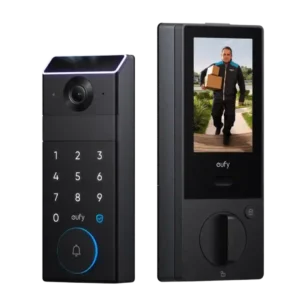
Build quality is frequently described as robust and premium, backed by Grade 1 durability/security claims. Multiple reviewers note the lock is physically large and heavy, reflecting the added camera and screen hardware.
The door sensor is widely viewed as a meaningful upgrade, enabling open/closed status, open-door alerts, and smarter auto-lock behavior that helps prevent locking when the door is ajar. Reviewers consistently frame it as useful for peace of mind and better automation.
The lock’s door-sense behavior is commonly tied to its auto-lock feature, helping it avoid locking when the door is open. Some hands-on reviewers mention it can misinterpret a nearly closed door, so placement and calibration matter.
Door compatibility is generally presented as standard deadbolt fit for typical U.S. doors, with common door thickness and bore/backset ranges. Most installs are described as straightforward when replacing an existing deadbolt, with extra work mainly if drilling new holes or correcting alignment.
Fit is generally standard for a deadbolt replacement, but the bulky exterior/interior escutcheons can be a visual and physical presence. Several reviews warn the interior screen is less useful on doors with glass, and screen or storm doors can obstruct the camera view or visitor interaction.
Firmware updates and software-driven features are commonly mentioned (adding or refining behaviors like Magic Shake, sensor-based auto-lock, and general stability). A caution appears in some user-feedback sections that updates or configuration changes can occasionally introduce issues, so keeping alignment and settings correct matters.
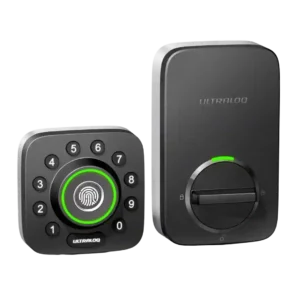
Fingerprint performance is a standout: most reviewers describe it as fast and accurate with quick setup. A few note that finger positioning/angle can matter and some users (especially older users in anecdotal feedback) may see inconsistent scans, but overall sentiment is strongly positive.
Biometric access is a core strength, implemented here as palm-vein recognition. Reviews generally find it fast and accurate once you learn the hand position, though a few note it can be sensitive to angle or may need a wake-up touch in some conditions to save battery.
A few reviewers note the exterior materials do a decent job resisting obvious smudges and fingerprints, helping the keypad area stay cleaner looking over time.
Geofencing behavior is mixed: some reviewers report a better experience than prior generations, while others call it unreliable or dependent on leaving a set radius before it will trigger properly. It can be helpful when tuned, but it is not the most universally dependable feature.
Guest access is repeatedly described as strong: temporary PINs, scheduled access windows, one-time codes, and shareable eKeys are highlighted as ideal for cleaners, dog walkers, and rentals. Logs tied to user identity improve accountability for shared access.
Guest access is strong on paper and in testing, with support for many PINs, scheduled codes, and multiple palm enrollments, making it suitable for families and frequent visitors.
Hub/bridge needs depend on the version: built-in Wi-Fi models remove the bridge requirement, while older bundles require a bridge placed close to the door (often described as within about 10 feet). Bridge requirement is a common source of complexity for voice assistants and remote features on non-Wi-Fi versions.
A hub is not required for basic operation and remote control over Wi-Fi, but a HomeBase is repeatedly positioned as the path to expanded storage and smarter alerts (such as facial recognition) and can also act as an indoor chime. There are also reports that certain smart-home pairing flows work best when the lock is on Wi-Fi rather than routed through a hub.
Installation varies sharply by generation: Wi-Fi revisions are often described as much easier and faster than early versions, with some installs completing in under 10–30 minutes. Older versions are described as finicky, sometimes requiring tailpiece trimming and very careful screw tightness and alignment to avoid binding.
Installation is usually described as straightforward (often around 15–20 minutes) with app-based video guidance, though it involves extra wiring compared to simpler locks. A few reviewers experienced early firmware/setup hiccups or needed recalibration after install.
There is no clear mention of an automatic jam-detection feature, but jamming/binding scenarios come up: misalignment, overtightened screws, and door fit can cause resistance. Newer hardware revisions are described as reducing prior jamming issues, but proper alignment remains important.
A few reviewers mention calibration and initial false jam/stuck behavior during setup; once calibrated, operation is typically stable.
The hidden physical key is broadly viewed as a reliable backup, and emergency external power via a USB port adds another recovery option when batteries die. This layered fallback approach is frequently cited as a major practical advantage versus app-only smart locks.
The hidden keyway under the doorbell button and the availability of an emergency USB-C power option are valued for backup entry. One reviewer noted the doorbell-button cover can be fiddly to reseat, but overall the mechanical override is seen as an important safety net.
The keypad earns praise for tactile buttons, backlighting, and the anti-peep feature that allows extra digits around the real code. A recurring usability nit is the circular layout, which some find slower than a traditional keypad, but most still consider it dependable and secure.
The keypad is widely viewed as responsive and easy to use, supporting many PINs and guest access patterns. Features like one-touch locking and optional scramble passcodes show up repeatedly as practical day-to-day conveniences.
Keyway quality is not heavily evaluated, but one review explicitly notes a standard-style keyway (Schlage mentioned) and most emphasize that the keyhole is hidden behind a flip-down faceplate. As a backup entry method, it is generally framed as dependable and well-integrated.
The keyway is cleverly concealed for aesthetics, though at least one review suggests the cover mechanism can be a bit finicky.
Lock/unlock speed is commonly described as quick, especially via fingerprint and keypad, with near-instant responses frequently noted in tests. Geofence-based behaviors can be slower or more conditional, but direct methods are consistently fast.
Unlocking speed is a recurring strength, especially with palm access and remote commands, with many reviewers describing near-instant actuation once the lock is properly calibrated.
The motor is often described as smooth and fast, but a couple of reviewers note it can be louder than some competing locks. Most still consider the sound level acceptable, and the faster action is often seen as a worthwhile tradeoff.
Multiple reviews call out the interior controls that can drive the deadbolt motor (in addition to a manual thumbturn), which can be helpful for users who prefer a push-button action.
Once installed correctly and aligned, locking reliability is usually described as excellent with consistent fingerprint/PIN/app operation. Reported reliability issues tend to cluster around connectivity (Wi-Fi pairing or app connection loss) and installation-related binding rather than everyday mechanical failures.
Locking and unlocking are generally reported as reliable, with stable connectivity and consistent response to palm scans, PINs, and app commands once the device is installed and calibrated.
Notifications are generally appreciated for remote awareness (lock/unlock events and battery alerts). Some app workflows are criticized for requiring per-user notification rules rather than a simple global option, but overall alerting is seen as helpful for security and household monitoring.
Notifications are typically fast and useful, with human-focused motion alerts and quick access to live view or buffered clips. Some advanced alert types are described as dependent on adding a HomeBase.
Physical attack resistance is framed as strong on Wi-Fi/door-sensor variants that reference commercial-grade/Grade 1 claims, while at least one older evaluation notes the model was not officially certified and was described as closer to Grade 2 in spirit. Overall, reviewers still describe it as robust for typical residential use.
Physical security is positioned as a major selling point, with repeated references to Grade 1 certification and a solid, heavy build intended to withstand force and long-term use.
Several reviewers reference anti-pick or encrypted-cylinder claims, but detailed independent pick/drill ratings are not commonly provided in the reviews; expectations are high given the Grade 1 positioning, but specifics are limited.
Remote access is a key benefit when Wi-Fi is built in or when a bridge is used: reviewers frequently highlight being able to lock/unlock from anywhere and manage users remotely. Some note remote actions can be slower over Wi-Fi than Bluetooth and that Wi-Fi stability depends on signal quality and network constraints.
Remote access is a strength thanks to built-in Wi-Fi and the Eufy app, typically without needing a separate bridge. Some apps require a press-and-hold action for lock/unlock to prevent accidental triggers.
Security features commonly mentioned include dual-layer encryption claims, the anti-peep keypad, activity logs, and a lockout mode that disables electronic access. These are generally seen as meaningful safeguards, though account-level protections are not universally praised.
Security features mentioned across reviews include local video storage, scramble passcodes, configurable lockout after failed attempts, and encrypted communications. Privacy and local data storage are frequently framed as benefits versus subscription-first competitors.
Smart-home integrations are broad (Alexa, Google, IFTTT, and sometimes SmartThings), enabling routines and automations. The most consistent limitation is the lack of Apple HomeKit support; setup can also be a bit quirky depending on how platforms label the integration and which connectivity version you own.
Matter support and voice assistant compatibility are consistently described as real but limited: third-party platforms generally expose basic lock controls, while camera, doorbell, and palm features remain primarily inside the Eufy ecosystem.
Tamper and suspicious-activity protections show up via mentions of tamper alarms, loitering alerts, and wrong-try lockouts. Sensitivity and alert volume can usually be tuned in the app.
The touch interface and capacitive keypad lighting are repeatedly praised for responsiveness and visibility, making PIN entry and one-touch actions easy at the door.
At least one review explicitly criticizes the companion app for lacking two-factor authentication, even while other reviews mention phone-number verification during account creation. If account security is a top priority, this is a notable weakness compared with platforms that offer robust 2FA.
User access management is repeatedly praised: multiple roles (admin/normal/temporary), schedules, usage limits, and support for many users with PINs and fingerprints. This flexibility is a primary reason reviewers recommend it for families, offices, and rental properties.
User management is a highlight: per-person profiles, scheduled or one-time access, and tying palm scans to users are repeatedly described as well implemented.
Value is generally rated positively relative to competitors because it bundles many entry methods (fingerprint + keypad + app + key) and strong guest-management features. Some reviewers still call MSRP expensive, but discounts and the feature set often shift the judgment toward good value.
Price is the biggest recurring downside: most reviews call it expensive, though many also concede it can replace a separate smart lock and doorbell. Value improves most for users who genuinely want the integrated screen and consolidated hardware.
Voice control (Alexa/Google) is commonly supported, typically requiring a voice PIN for unlocking. Experience depends on version: Wi-Fi models simplify setup, while bridge-based versions add placement constraints but still work well once configured.
Voice control is generally reported as responsive for basic locking and unlocking through Alexa, Google, and Siri, and some reviewers mention the ability to view the camera feed on compatible smart displays.
Warranty and support are not deeply reviewed across sources, but one review’s user-feedback roundup notes generally responsive customer support and replacement parts when needed. Most other coverage focuses more on features and setup than long-term service outcomes.
Warranty details are mentioned as longer on the mechanical side than electronics, though hands-on support experiences are not deeply covered in the reviews.
Weather resistance is frequently cited through IP65 and wide operating temperature claims, with reviewers expecting it to hold up in typical outdoor conditions. Real-world endurance commentary is limited, but the overall framing is that it is designed for exterior exposure.
Weather resistance is reinforced by repeated references to an IP65 rating and outdoor placement suitability, though extreme conditions and long-term finish wear are not heavily tested across reviews.
Wi-Fi is a major convenience upgrade on built-in models, enabling remote access without extra hardware, but 2.4GHz-only requirements are a recurring pain point—especially for certain mesh setups. Strong signal and correct band selection are repeatedly emphasized for stable operation.
Wi-Fi connectivity is typically stable, but multiple sources note the lock operates on 2.4GHz networks. Some marketing and reviewer notes cite Wi-Fi 6, yet practical guidance still centers on 2.4GHz setup and the lack of 5GHz support.