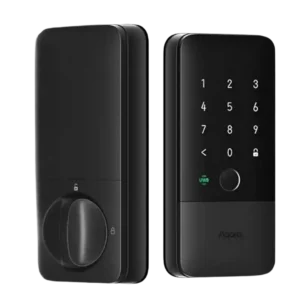
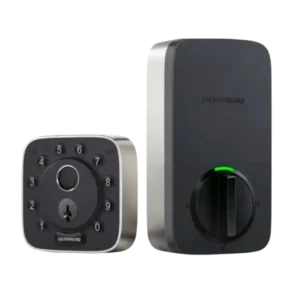
Access logs are highlighted most clearly in app walkthroughs that show event histories for lock/unlock actions and alerts, supporting practical oversight for families and guest access.
Logs are generally described as robust, showing an activity timeline that can identify lock events and, in many cases, which method or user was involved. One review notes that actions initiated through certain integrations can be labeled oddly in the timeline.
The lock includes audible feedback and alarm-related settings (including volume/muting and Do Not Disturb in some ecosystems), but reviews do not deeply quantify siren loudness. The emphasis is on configurable audio cues rather than raw volume.
The Aqara app is generally described as clean and functional for setup, settings, and firmware updates, and it can unlock extra features. Some reviewers still prefer living in Apple Home day-to-day, and a few mention minor friction (learning curve or occasional platform-specific bugs like code generation).
The U home app is often described as easy to navigate for users, codes, and basic settings, but experiences are inconsistent. Multiple reviewers report setup quirks or occasional failures to connect/control the lock, while others report smooth day-to-day control.
Auto-lock is widely supported and commonly used, with options ranging from immediate lock-on-close styles to time-based delays. Some reviewers note occasional timing quirks (door-close detection can take a few seconds or mis-time), so many recommend keeping a time-based auto-lock as a safety net.
Auto-lock is widely praised when configured, especially when paired with the door sensor to confirm the door is closed, and timing controls are commonly cited. However, at least one reviewer reports software trouble enabling auto-lock reliably. Hands-free unlocking is available via phone location and short-range connectivity, and some reviewers like it as a Home Key alternative. Others report it can be slow or inconsistent and choose to leave it disabled.
Beyond basic lockout behavior after repeated failed entries, some reviewers highlight safety behaviors like re-locking after remote/unattended unlock events. Where described, these features are positioned as thoughtful safeguards rather than headline features.
Backset adjustability is explicitly demonstrated in at least one install-focused review, where the deadbolt length can be adjusted to center properly in the door prep.
Backset adjustment is described as supported via an adjustable bolt/latch, helping it fit common door configurations without special work.
Battery life is typically characterized as around six months per charge, with strong praise for USB-C charging and emergency external power options. A recurring concern is the practicality of spare/replaceable rechargeable packs compared with swapping AA batteries.
The lock uses eight AA batteries, with reviewers commonly citing a target of roughly a year of life, and noting that heavy Wi-Fi usage can increase drain. Some reviewers prefer rechargeable systems, but most appreciate that AAs are easy to replace.
Bluetooth is present and often used for certain local interactions or setup flows, but reviewers generally position Thread/UWB as the main performance story. Some call out Bluetooth-based auto-unlock on other locks as unreliable compared with UWB.
Bluetooth is commonly used for local control and platform pairing; it is generally responsive, but some reviewers note Bluetooth-based control in certain ecosystems can feel slower at times.
Build quality impressions are generally positive, with several reviewers describing the lock as solid and well made. Some note that aesthetics are subjective (larger, clearly a smart lock), and at least one review references the enclosure/material feel as less premium than a truly metal-bodied alternative.
Build quality is frequently described as solid, with metal components and sturdy feel, though aesthetics are divisive. Some versions use more plastic on the face, which can look cheaper even if it does not feel flimsy.
Door-sense behavior is frequently mentioned: the lock can infer door closed/open states for automation and lock-on-close style behavior, though at least one review notes that door state may not always be exposed to every smart-home platform as a simple contact sensor would be.
The optional door sensor is repeatedly recommended because it enables door-open/ajar awareness, supports smarter auto-lock behavior, and can trigger alerts when a door is left open. Some note it is not always exposed to every smart-home platform the same way.
Most reviews indicate compatibility with standard deadbolt doors, and several note included adapters/rings to handle different bore sizes. Because it replaces the full lock assembly, it may be less suitable for situations where you must keep existing exterior hardware (some apartments/condos).
Multiple reviewers describe the lock as fitting most standard U.S. doors as a full deadbolt replacement. Compatibility is generally not a blocker when replacing an existing deadbolt.
Because the U400 replaces the full deadbolt hardware, it is not a retrofit-only upgrade. Some installers highlight included plates/adapters that can reduce the need for extra drilling in certain scenarios, but overall it is less about reusing existing deadbolt hardware and more about replacing it cleanly.
Some installers successfully reuse existing hardware like a strike plate, but at least one reviewer found that trying to reuse parts slowed installation. Using the included hardware is often suggested for the smoothest setup.
Firmware updates and future-facing standards are frequently referenced, including ongoing updates, Aliro readiness, and platform-driven improvements. A few reviewers mention update friction in some apps, suggesting the manufacturer app may be the smoother path at times.
Fingerprint performance is repeatedly described as quick and accurate, often serving as the preferred backup method even for users who primarily rely on UWB. Several reviews note that fingerprint enrollment can be handled via the app or directly on-lock in certain workflows.
Fingerprint performance is one of the strongest themes: reviewers repeatedly describe it as fast, accurate, and reliable, often unlocking in under a second. A few note occasional misses can be improved by enrolling the same finger more than once.
Finish observations focus more on appearance and fingerprint/smudge resistance than on long-term wear. Where mentioned, reviewers appreciate a finish that resists fingerprints and looks clean day-to-day.
Several reviewers highlight that the printed/illuminated keypad markings and button materials are designed to resist obvious wear, reducing the chance that frequently used digits become visibly obvious over time. Long-term finish wear is not broadly tested.
Geofencing is mostly discussed as a negative point for older smart locks, with reviewers favoring UWB because it avoids the unreliable behavior they experienced from Bluetooth/geofence auto-unlock systems.
Geofencing-based behavior is available and can work well, but reviewers disagree on reliability and speed. Some appreciate the convenience, while others find it slow or prefer not to share location continuously.
Guest access is a strong area: reviewers mention multiple PINs, temporary/one-time codes, time-limited schedules, and in Apple Home the ability to share Home Key-style access. Some NFC accessories may be optional purchases depending on the setup.
Guest access is described as flexible, with support for one-time, scheduled, recurring, and time-bounded PIN codes. Reviewers frequently cite this as a practical advantage for visitors, neighbors, cleaners, and deliveries.
A Thread border router is commonly described as effectively required to get meaningful Matter/Thread functionality and remote control in third-party platforms. Aqara hubs are optional but can add Aqara-app remote access and certain integrations.
Hub needs depend on ecosystem and model. Some versions are described as not needing a dedicated hub for standard smart features, while Apple Home/Matter remote control can depend on a compatible hub or adapter depending on configuration.
Installation is typically described as straightforward for a full deadbolt replacement, often quoted in the 15–45 minute range depending on door fit and experience. Minor pain points include tight wiring routes, small screws, and occasional door-prep quirks (latch recess/backset adjustments).
Physical installation is commonly described as quick and straightforward for a full deadbolt replacement, often taking only a few minutes for experienced installers. Software setup and platform pairing are more variable, with some reviewers reporting repeated connection or onboarding friction.
Physical key access is treated as an important fallback, with the keyway often hidden behind a sliding cover. Reviewers generally expect it to be dependable even if they rarely use it.
Key override is consistently presented as a usable backup method, and reviewers treat it as a standard fail-safe alongside digital access. Detailed long-term reliability testing is not common in the reviews.
The keypad is commonly praised for a stealth look (numbers hidden until activated) and reliable entry, though multiple reviewers mention occasional wake sensitivity where it may take an extra tap before accepting input.
The keypad is widely liked for being tactile and easy for guests, with an anti-peep approach that allows extra digits before or after the real PIN. It is generally described as responsive and useful when fingerprints are not ideal.
Keyway design is typically described as discreet (hidden behind a panel) and practical as a backup. Rekeyability is explicitly called out in at least one review as a convenience for matching house keys.
One security-focused review points out an unusual mechanical cylinder/keyway presentation that may be confusing from a traditional lock perspective. This is not raised as an issue by typical user reviews focused on daily usability.
Speed is a recurring compliment: Thread-based control is often described as instant or very responsive, and UWB unlock triggers early enough that users can keep walking without pausing at the door.
Lock/unlock actions are often described as quick, including near-instant response to app commands in some tests. Others note slower response in some integration paths or platforms, particularly when relying on certain network/control routes.
Motor behavior is polarizing: some reviewers do not call out noise at all, while others describe the motor as grinding, whining, or too loud for regular home use. This appears to vary by version and subjective tolerance.
Locking reliability is strongly rated across reviews, especially for UWB unlocking and routine locking/unlocking in Apple Home. Minor inconsistencies appear more around door-close auto-lock timing rather than core lock actuation failures.
Core locking reliability is generally reported as strong, with consistent success across fingerprint and keypad entry. When reliability issues appear, they are more often tied to connectivity, app control, or ecosystem integration rather than the physical bolt failing to actuate.
Notifications and alerts are frequently mentioned, including lock/unlock confirmations, door left open/unlocked warnings, and watch-based prompts that can even enable quick relocking. Some audio/alert behavior can be tuned with modes like Do Not Disturb in certain ecosystems.
Notifications are frequently highlighted as useful, including alerts for lock/unlock events, specific user activity, and door-left-open states when the door sensor is used. Some reviewers appreciate fine-grained control over which alerts to receive.
Several reviews cite the U400 as BHMA Grade 3, which is a basic certification tier. Reviewers generally accept it for typical residential use but note it is not the top choice if you are prioritizing maximum forced-entry resistance.
Security-focused commentary includes claims of strong overall security ratings on some variants and at least one discussion of strong bump resistance in the mechanical cylinder. However, in-depth, standardized attack testing is not consistently provided across reviews.
Rather than detailed pick/drill testing, reviewers lean on the BHMA Grade 3 reference as the primary proxy for physical resistance. It is acknowledged as better than nothing but not the highest tier available.
One lockpicking-focused review suggests the mechanical cylinder does not showcase especially impressive anti-pick measures, even while noting strong bump resistance. Drilling resistance is not meaningfully assessed in these reviews.
Remote access is generally reliable when the lock is paired through a Thread-enabled smart-home platform (like Apple Home) or when used with an Aqara hub for Aqara-app remote control. Without that infrastructure, functionality is described as more local and limited.
Remote access depends heavily on model and setup: some Wi-Fi versions are intended to provide remote control directly, while Matter/HomeKit remote control can require a compatible hub or additional adapter. Several reviewers report inconsistent remote reachability when the lock drops offline.
Security discussions center on UWB precision and anti-relay style benefits compared with Bluetooth-based proximity unlocking. Reviewers frame UWB as more intent-aware and harder to spoof in typical use than older Bluetooth/geofence approaches.
Smart-home integration is a major strength: Matter over Thread is repeatedly cited for broad compatibility (Apple Home, Google Home, Alexa, SmartThings, Home Assistant) and responsive local control. Apple Home Key is central to the best experience for Apple users.
Smart-home compatibility is repeatedly cited as a major strength, spanning popular ecosystems (including Apple Home/HomeKit, Alexa, Google, and, on some variants, Matter). A recurring caveat is that certain advanced features may still require the manufacturer app, and responsiveness can vary by platform.
Tamper-related behavior is referenced through lockout timers, alerts for unusual conditions (like too many failed attempts or door left unlocked), and forced-entry style notifications in some setups. Detailed sensitivity tuning is not consistently covered, but protective behaviors are present.
As a touch interface, the hidden keypad generally works well, but wake-up responsiveness is a recurring minor quirk across reviews. Once active, entering codes is typically smooth and reliable.
User access management is repeatedly described as flexible, with role-based controls in Aqara and a more constrained but still practical set of limits in Matter-based ecosystems. For most households, the practical user and credential limits are viewed as sufficient.
User management is described as flexible, supporting multiple user roles, schedules, and access methods per user (PIN, fingerprint, app). Reviewers routinely point to this as a standout for families and service-provider access.
Pricing is often framed around a roughly $270 tier: some call it reasonable for first-to-market UWB convenience, while others label it pricey compared with strong fingerprint-first alternatives. The perceived value rises sharply for Apple Home users who will actually use UWB daily.
Pricing is commonly described as on the expensive side for a smart lock, but some reviewers feel the access flexibility and ecosystem support justify it. Value perception drops when reviewers encounter connectivity problems, missing built-in Wi-Fi on certain variants, or loud motor noise.
Voice control is commonly described as available through connected ecosystems (notably Siri in Apple Home, and also Alexa/Google in Matter setups), making lock status checks and basic locking actions convenient hands-free.
Voice control is generally described as working well once paired to an assistant ecosystem, including voice-triggered locking/unlocking flows. A few reports mention occasional assistant-side command failures when the lock is not responding reliably.
Support experiences are not deeply covered, but at least one reviewer reports contacting the company about Wi-Fi/app issues and receiving acknowledgment and escalation. Clear resolution timelines or outcomes are not broadly documented.
Weather resistance is repeatedly supported by references to an IP65 rating for the exterior keypad panel, and at least one long-use review reports stable performance across rain, snow, ice, and temperature swings.
Weather resistance is repeatedly associated with an IP65-style rating and suitability for outdoor exposure like rain and dust. Long-term durability in harsh conditions is not extensively tested in the reviews.
Wi-Fi is commonly referenced in comparisons: Thread is described as faster and more battery-friendly than typical Wi-Fi smart locks. The U400 is generally not treated as a Wi-Fi-first lock, so remote features are expected to come via Thread border routers or hubs instead of direct Wi-Fi.
Wi-Fi behavior varies by model and experience: some versions are described as having built-in Wi-Fi, while at least one Matter-focused review states Wi-Fi is not integrated and may require an extra adapter. Some users also report Wi-Fi dropouts that make remote access unreliable.