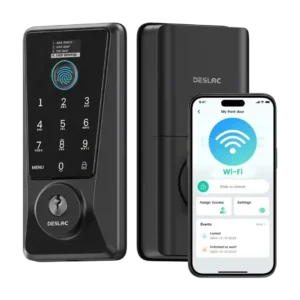
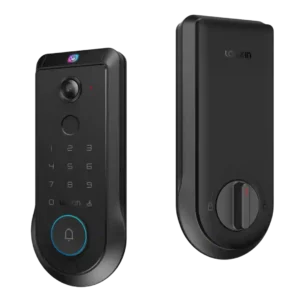
Activity history is commonly available via an events or logs view showing locks and unlocks, though at least one review noted failed attempts may not always be logged unless a lockout triggers.
Event/activity logs are repeatedly mentioned, with reviewers noting access to doorbell and lock/unlock histories and the ability to review event records inside the app.
Audio/alarm volume is adjustable in the app and reviewers note it can be loud by default during setup; the ability to tune or mute sounds is a plus, but audio quality for doorbell recordings was criticized by at least one reviewer.
The app generally earns good marks for straightforward control, logs, user setup, and modes, but some reviewers wanted clearer or more adjustable advanced settings (notably around lockout behavior and alerts).
The Lockin app is widely described as feature-packed and customizable (modes, power management, access controls, event viewing), but multiple reviewers also flagged rough edges such as hidden controls, missing/immature video history features at launch, slow clip loading, and occasional troubleshooting or resets.
Auto-lock is available with a short delay range (often cited as 5 to 120 seconds) and works as intended for many users, but its time-based nature and limited delay range drew criticism in a few reviews.
Auto-lock is widely praised and highly configurable (immediate to timed delays). The built-in door-closed sensing helps prevent locking before the door is shut, improving real-world reliability.
Failed-attempt protection can trigger a temporary lockout after repeated wrong codes, and at least one review described adjustable thresholds, though another noted limited transparency or controls.
Wrong-try protection and lockout behavior are described as available and configurable, adding a practical layer of protection against repeated code attempts.
Supports common backsets (2-3/8 and 2-3/4), matching typical residential door prep.
Battery life is commonly quoted around six months on four AA cells (often not included), with Wi-Fi potentially increasing drain; multiple reviews highlighted USB-C emergency power, and one follow-up credited firmware updates and a Wi-Fi toggle with improving battery impact.
Battery life is commonly framed as roughly three months for the Pro, with USB-C charging and emergency power options. Several reviews highlight an optional solar panel that can meaningfully top up the battery, although placement and looks are a frequent complaint.
Bluetooth appears mainly in setup and onboarding flows for pairing and Wi-Fi bridging, rather than as the primary day-to-day control method.
Bluetooth is used in setup/bridging to Wi-Fi in several reviews and is generally portrayed as convenient during onboarding.
Build is generally described as solid for the price, with BHMA Grade 3 positioning and a mix of metal and plastic; one review questioned overall construction quality and budget compromises.
Build quality impressions are mostly positive: reviewers call the lock hefty, solid, and less plastic-heavy, though the exterior assembly is bulky and at least one reviewer criticized hardware tolerances (bolts/threads) as a quality-control pain point.
Reviews repeatedly note the lack of a true door sensor, meaning auto-lock can extend the bolt even if the door is open, which can be inconvenient and potentially hard on door trim.
The integrated door-open/closed sensing via the strike plate and smart deadbolt is repeatedly called out as a smart, cleaner alternative to external sensors and is tied to better auto-lock behavior and door-status awareness.
Fits standard US deadbolt prep in most cases, including common door thickness ranges, but one reviewer noted it is less ideal for very thick doors without modification.
One review provides specific door thickness and bore-fit guidance and generally treats the lock as compatible with standard deadbolt installs; the main fit concern raised is bulk rather than incompatibility.
This is a full deadbolt replacement, so you generally swap existing hardware; one reviewer chose to reuse a preferred deadbolt piece, but reuse options are limited versus retrofit-style locks.
Firmware updates are a recurring theme in longer-term coverage, including improvements like a Wi-Fi toggle, better Wi-Fi stability, reduced power usage, and privacy tweaks like masking passcode entry.
Fingerprint access is a headline feature and is often described as quick and accurate for the price, with support for up to about 50 fingerprints; one review found it hit-or-miss and requiring multiple scans.
Fingerprint access is usually described as quick and usable, but experiences vary: some found it reliable, others needed multiple tries or noted setup is slower than palm enrollment and can be harder for some users (including kids).
A 90-day outdoor follow-up and several user impressions suggest the exterior holds up reasonably well, but long-term finish wear is still lightly documented.
Geofencing is mentioned as present in some materials and apps, but reviewers say it is limited, often used for changing modes/settings rather than true automatic lock/unlock behavior.
Guest access options commonly include always-on users, scheduled access windows, and one-time or one-pass codes, making it suitable for cleaners, visitors, and rentals.
Guest access features are a highlight: reviewers cite one-time, temporary, and scheduled PIN codes and easy sharing, though some note restrictions (temporary access may be PIN-only, and permission tiers/time restrictions for full users can be limited).
No hub or separate gateway is required for remote features because Wi-Fi is integrated.
For ecosystem control, reviewers note you may need a Matter controller hub (or similar hub) to add the lock to platforms like Apple Home, Google Home, Alexa, or SmartThings; hub use often comes with reduced feature depth versus the Lockin app.
Most reviewers found installation straightforward and comparable to swapping a standard deadbolt, but one hands-on test reported overly tight/stiff hardware that made mounting difficult and another noted a short internal cable that can complicate assembly.
Installation is often reported as a straightforward 10–15 minute swap for a standard deadbolt, with guided in-app setup, but one critical review cited poorly machined/jamming long bolts and lots of cable routing that can make assembly more frustrating than typical.
Backup entry is well covered via a traditional keyway, and several reviews also liked the USB-C emergency power option as an extra failsafe when batteries die.
A physical key is included and used as a backup method; no review reported key override failures, and several call out the presence of emergency power as an additional fallback.
The backlit touchscreen keypad is usually described as clear and usable, and privacy features like anti-peeping or masked digits are appreciated; one review reported slow wake-up behavior requiring extra taps.
The keypad is generally seen as useful for kids/guests and as a backup method, but at least one reviewer criticized poor outside usability (a non-illuminated lock button and unclear manual locking cues).
The keyway is typically hidden behind the doorbell button and presented as a practical backup; reviewers do not report pick/drill testing, but also do not flag obvious keyway quality problems in normal use.
Speed is often praised, especially for fingerprint unlock and remote commands, but one critical review found the keypad slow to wake and fingerprint reads inconsistent, and another noted it is not the fastest compared with pricier locks.
Lock/unlock responsiveness is frequently described as very fast (both biometrics and app control), though overall perceived speed can be undercut when video clips or app functions lag.
The motor is generally described as smooth and reasonably quiet, but over-tightening during install can cause the bolt to struggle to slide smoothly.
Day-to-day locking/unlocking is generally reliable across reviews, including schedules and routines, though one reviewer characterized overall operation as only just OK despite not seeing jamming in testing.
Locking reliability is rated highly in several hands-on tests, but one critical review characterized the product as still beta-like, requiring reboots/force-quits and not yet fully trustworthy without more firmware refinement.
Notifications are available for lock activity and some alarm states, but experiences vary: some reviewers wanted push alerts over email or found certain emergency emails unreliable.
Notifications are often described as fast and informative (motion/doorbell/lock events), but at least one reviewer reported major notification failures that required support and factory resets, and another noted limited per-alert toggles in the app.
Physical robustness is most often framed around BHMA Grade 3, which is a baseline residential-grade rating; it is not positioned as a high-security, hardened deadbolt.
At least two reviews cite BHMA/ANSI Grade 2 level certification for the lock, suggesting solid baseline physical security for residential use, though most testing focused on convenience and software rather than attack trials.
Remote locking/unlocking, status checks, and managing users from anywhere are consistently highlighted as strong points when the lock has a stable Wi-Fi connection.
Remote control via the Lockin app is positioned as a core strength (live view, lock/unlock, codes, alerts), though performance varies by reviewer, with some praising responsiveness and others reporting lag or slow video clip loading.
Security features mentioned include anti-peeping PIN entry, vacation-style restriction modes, failed-attempt lockouts, and anti-hijacking or SOS-style alerts; some sources also mention encrypted fingerprint storage, but overall physical security is positioned as budget-grade.
Some reviewers highlight on-device processing, local storage, and direct device-to-phone style connections (often described as more private), but concrete third-party verification details are limited; advanced security claims should be weighed against real-world software stability.
Smart-home support is consistently limited to Alexa and Google ecosystems, with repeated callouts that Apple HomeKit and Matter support are not available.
Smart-home compatibility is frequently advertised as broad (Matter/Thread plus major platforms), and pairing generally works, but reviewers repeatedly note that third-party apps expose only basic lock functions and omit many advanced features (especially doorbell/camera and granular access controls).
Anti-hijacking or alarm-style features are described as a way to signal distress or tampering, but detailed sensitivity or false-alarm behavior is not well documented in the reviews.
Anti-tamper and unusual-activity detection are referenced (including tamper events surfaced in some ecosystem apps), but few reviewers deeply tested sensitivity or false-alarm behavior.
Touch controls and illumination are generally well liked, but responsiveness can vary, with one hands-on review calling the interface sluggish to wake.
The touch interface is often described as responsive and modern, with some praise for smudge resistance; however, visibility/UX issues (fish-eye video framing noted elsewhere, and unlit button behavior) can reduce ease of use at night.
User management is a strength, with support for multiple users, role-based sharing, and assigning different credentials per person.
User management is generally organized (multiple palms/fingerprints/PINs per user), but at least one reviewer criticized limited permission granularity, with full users effectively receiving always-on access.
Many reviews frame the lock as strong value, especially when discounted under $100, due to built-in Wi-Fi and multiple entry methods, but one outlet argued the compromises (install quirks and scanner quality) reduce the perceived bargain.
Value depends heavily on price: reviewers see the all-in-one concept and no-subscription local storage as compelling, but MSRP is considered expensive, and early-bird pricing is viewed as much more competitive given software maturity concerns.
Voice control via Alexa and Google is generally reliable for locking and, with a voice code, unlocking, but it does not provide the broader cross-platform benefits of Matter ecosystems.
Voice control via assistants (Siri/Alexa/Google) is described as working for basic lock/unlock commands; richer smart-home routines are possible, but broader feature access still tends to live in the Lockin app.
Multiple reviews cite an IP54-style dust/splash rating and reported normal rain exposure without issue, though a few creator claims vary; overall it is best treated as weather resistant rather than fully waterproof.
Multiple reviews cite IP65 weatherproofing and describe the lock holding up to rain/dust and outdoor conditions; long-term durability claims exist, but most evidence is short-to-medium term testing.
Built-in 2.4GHz Wi-Fi is a major advantage for remote access without extra hardware, but connection quality can affect responsiveness and battery use; updates and a Wi-Fi on/off toggle were noted as improvements in longer-term use.
Built-in 2.4GHz Wi-Fi is a recurring positive, enabling direct app control and remote features without a separate bridge for basic operation.