AirPlay support is frequently cited as a convenient way to stream music, with few complaints beyond general wireless variability.
There is no companion mobile app, which keeps things simple but removes per-input memory and app-based control backup.
The SmartThings app is commonly described as the easiest way to manage modes, EQ, and channel trims; some reviews still call out UI/streaming quirks or missing conveniences like fully automatic calibration behavior.
Dolby Audio and common Dolby Digital formats are supported in reports and specs, but there is no Dolby Atmos support.
Supports a wide range of formats including Dolby Atmos and DTS:X, with common praise for how convincingly it renders immersive mixes.
Compatibility is generally fine with typical TVs and sources, but the use of ARC instead of eARC and the absence of Atmos make it less future-proof for feature hunters.
Compatibility is good across TVs via HDMI eARC/ARC, and optical offers a fallback; region-specific streaming feature availability (like Chromecast) is the main compatibility caveat.
Codec support is basic in reports, with at least one reviewer explicitly observing SBC; there is no consistent mention of premium codecs.
Bluetooth is generally described as stable for casual streaming, with few complaints about drops; range depends on room conditions and some note typical short-range limits.
Bluetooth playback is generally regarded as convenient and functional; fewer comments focus on stability, but reported experiences are mostly positive with quality depending on source.
Expected Bluetooth range is around a typical 10 meters in open space, with real-world walls and placement potentially reducing it.
Chromecast support is inconsistent across sources and regions; some reviews list it as supported while others (notably in the US context) say it’s unavailable.
Most reviews describe the overall sound as cohesive, with the subwoofer generally well integrated, though boosting bass too much can upset balance.
Cohesion between the bar, rears, and sub is often described as seamless, with smooth handoffs that keep effects anchored as they move around the room.
On-unit buttons are generally described as easy and responsive, especially for quick source and SuperWide toggling.
Physical buttons are basic but functional; at least one review prefers the clicky, non-touch controls for responsiveness and reliability.
Design is compact and generally liked, with some enjoying the bronze accents and others calling it cheap-looking. The small size suits desks and smaller TVs more than large screens.
Design is generally seen as premium and understated, though the bar’s large size and industrial/monolithic look can feel dated or imposing in smaller spaces.
Detail is better than expected for the price, especially for dialogue and smaller-room movie playback, though some midrange congestion appears with dense mixes or processing engaged.
Detail retrieval is repeatedly praised for a soundbar system, with clear effects placement and good separation; a few reviewers still find ultra-premium modular systems extract slightly more microdetail.
Across reviews, dialogue is a standout strength: many call speech crisp, clear, and easy to follow, though at least one tester reports muffled dialogue in busy action scenes when bass is pushed hard.
Dialogue is consistently praised for clarity, helped by center-channel focus and voice-enhancement/AVA options that many found effective for TV and movies.
At moderate levels it stays controlled, but multiple reviewers hear strain or sharpness at higher volumes, and one notes brief audio skipping with UHD Blu-ray playback.
Generally stays clean at high levels, but a few sources note occasional crackle/static or the sub chuffing on extreme ultra-low bass passages.
Dynamic swings in movies are a strong point, with punchy transients and convincing impact; the system generally keeps composure even in demanding scenes.
Bass and treble adjustments on the remote are widely appreciated for quick tuning. Deeper multi-band EQ is not available, and some find the preset modes subtle.
EQ and channel-level controls are a highlight for tweakers (especially in the app), though a few reviewers want easier presets or broader access to adjustments without mode limitations.
Tuning leans lively with boosted mids and/or highs to help clarity. It can sound bright or sharp when cranked, and SuperWide processing may trade detail for space.
Balanced tuning is a recurring theme: weighty lows paired with clear mids/treble, though a few listeners found bass-heavy music can get a bit muddy without tweaks.
HDMI 2.1 passthrough is the headline upgrade, enabling 4K/120Hz and gaming features for consoles/PCs; most sources call it a meaningful addition, with rare reports of port-specific issues.
HDMI ARC works for basic TV integration and CEC control, but multiple users report volume-scaling quirks or prefer optical to avoid HDMI behavior.
HDMI eARC/ARC is the recommended connection for best reliability and full-format support; it also enables convenient TV-remote control via CEC in most setups.
Best results are reported in bedrooms, offices, and small-to-medium rooms. Larger spaces expose limits in soundstage scale and subwoofer output.
Integration in a home theater is a key strength, with convincing immersion and easy expansion-free setup; Samsung TV owners can gain extra front-stage width and tighter on-screen anchoring via Q-Symphony.
Wireless linking between the bar, surrounds, and sub is commonly reported as stable with few dropouts; isolated anecdotes mention occasional blips or unit-specific issues, but most experiences are robust.
Lip-sync is generally not flagged as a major problem, but one review reports brief half-second audio skips with UHD Blu-ray content, suggesting occasional source/format sensitivity.
Latency is generally well controlled (including reports of very low passthrough lag), though some setups can see more delay on certain formats over optical or wireless connections.
Volume output is impressively high for a compact bar, with plenty of headroom for small rooms and desktop use. Several note it can get uncomfortably loud up close.
Loud output with ample headroom; most reviewers rarely needed to push volume high, and the system can fill large rooms without sounding strained.
Low-volume listening is workable, but some want finer steps, a night mode, or a lower baseline level on HDMI for bedrooms.
No summary yet.
The multi-piece system usually pairs and stays linked reliably once powered, with most reviews reporting stable operation across the bar, rears, and sub.
Top-mounted controls for power, volume, input, and SuperWide are convenient for desktop use and provide a fallback if the remote is unavailable.
On-bar controls are simple but handy when a remote isn’t nearby; most interaction still happens through the app, especially for deeper tuning.
Optical input is commonly used as a stable fallback for TVs, though it may require separate remote control handling depending on the source device.
Optical input is available as a legacy fallback, but multiple sources note it limits advanced formats like Dolby Atmos compared with HDMI eARC.
The remote offers helpful direct access to modes and tone controls, but it often requires separate AAA batteries and a few users mention minor ergonomics or control quirks.
The included remote is serviceable and handy for quick adjustments, but several reviews prefer the app, and some note missing shortcuts or that the small front display reduces remote usefulness.
Setup is repeatedly described as plug-and-play, with straightforward wiring and quick switching between TV, PC, and Bluetooth sources.
Setup is widely described as straightforward for a four-piece system, with the rears/sub often pairing quickly; optimal placement and app onboarding can add a bit of time.
Smart assistant support (notably Alexa, plus Google/Bixby in some regions) is a key feature; voice control is generally useful, though some users prefer app/remote control for consistency.
Smart features are minimal: no voice assistants and no Wi-Fi streaming, with emphasis instead on simple presets and SuperWide processing.
Smart features like Q-Symphony, wireless Atmos options, Private Rear Sound, and grouping modes add flexibility; several are Samsung-TV dependent or more niche in day-to-day use.
Height effects are a standout for many, creating a dome-like presentation; results can vary with ceiling height, room treatments, and placement.
Spotify Connect works for many, but at least one review flags frustrating volume-step behavior; overall reliability appears good with occasional app/control oddities.
The front LED display is useful for showing source and volume, but brightness and standby behavior can be distracting in dark rooms, with limited dimming control noted.
The front status display is a frequent complaint: small, scroll-limited, and hard to read through the grille or from across a room.
Stereo imaging is best when you are centered and fairly close. From a couch distance or off-axis seating, the image can feel localized and less immersive.
Imaging is strong for a soundbar system, with precise placement and improved width; some note it still can’t fully match the spatial organization of top modular/separates rigs.
No summary yet.
No summary yet.
SuperWide Near and Far modes can widen the presentation and add a wraparound feel, but Far often softens focus and Near can be distance-sensitive. Many prefer using it selectively depending on content.
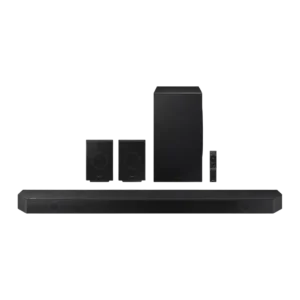
Creates an enveloping surround field that’s widely described as class-leading for a soundbar package, especially with the included rears and upfiring drivers.
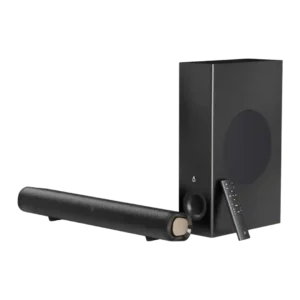
Reviewers repeatedly frame Stage Pro as a punch-above-its-price 2.1 bundle, especially because it includes a subwoofer and multiple inputs while staying in the budget range.
Value is viewed as strong versus comparable full Atmos packages, especially with discounts; however, many note the prior Q990C can be a better deal if HDMI 2.1 isn’t needed.
Video passthrough support is robust in reviews that mention it, including HDR formats and Dolby Vision passthrough, making the HDMI inputs more useful for source devices.
Vocals and spoken-word content generally come through clean and forward, with Vocal-focused modes seen as optional rather than required.
The bar and sub are described as sizable and hefty, which signals premium build but can be inconvenient for smaller rooms or lighter furniture.
Wi-Fi streaming features are absent, so services like Spotify Connect or Tidal-style direct streaming are not available without going through a TV, streamer, or phone.
Wi-Fi streaming is broadly stable, and Samsung TV owners often praise wireless connection options; a few reports mention occasional blips or format-specific quirks, so HDMI eARC remains the most dependable path.
Input options are a strong point for the price, commonly cited as HDMI ARC, optical, AUX, USB-C/USB audio, and Bluetooth.
Wired connectivity is strong for a modern soundbar system, with HDMI eARC plus additional HDMI inputs and optical; the main complaint is the lack of analog inputs for legacy sources.