- Worse: HDMI 2.1 support The Q990D is favored over the JBL Bar 1300X on HDMI 2.1 support.
- Alternative: non-Samsung alternative The Bar 1300X is presented as an alternative for users without a Samsung TV.
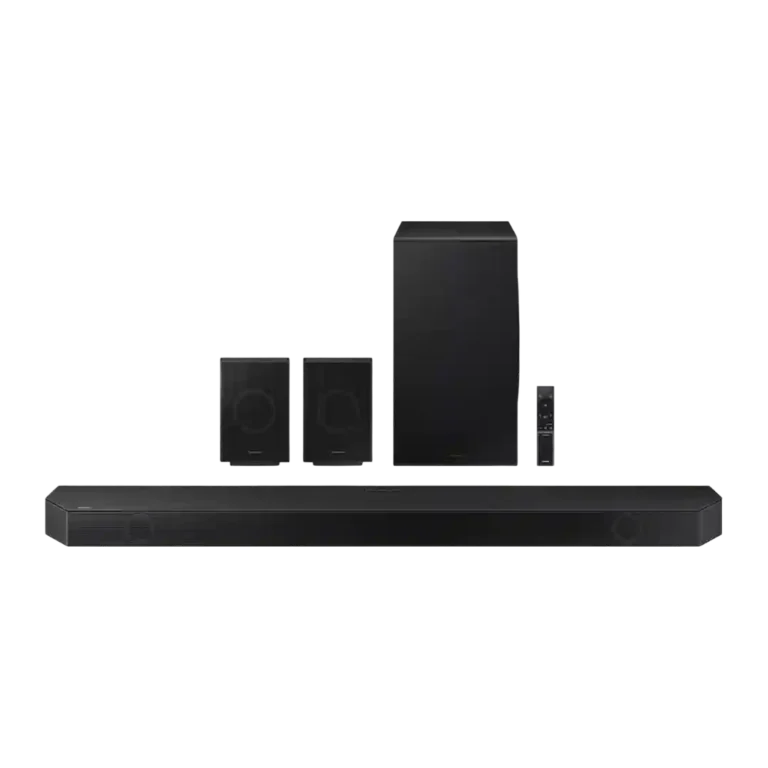
Samsung HW-Q990D Soundbar Review
Bottom Line
Choose the HW-Q990D for immersive Atmos, clear dialogue, strong bass, and HDMI 2.1 gaming in a full soundbar package. Skip it if price, large hardware, small display, or the cheaper Q990C matters more.
Best for buyers who want a near-complete home theater soundbar package with immersive Dolby Atmos, clear dialogue, strong bass, and HDMI 2.1 gaming support. It is especially appealing for Samsung TV owners who can use Q-Symphony and related ecosystem features.
Not for shoppers mainly seeking the lowest price, a compact bar, a readable front display, or a major sonic leap over the discounted Q990C. It is also less ideal if you need analog inputs, perfect Spotify Connect behavior, or highly audible room correction.
Across the reviews, the Samsung HW-Q990D lands as a premium, highly immersive Atmos soundbar system rather than a radical reinvention. Reviewers consistently praised its room-filling surround field, convincing height effects, clear dialogue, strong but generally controlled subwoofer, and useful HDMI 2.1 upgrade for console gaming. The tradeoff is that some improvements over the Q990C are incremental, and the Q990C often looks like better value if gaming passthrough is unimportant. Other recurring drawbacks include the tiny front display, mixed reactions to SpaceFit room calibration, large physical footprint, and occasional connection or streaming quirks. Even with those caveats, the evidence points to one of the strongest all-in-one home theater soundbar packages reviewed here.
Compared in Reviews
Products reviewers directly compared with this model, grouped into quick takeaways.
Q990C
- Alternative: value without gaming features The Q990C is treated as a cheaper alternative if the Q990D's gaming features do not matter.
- Similar: design and core package The Q990D is described as strikingly similar to the Q990C apart from key upgrades.
- Older model: sound refinement The Q990D is presented as a modest but positive refinement over the Q990C.
LG s95 TR
- Worse: HDMI 2.1 support The Q990D is favored over the LG S95TR on HDMI 2.1 support.
- Worse: soundbar competition The reviewer found the LG S95TR disappointing and treated the Q990D as stronger for movies.
Feature Scorecards
Summary
45 reviewed features- Very positive 4.5-5.0 47% 21 features
- Positive 3.5-4.4 38% 17 features
- Neutral 2.5-3.4 7% 3 features
- Negative 1.5-2.4 9% 4 features
- Very negative below 1.5 0% 0 features
Pros
-
Soundstage height was a clear strength, with reviewers describing height, overhead scale, and dome-like placement.
-
Surround performance was one of the strongest areas, with reviewers describing immersive, room-filling effects and convincing movement around the listening position.
-
Dialogue clarity drew strong agreement, with reviewers repeatedly saying voices stayed clear through dense movie mixes, sports, and dialogue-heavy content.
-
Cohesion was praised through seamless surround handoffs, integrated bass, refined delivery, and a warm detailed presentation.
-
Dolby Atmos height effects were repeatedly praised as immersive, overhead, and convincing, though one reviewer wanted more true above-you sensation.
-
Reviewers found the system loud enough for large rooms and cinematic impact, with only contextual concerns about using that power in smaller spaces.
-
Latency evidence was positive, with reviewers reporting synced audio/video and no added delay from HDMI pass-through.
-
Setup simplicity was strongly praised across reviews, with several calling it effortless, intuitive, or complete in minutes.
-
Dynamic headroom was praised for big volume shifts, impact differences, and enough dynamic range for cinematic material.
-
HDMI 2.1 gaming support was a major strength, with repeated praise for 4K/120Hz, VRR, low latency, and console usefulness.
-
Inter-speaker connectivity was reliable in review use, with no dropouts, flawless connection, easy power-only satellite use, and automatic sync comments.
-
Detail retrieval was praised for fine effects, instrument separation, and precision, though one reviewer said it lacked the highest premium detail.
-
Home theater integration was strong, especially with compatible Samsung TVs through Q-Symphony, though benefits depend on TV ownership.
-
Reviewers consistently described a balanced profile with clear mids and treble, controlled bass, and only occasional low-end muddiness or content-dependent tuning caveats.
-
The SmartThings app was usually praised for easier setup and deeper control, despite remote/display limitations pushing users toward it.
-
Build quality was consistently described as premium, solid, robust, and well constructed.
-
HDMI eARC was recommended as the best wired route for reliability and sound quality.
-
Pairing reliability was positive where tested, with speakers pairing immediately or expected to sync automatically during setup.
-
Cabinet construction evidence was positive, with the bar described as a serious, solid piece of gear.
-
Physical buttons were praised as clicky rather than touch-sensitive, which one reviewer explicitly preferred.
-
On-device controls received positive but limited evidence as useful when the remote is unavailable.
-
Stereo imaging was generally praised, especially with music and front/rear speaker modes, though it remains a soundbar-based presentation.
-
Smart features were generally praised, especially Q-Symphony, Private Rear Sound, useful modes, and Samsung ecosystem extras.
-
Video passthrough support was praised for Dolby Vision/HDR formats and 4K/120Hz support, with one reviewer preferring TV ports for best image quality.
-
The subwoofer was widely praised for power, punch, and integration, though reviewers disagreed on whether it was earth-shaking enough or fully refined.
-
Most reviewers reported clean output or very low compression at high volume, though a few heard subwoofer crackle, chuffing, or stress on extreme bass passages.
-
Audio format support was praised for covering key formats such as Dolby Atmos and DTS variants, though some mentions were primarily factual.
-
Voice clarity was a strength overall, especially with dialogue aids, though one reviewer found voice processing hit-and-miss and another chose to leave it off.
-
EQ and sound customization were praised through the app, especially channel levels, EQ tools, and near-total control.
-
Low-volume features were useful for late-night listening, though they involved compromises such as reduced dynamics or rear-only playback.
-
Bluetooth connection evidence was limited but positive, with one reviewer saying it worked as advertised despite feeling awkward on a premium system.
-
Wi-Fi connection was described as surprisingly seamless with only a few blips, though HDMI was still recommended for maximum reliability.
-
Value opinions were mixed but generally positive: reviewers saw strong performance for the money, while often noting the cheaper Q990C as better value for non-gamers.
-
Design aesthetics were mostly positive for understated, sleek, high-end looks, though some found the angular design dated or severe.
-
Wired input evidence was mixed: reviewers praised eARC and wired reliability but criticized the absence of analog inputs.
-
Gaming HDMI passthrough was mostly praised as a major upgrade, though one reviewer reported a faulty HDMI port on the tested unit.
-
Room calibration drew divided reactions: some reviewers said SpaceFit worked well or optimized bass, while others noticed little or no audible change.
-
Rear speaker cable feedback was mixed: one review praised extra-long power cables, while others wanted longer cables or noted shorter rear-speaker runs.
Cons
-
Remote usability was mixed: some found it simple or well-designed, while others criticized cumbersome adjustments and missing shortcuts.
-
Spotify Connect evidence was mixed: one reviewer had a maddening volume-step issue, while another called Spotify Connect a favorite feature.
-
Weight and size convenience was a mild drawback: reviewers noted the bar is large, heavy, and best matched with bigger TVs.
-
Status indicators were a common complaint because the small front display was hard to read, limited, or nearly useless for settings.
-
Chromecast compatibility was a weak point in one review because Chromecast was not supported in the US version tested.
-
Google-related support was marked down because one reviewer specifically found the lack of US Chromecast support irksome.
-
Optical input was treated as a fallback because it lacks Dolby Atmos and was framed as a compromised connection compared with eARC.
Compared With Category Average
Compared with other Sound Bars, this product is above average in Video passthrough support, Dolby Atmos height effects, HDMI 2.1 gaming, below average in Chromecast compatibility, Status indicators, optical.
Summary
8 compared features- Above average 0.4+ pts higher 50% 4 features
- Same as average within 0.3 pts 0% 0 features
- Below average 0.4+ pts lower 50% 4 features
| Attribute | This product | Category average | Difference |
|---|---|---|---|
| Chromecast compatibility | 2.0 | 3.9 | -1.9 |
| Video passthrough support | 4.4 | 2.7 | +1.7 |
| Dolby Atmos height effects | 4.8 | 3.3 | +1.5 |
| HDMI 2.1 gaming | 4.6 | 3.2 | +1.4 |
| Status indicators | 2.0 | 3.6 | -1.6 |
| optical | 2.0 | 3.5 | -1.5 |
| Soundstage height | 5.0 | 3.9 | +1.1 |
| Weight convenience | 2.9 | 4.0 | -1.1 |
FAQ
Is the Samsung HW-Q990D good for Dolby Atmos movies?
Yes. Reviewers repeatedly praised its immersive surround field, convincing height effects, clear dialogue, and strong subwoofer performance for movies.
Is the HW-Q990D worth it for gaming?
It is especially compelling for gamers who need HDMI 2.1 features such as 4K/120Hz, VRR, and low input lag through the soundbar.
Do you need a Samsung TV to enjoy it?
No. Reviewers found it strong with non-Samsung displays too, but Samsung TVs unlock extras such as Q-Symphony and wireless Dolby Atmos.
How clear is dialogue on the Q990D?
Dialogue clarity was one of the most consistent strengths, with reviewers saying voices stayed understandable even in busy mixes. Voice enhancement features helped some reviewers, though one found them hit-and-miss.
What are the biggest drawbacks?
The most repeated complaints were the tiny front display, high price, large size, mixed SpaceFit calibration results, and the cheaper Q990C being a better value for many non-gamers.
How good is the subwoofer?
Most reviewers described the subwoofer as powerful, punchy, and well integrated. A few heard crackle, chuffing, or wanted more earth-shaking bass in specific situations.
Sample Expert Reviews We Analyzed
These are a few of the reviews included in our analysis.

Video Reviews
- Review score
- 4.1/5
Article Reviews
- Review score
- 4.2/5
- Review score
- 4.6/5
Consider This Instead
If you want better optical
Choose Bluesound Pulse Cinema Soundbar. It scores 5.0 vs 2.0 for optical, with a 4.1 overall score.
If you want better Chromecast compatibility
Choose Bose Smart Soundbar. It scores 5.0 vs 2.0 for Chromecast compatibility, with a 3.8 overall score.
If you want better Status indicators
Choose JBL Bar 1300X Soundbar. It scores 4.7 vs 2.0 for Status indicators, with a 3.9 overall score.
If you want better Spotify Connect reliability
Choose Sonos Arc Soundbar. It scores 5.0 vs 3.3 for Spotify Connect reliability, with a 4.1 overall score.
Overall Top Sound Bars Alternatives
Choose the Samsung HW-Q990F if you want a premium, easy Atmos system with huge surround, strong bass, and Samsung TV perks. Skip it if price, a four-piece setup, music purity,...
Pros: Multi-speaker pairing reliability, Gaming HDMI passthrough
Cons: Google, Cabinet construction / bracing
Choose the Sonos Beam Gen 2 for compact, stylish TV sound with excellent dialogue, easy setup, and upgradeable Sonos surround. Skip it if you need true overhead Atmos, built-in Bluetooth,...
Pros: Multi-speaker pairing reliability, Voice recognition accuracy
Cons: Bluetooth connectivity, Video passthrough support
Choose the Sonos Arc if you want immersive Atmos, easy Sonos setup, and a soundbar you can expand with Sub and surrounds. Skip it if price, HDMI passthrough, Bluetooth, or...
Pros: Multi-speaker pairing reliability, Spotify Connect reliability
Cons: Gaming HDMI passthrough, Video passthrough support
Choose the JBL Bar 500 MK2 if you want a compact soundbar with strong bass, clear dialogue, simple setup, and convincing surround for small to medium rooms. Skip it if...
Pros: Spotify Connect reliability, Setup simplicity
Cons: On-device controls, HDMI 2.1 gaming